

Chicken, broilers or fryers, leg, meat and skin, raw
Whole food · Poultry Products

Photo: Wikipedia
This is the raw, skin-on meat from the lower portion of a broiler chicken, offering a rich, savory flavor with a tender yet slightly firmer texture than the breast. Its high fat content, concentrated in the skin, promises a juicy, succulent outcome when cooked. Nutritionally, it is a powerhouse of complete protein and dietary fats, providing substantial energy with virtually no carbohydrates.
Calorie split: 31% protein · 0% carbs · 68% fat
↓ Full nutrition💚 Why it's loved
People adore it for its deep, savory flavor and forgiving nature in the kitchen; the skin crisps up beautifully while the meat stays moist. Its versatility makes it a staple for everything from slow-braised stews to grilled favorites, fitting seamlessly into countless global cuisines.
⚠️ Watch-outs & how to enjoy it better
The high fat and skin content, while flavorful, makes it a calorie-dense choice that may not suit low-fat diets. The skin can also be a significant source of dietary cholesterol and saturated fat. To counteract, one can simply remove the skin before or after cooking to drastically reduce fat and calorie intake, or balance the meal with large portions of fibrous, non-starchy vegetables.
Key benefits
- Excellent source of high-quality, complete protein for muscle maintenance and repair.
- Rich in dietary fats, providing a dense source of energy and aiding in fat-soluble vitamin absorption.
- Contains essential minerals like selenium, phosphorus, and zinc.
- A good source of B vitamins, particularly niacin (B3) and B6, crucial for metabolism.
- The skin adds flavor and helps retain moisture during cooking.
🍽️ Popular dishes
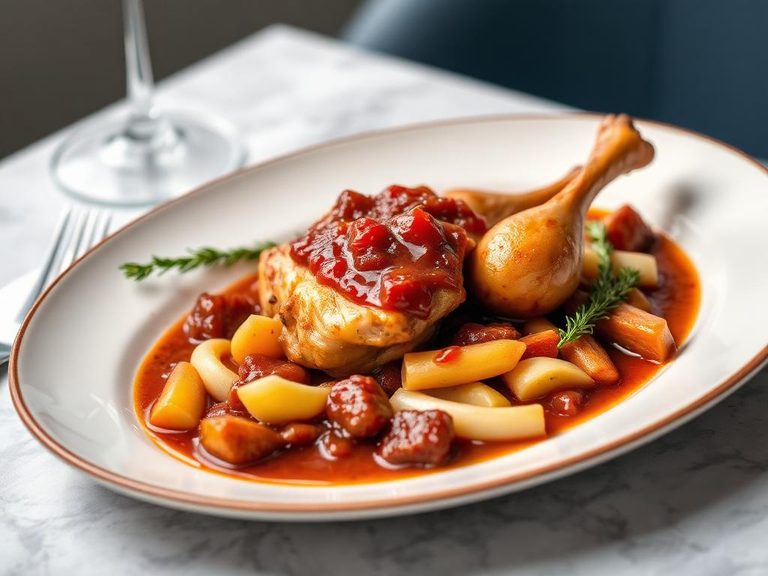
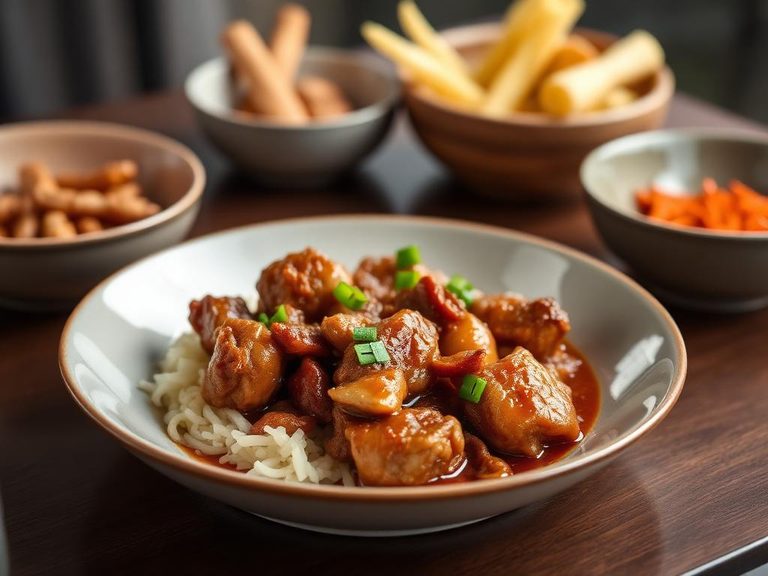
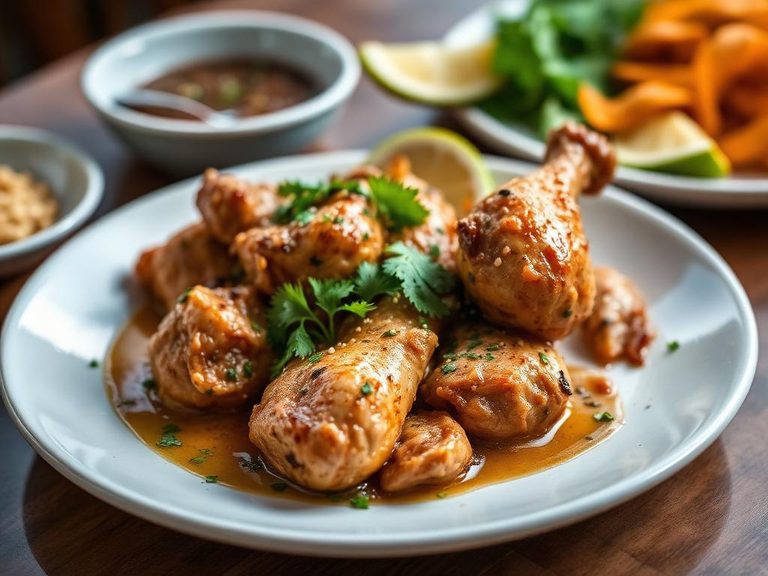


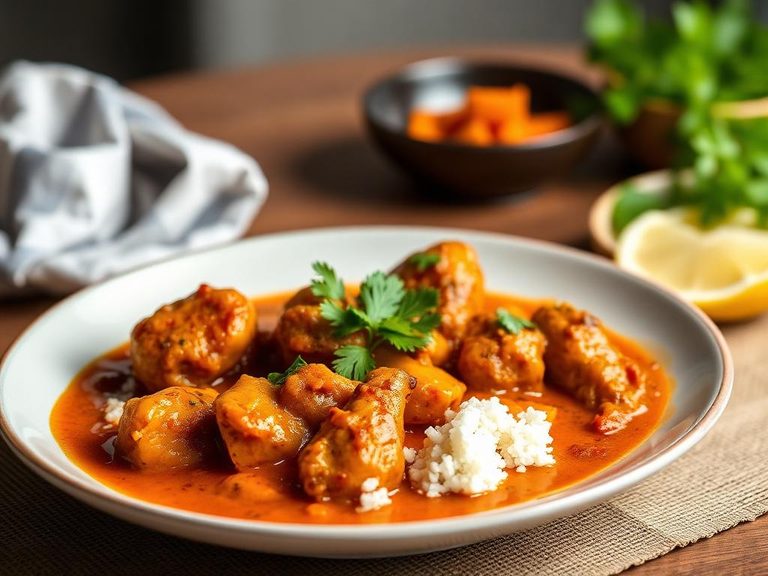
🌍 Where it's eaten
💡 Did you know?
The 'dark meat' of the leg gets its color from myoglobin, a protein that stores oxygen in muscle cells, which is more abundant in muscles used for sustained activity like walking.
Full nutrition (USDA data · scales with serving)
| Water | 67.3 g |
| Energy | 214 kcal |
| Energy | 897 kj |
| Protein | 16.4 g |
| Total lipid (fat) | 15.9 g |
| Ash | 0.81 g |
| Carbohydrate, by difference | 0.17 g |
| Fiber, total dietary | 0.00 g |
| Total Sugars | 0.00 g |
| Calcium, Ca | 9.0 mg |
| Iron, Fe | 0.69 mg |
| Magnesium, Mg | 19.0 mg |
| Phosphorus, P | 155 mg |
| Potassium, K | 203 mg |
| Sodium, Na | 84.0 mg |
| Zinc, Zn | 1.5 mg |
| Copper, Cu | 0.05 mg |
| Manganese, Mn | 0.02 mg |
| Selenium, Se | 18.0 ug |
| Vitamin C, total ascorbic acid | 0.20 mg |
| Thiamin | 0.07 mg |
| Riboflavin | 0.14 mg |
| Niacin | 4.7 mg |
| Pantothenic acid | 0.99 mg |
| Vitamin B-6 | 0.32 mg |
| Folate, total | 4.0 ug |
| Folic acid | 0.00 ug |
| Folate, food | 4.0 ug |
| Folate, DFE | 4.0 ug |
| Choline, total | 41.6 mg |
| Betaine | 8.1 mg |
| Vitamin B-12 | 0.56 ug |
| Vitamin B-12, added | 0.00 ug |
| Vitamin A, RAE | 28.0 ug |
| Retinol | 28.0 ug |
| Carotene, beta | 0.00 ug |
| Carotene, alpha | 0.00 ug |
| Cryptoxanthin, beta | 0.00 ug |
| Vitamin A, IU | 92.0 iu |
| Lycopene | 0.00 ug |
| Lutein + zeaxanthin | 91.0 ug |
| Vitamin E (alpha-tocopherol) | 0.22 mg |
| Vitamin E, added | 0.00 mg |
| Tocopherol, beta | 0.00 mg |
| Tocopherol, gamma | 0.08 mg |
| Tocopherol, delta | 0.00 mg |
| Tocotrienol, alpha | 0.02 mg |
| Tocotrienol, beta | 0.02 mg |
| Tocotrienol, gamma | 0.03 mg |
| Tocotrienol, delta | 0.00 mg |
| Vitamin D (D2 + D3), International Units | 2.0 iu |
| Vitamin D (D2 + D3) | 0.10 ug |
| Vitamin D3 (cholecalciferol) | 0.10 ug |
| Vitamin K (phylloquinone) | 2.3 ug |
| Vitamin K (Dihydrophylloquinone) | 0.00 ug |
| Alcohol, ethyl | 0.00 g |
| Caffeine | 0.00 mg |
| Theobromine | 0.00 mg |
Fat & fatty acid profile (per 100g)
| Fatty acids, total saturated | 4.4 g |
| SFA 4:0 | 0.00 g |
| SFA 6:0 | 0.00 g |
| SFA 8:0 | 0.00 g |
| SFA 10:0 | 0.00 g |
| SFA 12:0 | 0.01 g |
| SFA 14:0 | 0.10 g |
| SFA 15:0 | 0.01 g |
| SFA 16:0 | 3.3 g |
| SFA 17:0 | 0.01 g |
| SFA 18:0 | 0.84 g |
| SFA 20:0 | 0.01 g |
| SFA 22:0 | 0.01 g |
| SFA 24:0 | 0.00 g |
| Fatty acids, total monounsaturated | 6.6 g |
| MUFA 14:1 | 0.02 g |
| MUFA 15:1 | 0.00 g |
| MUFA 16:1 | 0.92 g |
| MUFA 17:1 | 0.01 g |
| MUFA 18:1 | 5.5 g |
| MUFA 20:1 | 0.10 g |
| MUFA 22:1 | 0.00 g |
| MUFA 24:1 c | 0.00 g |
| Fatty acids, total polyunsaturated | 3.4 g |
| PUFA 18:2 | 3.0 g |
| PUFA 18:3 | 0.15 g |
| PUFA 18:4 | 0.00 g |
| PUFA 20:2 n-6 c,c | 0.02 g |
| PUFA 20:3 | 0.03 g |
| PUFA 20:4 | 0.10 g |
| PUFA 20:5 n-3 (EPA) | 0.00 g |
| PUFA 22:4 | 0.02 g |
| PUFA 22:5 n-3 (DPA) | 0.01 g |
| PUFA 22:6 n-3 (DHA) | 0.01 g |
| Fatty acids, total trans | 0.06 g |
| Cholesterol | 93.0 mg |
Amino acid profile (per 100g)
| Tryptophan | 0.17 g |
| Threonine | 0.73 g |
| Isoleucine | 0.74 g |
| Leucine | 1.3 g |
| Lysine | 1.4 g |
| Methionine | 0.44 g |
| Cystine | 0.19 g |
| Phenylalanine | 0.63 g |
| Tyrosine | 0.57 g |
| Valine | 0.77 g |
| Arginine | 1.1 g |
| Histidine | 0.47 g |
| Alanine | 1.0 g |
| Aspartic acid | 1.5 g |
| Glutamic acid | 2.5 g |
| Glycine | 0.98 g |
| Proline | 0.76 g |
| Serine | 0.66 g |
FAQ
What's the difference between a broiler and a fryer chicken?
The terms are often used interchangeably in modern labeling. Historically, a 'broiler' was a young chicken (6-10 weeks) raised for general cooking, while a 'fryer' was a slightly older, larger bird (7-12 weeks) specifically marketed for frying. Today, they refer to the same category of young, tender chickens.
Should I remove the skin before or after cooking?
It depends on your goal. Removing skin before cooking reduces fat absorption and calories significantly. Leaving it on during cooking, especially for methods like roasting or braising, helps baste the meat and keep it moist; you can then remove the skin before eating if desired.
How do I know when a chicken leg is fully cooked?
The safest method is using a meat thermometer. Insert it into the thickest part of the thigh, avoiding bone. It is safe to eat when the internal temperature reaches 165°F (74°C). The juices should run clear, and the meat should no longer be pink at the bone.
Nutrient density (calculated · NRF9.3)
Nutrient Rich Foods index: beneficial nutrients (protein, fiber, vitamins, minerals) minus saturated fat, added sugar & sodium, per 100 kcal.
NRF9.3 index — Fulgoni, Keast & Drewnowski, 2009. Computed from USDA nutrients.
Weight-loss friendliness (composite index)
Energy density 2.14 kcal/g · 31% calories from protein · 0.0 g fiber · 0.0 g sugar per 100 g.
Composite of energy density (Rolls et al., 1999), protein & fiber satiety, minus sugar. A calculated heuristic — ranks satiety-per-calorie, not a clinical measure.
Dietary load (calculated from USDA values)
Potential renal acid load. Positive = acid-forming, negative = alkaline-forming.
Sodium-to-potassium ratio: 0.41 (lower is better — aim for ≤ 1)
Sodium:potassium per WHO potassium guidance. Computed from USDA nutrients.