

Candies, milk chocolate
Whole food · Sweets
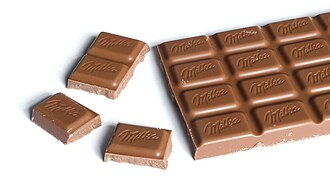
Photo: Wikipedia
Milk chocolate is a creamy, sweet confection made from cocoa solids, cocoa butter, milk powder, and sugar, offering a smooth, melt-in-your-mouth texture. It is a calorie-dense treat, providing 535 kcal per 100g, with a notable 51.5g of sugar and 29.66g of fat, making it a high-energy indulgence. Its flavor profile balances the earthy notes of cocoa with the rich sweetness of milk and sugar, creating a universally appealing taste.
Calorie split: 6% protein · 44% carbs · 50% fat
↓ Full nutrition💚 Why it's loved
People love milk chocolate for its comforting, sweet, and creamy flavor that evokes nostalgia and pleasure. Its versatility makes it a staple in desserts, snacks, and gifts, deeply embedded in global culture from holiday traditions to everyday treats.
⚠️ Watch-outs & how to enjoy it better
The high sugar content (51.5g per 100g) can cause blood-sugar spikes and contribute to weight gain if consumed in excess. To counteract this, pair it with protein or healthy fats (like nuts) to slow sugar absorption, practice portion control by limiting to 1-2 squares, and opt for varieties with higher cocoa content when possible.
Key benefits
- Provides a quick source of energy from carbohydrates and fats.
- Contains small amounts of protein (7.65g) and fiber (3.4g) per 100g.
- Offers a mood-boosting effect due to sugar and potential theobromine content.
- A versatile ingredient in baking and confectionery.
- Can be a source of antioxidants, though in lower amounts than dark chocolate.
🍽️ Popular dishes





🌍 Where it's eaten
💡 Did you know?
The first milk chocolate bar was invented in 1875 by Swiss chocolatier Daniel Peter, who collaborated with Henri Nestlé to develop condensed milk, which allowed the creation of a smooth, creamy chocolate.
Full nutrition (USDA data · scales with serving)
| Water | 1.5 g |
| Energy | 535 kcal |
| Energy | 2239 kj |
| Protein | 7.7 g |
| Total lipid (fat) | 29.7 g |
| Ash | 1.8 g |
| Carbohydrate, by difference | 59.4 g |
| Fiber, total dietary | 3.4 g |
| Total Sugars | 51.5 g |
| Calcium, Ca | 189 mg |
| Iron, Fe | 2.4 mg |
| Magnesium, Mg | 63.0 mg |
| Phosphorus, P | 208 mg |
| Potassium, K | 372 mg |
| Sodium, Na | 79.0 mg |
| Zinc, Zn | 2.3 mg |
| Copper, Cu | 0.49 mg |
| Manganese, Mn | 0.47 mg |
| Selenium, Se | 4.5 ug |
| Fluoride, F | 5.0 ug |
| Vitamin C, total ascorbic acid | 0.00 mg |
| Thiamin | 0.11 mg |
| Riboflavin | 0.30 mg |
| Niacin | 0.39 mg |
| Pantothenic acid | 0.47 mg |
| Vitamin B-6 | 0.04 mg |
| Folate, total | 12.0 ug |
| Folic acid | 0.00 ug |
| Folate, food | 11.0 ug |
| Folate, DFE | 11.0 ug |
| Choline, total | 46.1 mg |
| Betaine | 2.6 mg |
| Vitamin B-12 | 0.75 ug |
| Vitamin B-12, added | 0.00 ug |
| Vitamin A, RAE | 59.0 ug |
| Retinol | 59.0 ug |
| Carotene, beta | 0.00 ug |
| Carotene, alpha | 0.00 ug |
| Cryptoxanthin, beta | 0.00 ug |
| Vitamin A, IU | 195 iu |
| Lycopene | 0.00 ug |
| Lutein + zeaxanthin | 6.0 ug |
| Vitamin E (alpha-tocopherol) | 0.51 mg |
| Vitamin E, added | 0.00 mg |
| Tocopherol, beta | 0.00 mg |
| Tocopherol, gamma | 0.92 mg |
| Vitamin D (D2 + D3), International Units | 0.00 iu |
| Vitamin D (D2 + D3) | 0.00 ug |
| Vitamin K (phylloquinone) | 5.7 ug |
| Vitamin K (Dihydrophylloquinone) | 0.00 ug |
| Alcohol, ethyl | 0.00 g |
| Caffeine | 20.0 mg |
| Theobromine | 205 mg |
Fat & fatty acid profile (per 100g)
| Fatty acids, total saturated | 18.5 g |
| SFA 4:0 | 0.36 g |
| SFA 6:0 | 0.10 g |
| SFA 8:0 | 0.11 g |
| SFA 10:0 | 0.25 g |
| SFA 12:0 | 0.25 g |
| SFA 13:0 | 0.00 g |
| SFA 14:0 | 1.2 g |
| SFA 15:0 | 0.00 g |
| SFA 16:0 | 8.3 g |
| SFA 17:0 | 0.01 g |
| SFA 18:0 | 7.8 g |
| SFA 20:0 | 0.07 g |
| SFA 22:0 | 0.01 g |
| SFA 24:0 | 0.00 g |
| Fatty acids, total monounsaturated | 7.2 g |
| MUFA 14:1 | 0.00 g |
| MUFA 15:1 | 0.00 g |
| MUFA 16:1 | 0.41 g |
| MUFA 17:1 | 0.00 g |
| MUFA 18:1 | 6.1 g |
| MUFA 18:1 c | 6.1 g |
| MUFA 20:1 | 0.00 g |
| MUFA 22:1 | 0.00 g |
| MUFA 24:1 c | 0.00 g |
| Fatty acids, total polyunsaturated | 1.4 g |
| PUFA 18:2 | 1.2 g |
| PUFA 18:3 | 0.12 g |
| PUFA 18:3 n-3 c,c,c (ALA) | 0.12 g |
| PUFA 18:3 n-6 c,c,c | 0.00 g |
| PUFA 18:4 | 0.00 g |
| PUFA 20:2 n-6 c,c | 0.00 g |
| PUFA 20:3 | 0.00 g |
| PUFA 20:4 | 0.00 g |
| PUFA 20:5 n-3 (EPA) | 0.00 g |
| PUFA 22:5 n-3 (DPA) | 0.00 g |
| PUFA 22:6 n-3 (DHA) | 0.00 g |
| TFA 18:1 t | 0.00 g |
| Cholesterol | 23.0 mg |
| Stigmasterol | 16.0 mg |
| Campesterol | 6.0 mg |
| Beta-sitosterol | 37.0 mg |
Amino acid profile (per 100g)
Estimated from Candies, honey-combed, with peanut butter — USDA does not publish this profile for Candies.
| Tryptophan | 0.09 g |
| Threonine | 0.21 g |
| Isoleucine | 0.24 g |
| Leucine | 0.61 g |
| Lysine | 0.27 g |
| Methionine | 0.10 g |
| Cystine | 0.09 g |
| Phenylalanine | 0.47 g |
| Tyrosine | 0.33 g |
| Valine | 0.31 g |
| Arginine | 1.1 g |
| Histidine | 0.22 g |
| Alanine | 0.36 g |
| Aspartic acid | 1.2 g |
| Glutamic acid | 2.0 g |
| Glycine | 0.56 g |
| Proline | 0.55 g |
| Serine | 0.58 g |
FAQ
Is milk chocolate healthier than dark chocolate?
Generally, no. Milk chocolate has more sugar and less cocoa than dark chocolate, which means it has fewer antioxidants and a higher glycemic impact. Dark chocolate with 70%+ cocoa is typically considered more nutritious.
Can milk chocolate be part of a balanced diet?
Yes, in moderation. Enjoying small portions (e.g., 15-30g) as an occasional treat can fit into a balanced diet, especially when paired with protein or fiber to mitigate blood-sugar spikes.
Does milk chocolate contain lactose?
Yes, milk chocolate contains milk powder or condensed milk, which includes lactose. Individuals with lactose intolerance may experience digestive issues, so lactose-free alternatives or dark chocolate may be better options.
Nutrient density (calculated · NRF9.3)
Nutrient Rich Foods index: beneficial nutrients (protein, fiber, vitamins, minerals) minus saturated fat, added sugar & sodium, per 100 kcal.
NRF9.3 index — Fulgoni, Keast & Drewnowski, 2009. Computed from USDA nutrients.
Weight-loss friendliness (composite index)
Energy density 5.35 kcal/g · 6% calories from protein · 3.4 g fiber · 51.5 g sugar per 100 g.
Composite of energy density (Rolls et al., 1999), protein & fiber satiety, minus sugar. A calculated heuristic — ranks satiety-per-calorie, not a clinical measure.
Dietary load (calculated from USDA values)
Potential renal acid load. Positive = acid-forming, negative = alkaline-forming.
Sodium-to-potassium ratio: 0.21 (lower is better — aim for ≤ 1)
Sodium:potassium per WHO potassium guidance. Computed from USDA nutrients.