

Sugars, granulated
Whole food · Sweets
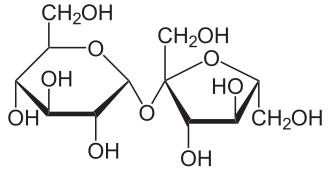
Photo: Wikipedia
Granulated sugar is the crystalline form of sucrose, typically derived from sugarcane or sugar beet. It has a clean, sweet taste and a dry, free-flowing texture that dissolves readily in liquids. Nutritionally, it is a pure carbohydrate source, providing 385 kcal of energy per 100g with virtually no protein, fat, or fiber.
Calorie split: 0% protein · 99% carbs · 1% fat
↓ Full nutrition💚 Why it's loved
People love granulated sugar for its unparalleled ability to deliver immediate sweetness and its incredible versatility as a foundational ingredient in baking, confectionery, and beverage preparation. Its cultural significance is profound, symbolizing celebration, comfort, and hospitality across countless global traditions.
⚠️ Watch-outs & how to enjoy it better
The primary downside is its high glycemic impact, causing rapid spikes in blood sugar and insulin levels, which is a concern for individuals managing diabetes or insulin resistance. To counteract this, pair sugary foods with protein, healthy fats, or fiber (e.g., nuts, yogurt, whole grains) to slow absorption, and practice strict portion control. It also contributes empty calories, so mindful consumption is key for overall metabolic health.
Key benefits
- Provides a rapid source of energy for the body and brain.
- Acts as a natural preservative in jams, jellies, and pickles by binding water.
- Enhances and balances flavors in both sweet and savory dishes.
- Facilitates fermentation in baking, feeding yeast to leaven bread.
- Helps create desirable textures like crispness in cookies or chewiness in cakes.
🍽️ Popular dishes






🌍 Where it's eaten
💡 Did you know?
The word 'sugar' comes from the Sanskrit 'śarkarā,' meaning 'grit' or 'gravel,' a reference to the first crystalline sugar solids transported from India to the ancient world.
Full nutrition (USDA data · scales with serving)
| Water | 0.02 g |
| Energy (Atwater General Factors) | 401 kcal |
| Energy (Atwater Specific Factors) | 385 kcal |
| Energy | 385 kcal |
| Energy | 1610 kj |
| Nitrogen | 0.00 g |
| Protein | 0.00 g |
| Total lipid (fat) | 0.32 g |
| Ash | 0.07 g |
| Carbohydrate, by difference | 99.6 g |
| Sugars, Total | 99.8 g |
| Sucrose | 99.8 g |
| Glucose | 0.00 g |
| Fructose | 0.00 g |
| Lactose | 0.00 g |
| Maltose | 0.00 g |
| Galactose | 0.03 g |
| Calcium, Ca | 1.0 mg |
| Iron, Fe | 0.05 mg |
| Magnesium, Mg | 0.30 mg |
| Phosphorus, P | 0.00 mg |
| Potassium, K | 2.0 mg |
| Sodium, Na | 1.0 mg |
| Zinc, Zn | 0.01 mg |
| Copper, Cu | 0.01 mg |
| Manganese, Mn | 0.00 mg |
FAQ
What is the difference between granulated sugar and brown sugar?
Granulated sugar is pure sucrose crystals. Brown sugar is granulated sugar with molasses added back, giving it a moist texture, caramel flavor, and slightly higher mineral content.
Can I substitute powdered sugar for granulated sugar in recipes?
Generally, no. Powdered sugar contains cornstarch and has a different texture. It's ideal for frostings and dusting, while granulated sugar is needed for proper creaming, dissolving, and caramelization in baking.
Why does my recipe say to 'cream' butter and sugar?
Creaming beats air into the fat-sugar mixture, creating tiny air pockets that expand during baking, resulting in a lighter, more tender texture in cakes and cookies.
Nutrient density (calculated · NRF9.3)
Nutrient Rich Foods index: beneficial nutrients (protein, fiber, vitamins, minerals) minus saturated fat, added sugar & sodium, per 100 kcal.
NRF9.3 index — Fulgoni, Keast & Drewnowski, 2009. Computed from USDA nutrients.
Weight-loss friendliness (composite index)
Energy density 3.85 kcal/g · 0% calories from protein · 0.0 g fiber · 0.0 g sugar per 100 g.
Composite of energy density (Rolls et al., 1999), protein & fiber satiety, minus sugar. A calculated heuristic — ranks satiety-per-calorie, not a clinical measure.
Dietary load (calculated from USDA values)
Potential renal acid load. Positive = acid-forming, negative = alkaline-forming.
Sodium-to-potassium ratio: 0.50 (lower is better — aim for ≤ 1)
Sodium:potassium per WHO potassium guidance. Computed from USDA nutrients.