Spices, curry powder
Whole food · Spices and Herbs

Photo: Wikipedia
Curry powder is a vibrant, aromatic blend of ground spices, typically featuring turmeric, coriander, cumin, and fenugreek, creating a warm, earthy, and slightly pungent flavor profile. Its fine, powdery texture dissolves into liquids, forming the flavorful base for countless sauces and stews. Nutritionally, it is an exceptional source of dietary fiber, with over 53g per 100g, and provides a notable amount of plant-based protein.
💚 Why it's loved
People love curry powder for its ability to instantly transform a dish with complex, layered warmth and depth, offering a convenient shortcut to rich flavor. It is celebrated as a cultural cornerstone in many cuisines, symbolizing both home cooking and culinary exploration.
⚠️ Watch-outs & how to enjoy it better
The high fiber content can cause digestive discomfort if introduced too quickly; start with small amounts and drink plenty of water. Some blends may be high in sodium or contain added starches, so checking labels and using it as part of a balanced, low-sodium meal is wise.
Key benefits
- Rich in dietary fiber, aiding digestion.
- Contains antioxidants from turmeric and other spices.
- Provides plant-based protein.
- Low in sugar.
- Adds flavor without added fat or sodium.
🍽️ Popular dishes

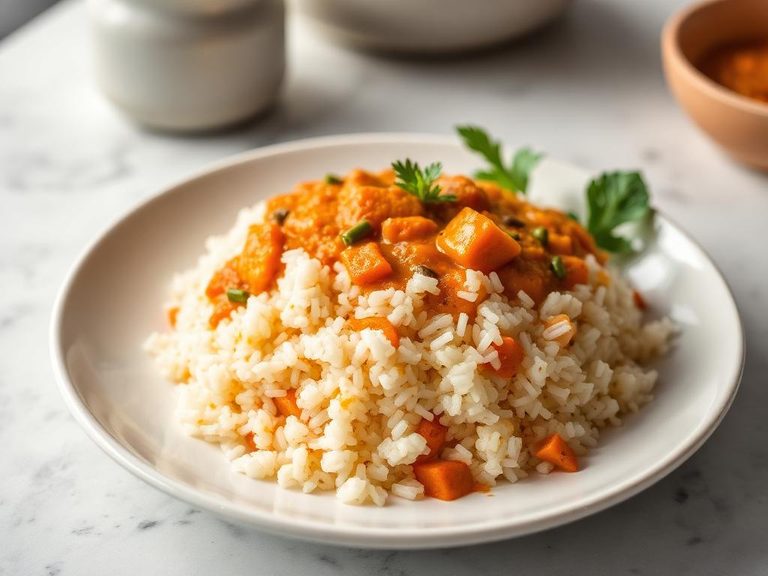
🌍 Where it's eaten
💡 Did you know?
The modern 'curry powder' blend is largely a British invention, created during the colonial era to replicate the complex spice mixtures (masalas) used in Indian cooking.
Full nutrition (scales with serving)
| Water | 8.8 g |
| Energy | 325 kcal |
| Energy | 1359 kj |
| Protein | 14.3 g |
| Total lipid (fat) | 14.0 g |
| Ash | 7.1 g |
| Carbohydrate, by difference | 55.8 g |
| Fiber, total dietary | 53.2 g |
| Total Sugars | 2.8 g |
| Sucrose | 0.62 g |
| Glucose | 1.1 g |
| Fructose | 0.79 g |
| Lactose | 0.00 g |
| Maltose | 0.00 g |
| Galactose | 0.21 g |
| Calcium, Ca | 525 mg |
| Iron, Fe | 19.1 mg |
| Magnesium, Mg | 255 mg |
| Phosphorus, P | 367 mg |
| Potassium, K | 1170 mg |
| Sodium, Na | 52.0 mg |
| Zinc, Zn | 4.7 mg |
| Copper, Cu | 1.2 mg |
| Manganese, Mn | 8.3 mg |
| Selenium, Se | 40.3 ug |
| Vitamin C, total ascorbic acid | 0.70 mg |
| Thiamin | 0.18 mg |
| Riboflavin | 0.20 mg |
| Niacin | 3.3 mg |
| Pantothenic acid | 1.1 mg |
| Vitamin B-6 | 0.10 mg |
| Folate, total | 56.0 ug |
| Folic acid | 0.00 ug |
| Folate, food | 56.0 ug |
| Folate, DFE | 56.0 ug |
| Choline, total | 64.2 mg |
| Betaine | 28.8 mg |
| Vitamin B-12 | 0.00 ug |
| Vitamin B-12, added | 0.00 ug |
| Vitamin A, RAE | 1.0 ug |
| Retinol | 0.00 ug |
| Carotene, beta | 11.0 ug |
| Carotene, alpha | 0.00 ug |
| Cryptoxanthin, beta | 0.00 ug |
| Vitamin A, IU | 19.0 iu |
| Lycopene | 0.00 ug |
| Lutein + zeaxanthin | 0.00 ug |
| Vitamin E (alpha-tocopherol) | 25.2 mg |
| Vitamin E, added | 0.00 mg |
| Tocopherol, beta | 0.00 mg |
| Tocopherol, gamma | 1.1 mg |
| Tocopherol, delta | 0.00 mg |
| Vitamin D (D2 + D3), International Units | 0.00 iu |
| Vitamin D (D2 + D3) | 0.00 ug |
| Vitamin K (phylloquinone) | 99.8 ug |
| Vitamin K (Dihydrophylloquinone) | 0.00 ug |
| Alcohol, ethyl | 0.00 g |
| Caffeine | 0.00 mg |
| Theobromine | 0.00 mg |
Fat & fatty acid profile (per 100g)
| Fatty acids, total saturated | 1.6 g |
| SFA 4:0 | 0.01 g |
| SFA 6:0 | 0.04 g |
| SFA 8:0 | 0.01 g |
| SFA 10:0 | 0.01 g |
| SFA 12:0 | 0.00 g |
| SFA 13:0 | 0.08 g |
| SFA 14:0 | 0.64 g |
| SFA 15:0 | 0.00 g |
| SFA 16:0 | 0.68 g |
| SFA 17:0 | 0.00 g |
| SFA 18:0 | 0.17 g |
| SFA 20:0 | 0.00 g |
| SFA 22:0 | 0.00 g |
| SFA 24:0 | 0.00 g |
| Fatty acids, total monounsaturated | 8.8 g |
| MUFA 14:1 | 0.00 g |
| MUFA 15:1 | 0.00 g |
| MUFA 16:1 | 0.01 g |
| MUFA 17:1 | 0.00 g |
| MUFA 18:1 | 8.7 g |
| MUFA 18:1 c | 8.7 g |
| MUFA 20:1 | 0.01 g |
| MUFA 22:1 | 0.01 g |
| MUFA 24:1 c | 0.00 g |
| Fatty acids, total polyunsaturated | 3.1 g |
| PUFA 18:2 | 2.8 g |
| PUFA 18:3 | 0.27 g |
| PUFA 18:3 n-3 c,c,c (ALA) | 0.26 g |
| PUFA 18:3 n-6 c,c,c | 0.01 g |
| PUFA 18:4 | 0.00 g |
| PUFA 20:2 n-6 c,c | 0.00 g |
| PUFA 20:3 | 0.00 g |
| PUFA 20:4 | 0.00 g |
| PUFA 20:5 n-3 (EPA) | 0.00 g |
| PUFA 22:5 n-3 (DPA) | 0.00 g |
| PUFA 22:6 n-3 (DHA) | 0.00 g |
| Fatty acids, total trans | 0.00 g |
| Fatty acids, total trans-monoenoic | 0.00 g |
| TFA 18:1 t | 0.00 g |
| Cholesterol | 0.00 mg |
Amino acid profile (per 100g)
| Tryptophan | 0.11 g |
| Threonine | 0.35 g |
| Isoleucine | 0.63 g |
| Leucine | 0.89 g |
| Lysine | 0.70 g |
| Methionine | 0.19 g |
| Cystine | 0.20 g |
| Phenylalanine | 0.58 g |
| Tyrosine | 0.40 g |
| Valine | 0.75 g |
| Arginine | 0.89 g |
| Histidine | 0.29 g |
| Alanine | 0.55 g |
| Aspartic acid | 1.8 g |
| Glutamic acid | 2.3 g |
| Glycine | 0.79 g |
| Proline | 1.2 g |
| Serine | 0.39 g |
| Hydroxyproline | 0.00 g |
FAQ
Is curry powder the same as a curry paste?
No. Curry powder is a dry blend of ground spices, while a curry paste is a wet mixture that often includes fresh ingredients like chilies, garlic, ginger, and shallots, in addition to ground spices.
How should I store curry powder?
Store it in an airtight container in a cool, dark place like a pantry. For maximum freshness and potency, use it within 6 months to a year.
Can I make my own curry powder?
Absolutely. The core spices are typically coriander, turmeric, cumin, and fenugreek. You can toast whole seeds, grind them, and customize the blend with additions like black pepper, cardamom, or dried chili.