Nuts, pine nuts, dried
Whole food · Nut and Seed Products

Photo: Wikipedia
Pine nuts are the edible seeds of pine trees, prized for their rich, buttery flavor and delicate, creamy texture. They are a nutritional powerhouse, packed with healthy monounsaturated fats and a notable amount of protein for a seed. Their high fat content (over 68%) makes them a dense source of energy and a vehicle for fat-soluble vitamins.
💚 Why it's loved
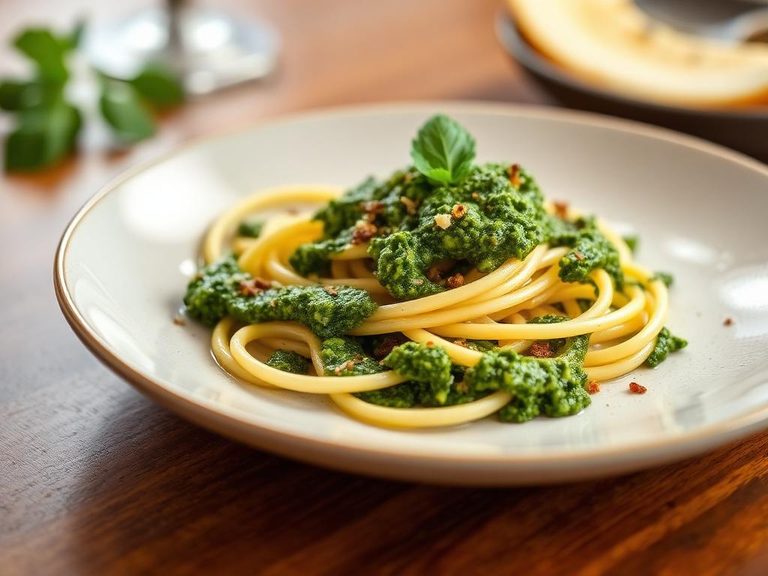
People adore pine nuts for their luxurious, slightly sweet, and resinous flavor that elevates both sweet and savory dishes. Their versatility allows them to be toasted for a crunchy garnish, blended into creamy sauces like pesto, or enjoyed raw as a nutritious snack.
⚠️ Watch-outs & how to enjoy it better
Due to their high fat and calorie density (673 kcal per 100g), overconsumption can hinder weight management goals. They are also a tree nut allergen, and some people experience 'pine mouth' (a temporary bitter or metallic taste) after eating them. To counteract calorie density, practice strict portion control (see portions below). For pine mouth, try lightly toasting the nuts or consuming them with other foods to mitigate the effect.
Key benefits
- Excellent source of heart-healthy monounsaturated fats
- Provides plant-based protein (13.7g per 100g)
- Rich in magnesium and manganese for bone and metabolic health
- Contains pinolenic acid, a unique fatty acid studied for appetite regulation
- Good source of dietary fiber
🍽️ Popular dishes
🌍 Where it's eaten
💡 Did you know?
The world's most expensive pine nuts, known as 'snow pine nuts' or 'white pine nuts,' come from the Chinese white pine and can cost over $100 per pound due to their labor-intensive harvesting and larger, sweeter kernels.
Full nutrition (scales with serving)
| Water | 2.3 g |
| Energy | 673 kcal |
| Energy | 2816 kj |
| Protein | 13.7 g |
| Total lipid (fat) | 68.4 g |
| Ash | 2.6 g |
| Carbohydrate, by difference | 13.1 g |
| Fiber, total dietary | 3.7 g |
| Total Sugars | 3.6 g |
| Sucrose | 3.5 g |
| Glucose | 0.07 g |
| Fructose | 0.07 g |
| Lactose | 0.00 g |
| Maltose | 0.00 g |
| Galactose | 0.00 g |
| Starch | 1.4 g |
| Calcium, Ca | 16.0 mg |
| Iron, Fe | 5.5 mg |
| Magnesium, Mg | 251 mg |
| Phosphorus, P | 575 mg |
| Potassium, K | 597 mg |
| Sodium, Na | 2.0 mg |
| Zinc, Zn | 6.5 mg |
| Copper, Cu | 1.3 mg |
| Manganese, Mn | 8.8 mg |
| Selenium, Se | 0.70 ug |
| Vitamin C, total ascorbic acid | 0.80 mg |
| Thiamin | 0.36 mg |
| Riboflavin | 0.23 mg |
| Niacin | 4.4 mg |
| Pantothenic acid | 0.31 mg |
| Vitamin B-6 | 0.09 mg |
| Folate, total | 34.0 ug |
| Folic acid | 0.00 ug |
| Folate, food | 34.0 ug |
| Folate, DFE | 34.0 ug |
| Choline, total | 55.8 mg |
| Betaine | 0.40 mg |
| Vitamin B-12 | 0.00 ug |
| Vitamin B-12, added | 0.00 ug |
| Vitamin A, RAE | 1.0 ug |
| Retinol | 0.00 ug |
| Carotene, beta | 17.0 ug |
| Carotene, alpha | 0.00 ug |
| Cryptoxanthin, beta | 0.00 ug |
| Vitamin A, IU | 29.0 iu |
| Lycopene | 0.00 ug |
| Lutein + zeaxanthin | 9.0 ug |
| Vitamin E (alpha-tocopherol) | 9.3 mg |
| Vitamin E, added | 0.00 mg |
| Tocopherol, beta | 0.00 mg |
| Tocopherol, gamma | 11.2 mg |
| Tocopherol, delta | 0.00 mg |
| Tocotrienol, alpha | 0.00 mg |
| Tocotrienol, beta | 0.00 mg |
| Tocotrienol, gamma | 0.69 mg |
| Tocotrienol, delta | 0.00 mg |
| Vitamin D (D2 + D3), International Units | 0.00 iu |
| Vitamin D (D2 + D3) | 0.00 ug |
| Vitamin K (phylloquinone) | 53.9 ug |
| Vitamin K (Dihydrophylloquinone) | 0.00 ug |
| Alcohol, ethyl | 0.00 g |
| Caffeine | 0.00 mg |
| Theobromine | 0.00 mg |
Fat & fatty acid profile (per 100g)
| Fatty acids, total saturated | 4.9 g |
| SFA 4:0 | 0.00 g |
| SFA 6:0 | 0.00 g |
| SFA 8:0 | 0.00 g |
| SFA 10:0 | 0.00 g |
| SFA 12:0 | 0.00 g |
| SFA 14:0 | 0.00 g |
| SFA 15:0 | 0.00 g |
| SFA 16:0 | 3.2 g |
| SFA 17:0 | 0.00 g |
| SFA 18:0 | 1.4 g |
| SFA 20:0 | 0.23 g |
| SFA 22:0 | 0.07 g |
| SFA 24:0 | 0.00 g |
| Fatty acids, total monounsaturated | 18.8 g |
| MUFA 14:1 | 0.00 g |
| MUFA 15:1 | 0.00 g |
| MUFA 16:1 | 0.02 g |
| MUFA 17:1 | 0.00 g |
| MUFA 18:1 | 17.9 g |
| MUFA 20:1 | 0.80 g |
| MUFA 22:1 | 0.00 g |
| Fatty acids, total polyunsaturated | 34.1 g |
| PUFA 18:2 | 33.1 g |
| PUFA 18:3 | 0.16 g |
| PUFA 18:3 n-3 c,c,c (ALA) | 0.11 g |
| PUFA 18:3 n-6 c,c,c | 0.05 g |
| PUFA 18:4 | 0.00 g |
| PUFA 20:2 n-6 c,c | 0.40 g |
| PUFA 20:3 | 0.35 g |
| PUFA 20:4 | 0.00 g |
| PUFA 20:5 n-3 (EPA) | 0.00 g |
| PUFA 22:5 n-3 (DPA) | 0.00 g |
| PUFA 22:6 n-3 (DHA) | 0.00 g |
| Cholesterol | 0.00 mg |
| Stigmasterol | 0.00 mg |
| Campesterol | 20.0 mg |
| Beta-sitosterol | 132 mg |
Amino acid profile (per 100g)
| Tryptophan | 0.11 g |
| Threonine | 0.37 g |
| Isoleucine | 0.54 g |
| Leucine | 0.99 g |
| Lysine | 0.54 g |
| Methionine | 0.26 g |
| Cystine | 0.29 g |
| Phenylalanine | 0.52 g |
| Tyrosine | 0.51 g |
| Valine | 0.69 g |
| Arginine | 2.4 g |
| Histidine | 0.34 g |
| Alanine | 0.68 g |
| Aspartic acid | 1.3 g |
| Glutamic acid | 2.9 g |
| Glycine | 0.69 g |
| Proline | 0.67 g |
| Serine | 0.83 g |
FAQ
What is 'pine mouth' and how can I avoid it?
Pine mouth is a temporary, unpleasant bitter or metallic aftertaste that some people experience 1-3 days after eating pine nuts. It's not harmful and resolves on its own. To potentially avoid it, choose fresh pine nuts, store them properly (in the freezer), and lightly toast them before use.
Are pine nuts a good source of protein?
Yes, for a seed. At 13.69g of protein per 100g, they are a solid plant-based protein source, making them valuable in vegetarian and vegan diets, especially when paired with grains or legumes in dishes.
How should I store pine nuts?
Due to their high oil content, pine nuts can go rancid quickly. Store them in an airtight container in the refrigerator for up to a month or in the freezer for up to 6 months to preserve their fresh flavor.