Nuts, almonds, blanched
Whole food · Nut and Seed Products

Photo: Wikipedia
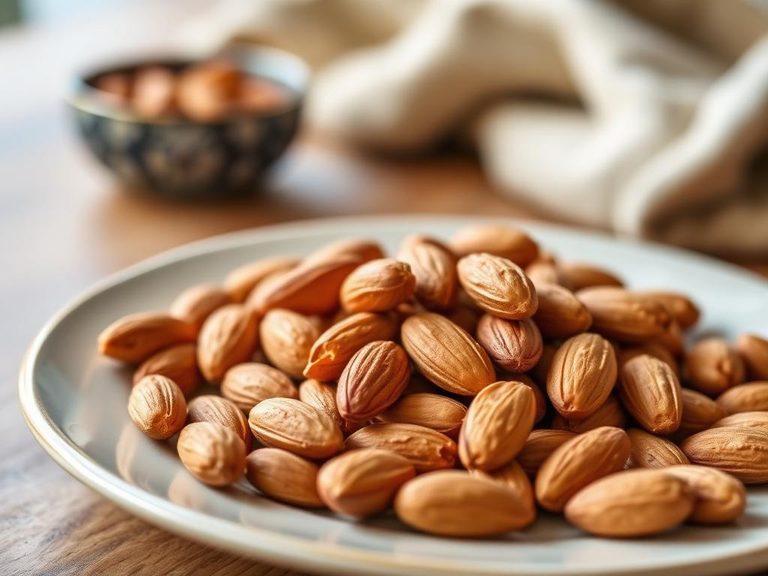
Blanched almonds are whole almonds with their brown skins removed, revealing a creamy, ivory-white kernel. They offer a milder, sweeter flavor and a smoother, less fibrous texture compared to their skin-on counterparts. Nutritionally, they are a powerhouse of plant-based protein and heart-healthy monounsaturated fats, with a notable fiber content.
💚 Why it's loved
People adore blanched almonds for their delicate, nutty sweetness and satisfying crunch that doesn't overpower other ingredients. Their versatility makes them a staple in both sweet baking (like macarons and frangipane) and savory dishes, where they add texture without the visual speckling of skins.
⚠️ Watch-outs & how to enjoy it better
As a tree nut, they are a common and potent allergen, requiring strict avoidance for those with allergies. Their high calorie density (590 kcal per 100g) means portion control is essential for weight management. To counteract, measure servings (e.g., a small handful) and pair with high-volume foods like berries or leafy greens to increase satiety without excess calories.
Key benefits
- Excellent source of plant-based protein (21.4g per 100g).
- Rich in monounsaturated fats, which support heart health.
- High in dietary fiber (9.9g per 100g) for digestive health.
- Provides a substantial amount of Vitamin E, a key antioxidant.
- Low in sugar (4.63g per 100g) for a nut.
🍽️ Popular dishes





🌍 Where it's eaten
💡 Did you know?
The process of blanching involves briefly boiling almonds, which loosens the skin for easy removal; this technique is believed to have been perfected in Spain, a major historical almond producer.
Full nutrition (scales with serving)
| Water | 4.5 g |
| Energy | 590 kcal |
| Energy | 2468 kj |
| Protein | 21.4 g |
| Total lipid (fat) | 52.5 g |
| Ash | 2.9 g |
| Carbohydrate, by difference | 18.7 g |
| Fiber, total dietary | 9.9 g |
| Total Sugars | 4.6 g |
| Sucrose | 4.5 g |
| Glucose | 0.03 g |
| Fructose | 0.00 g |
| Lactose | 0.00 g |
| Maltose | 0.14 g |
| Galactose | 0.00 g |
| Starch | 1.0 g |
| Calcium, Ca | 236 mg |
| Iron, Fe | 3.3 mg |
| Magnesium, Mg | 268 mg |
| Phosphorus, P | 481 mg |
| Potassium, K | 659 mg |
| Sodium, Na | 19.0 mg |
| Zinc, Zn | 3.0 mg |
| Copper, Cu | 1.0 mg |
| Manganese, Mn | 1.8 mg |
| Selenium, Se | 3.2 ug |
| Vitamin C, total ascorbic acid | 0.00 mg |
| Thiamin | 0.19 mg |
| Riboflavin | 0.71 mg |
| Niacin | 3.5 mg |
| Pantothenic acid | 0.31 mg |
| Vitamin B-6 | 0.12 mg |
| Folate, total | 49.0 ug |
| Folic acid | 0.00 ug |
| Folate, food | 49.0 ug |
| Folate, DFE | 49.0 ug |
| Choline, total | 52.1 mg |
| Vitamin B-12 | 0.00 ug |
| Vitamin B-12, added | 0.00 ug |
| Vitamin A, RAE | 0.00 ug |
| Retinol | 0.00 ug |
| Carotene, beta | 4.0 ug |
| Carotene, alpha | 0.00 ug |
| Cryptoxanthin, beta | 0.00 ug |
| Vitamin A, IU | 7.0 iu |
| Lycopene | 0.00 ug |
| Lutein + zeaxanthin | 1.0 ug |
| Vitamin E (alpha-tocopherol) | 23.8 mg |
| Vitamin E, added | 0.00 mg |
| Tocopherol, beta | 0.35 mg |
| Tocopherol, gamma | 0.66 mg |
| Tocopherol, delta | 0.20 mg |
| Vitamin D (D2 + D3), International Units | 0.00 iu |
| Vitamin D (D2 + D3) | 0.00 ug |
| Vitamin K (phylloquinone) | 0.00 ug |
| Alcohol, ethyl | 0.00 g |
| Caffeine | 0.00 mg |
| Theobromine | 0.00 mg |
Fat & fatty acid profile (per 100g)
| Fatty acids, total saturated | 4.0 g |
| SFA 4:0 | 0.00 g |
| SFA 6:0 | 0.00 g |
| SFA 8:0 | 0.00 g |
| SFA 10:0 | 0.00 g |
| SFA 12:0 | 0.00 g |
| SFA 13:0 | 0.00 g |
| SFA 14:0 | 0.00 g |
| SFA 15:0 | 0.00 g |
| SFA 16:0 | 3.3 g |
| SFA 17:0 | 0.01 g |
| SFA 18:0 | 0.67 g |
| SFA 20:0 | 0.00 g |
| SFA 22:0 | 0.00 g |
| SFA 24:0 | 0.00 g |
| Fatty acids, total monounsaturated | 33.4 g |
| MUFA 14:1 | 0.00 g |
| MUFA 15:1 | 0.00 g |
| MUFA 16:1 | 0.24 g |
| MUFA 17:1 | 0.06 g |
| MUFA 18:1 | 33.1 g |
| MUFA 20:1 | 0.00 g |
| MUFA 22:1 | 0.00 g |
| MUFA 24:1 c | 0.00 g |
| Fatty acids, total polyunsaturated | 12.4 g |
| PUFA 18:2 | 12.4 g |
| PUFA 18:3 | 0.00 g |
| PUFA 18:4 | 0.00 g |
| PUFA 20:2 n-6 c,c | 0.00 g |
| PUFA 20:3 | 0.00 g |
| PUFA 20:4 | 0.00 g |
| PUFA 20:5 n-3 (EPA) | 0.00 g |
| PUFA 22:5 n-3 (DPA) | 0.00 g |
| PUFA 22:6 n-3 (DHA) | 0.00 g |
| Fatty acids, total trans | 0.02 g |
| Cholesterol | 0.00 mg |
| Phytosterols | 114 mg |
| Stigmasterol | 1.0 mg |
| Campesterol | 4.0 mg |
| Beta-sitosterol | 109 mg |
Amino acid profile (per 100g)
| Tryptophan | 0.19 g |
| Threonine | 0.68 g |
| Isoleucine | 0.70 g |
| Leucine | 1.5 g |
| Lysine | 0.60 g |
| Methionine | 0.19 g |
| Cystine | 0.28 g |
| Phenylalanine | 1.2 g |
| Tyrosine | 0.53 g |
| Valine | 0.81 g |
| Arginine | 2.5 g |
| Histidine | 0.60 g |
| Alanine | 1.0 g |
| Aspartic acid | 2.8 g |
| Glutamic acid | 5.2 g |
| Glycine | 1.5 g |
| Proline | 0.97 g |
| Serine | 1.0 g |
FAQ
What's the difference between blanched and raw almonds?
Blanched almonds have their skins removed, resulting in a milder flavor, smoother texture, and pale color. Raw almonds typically still have their skins, which add a slightly bitter tannin note, more fiber, and a rustic appearance.
Are blanched almonds less healthy than almonds with skins?
The core nutrition (protein, fat, calories) is very similar. The skins contain extra fiber and antioxidants, so blanched almonds have a slight nutritional edge in those specific areas, but both are highly nutritious.
How should I store blanched almonds?
Store them in an airtight container in a cool, dark place for up to 3 months, or in the refrigerator for up to 6 months to prevent the oils from going rancid. For long-term storage, freeze them.