

Waffles, buttermilk, frozen, ready-to-heat
Whole food · Baked Products

Photo: Wikipedia
A frozen, ready-to-heat buttermilk waffle is a crisp-edged, fluffy-centered breakfast staple, offering a tangy, buttery flavor with a satisfyingly light texture. Nutritionally, it provides a quick source of carbohydrates for energy, with a modest protein content to help fuel your morning.
Calorie split: 10% protein · 60% carbs · 30% fat
↓ Full nutrition💚 Why it's loved
People love frozen buttermilk waffles for their nostalgic, comforting flavor and the sheer convenience of having a warm, crispy breakfast ready in minutes. They serve as a perfect blank canvas for both sweet and savory toppings, making them a versatile crowd-pleaser.
⚠️ Watch-outs & how to enjoy it better
The primary downside is their high carbohydrate content, which can lead to a rapid blood-sugar spike, especially when eaten plain. To counteract this, always pair them with a source of protein (like eggs, Greek yogurt, or nut butter) and healthy fat (like avocado or a drizzle of maple syrup) to slow digestion and stabilize energy levels.
Key benefits
- Quick and convenient breakfast option
- Good source of carbohydrates for energy
- Contains some protein from buttermilk and wheat
- Provides a small amount of dietary fiber
- Consistent taste and texture every time
🍽️ Popular dishes


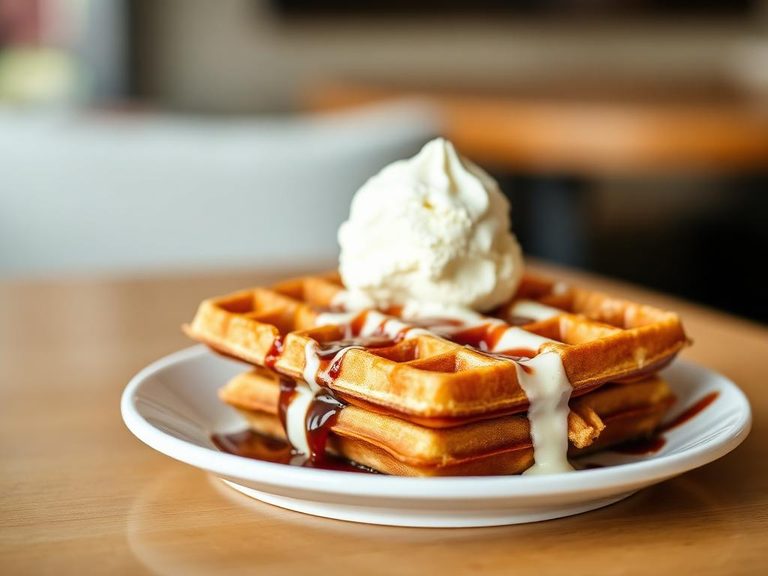
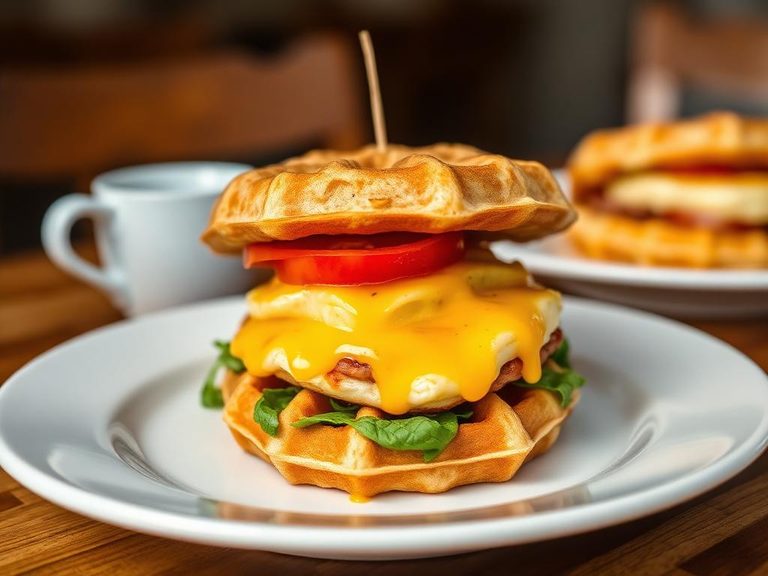

🌍 Where it's eaten
💡 Did you know?
The grid pattern on a waffle isn't just for looks; it was originally designed to hold more melted butter and syrup, maximizing flavor in every bite.
Full nutrition (USDA data · scales with serving)
| Water | 40.3 g |
| Energy | 273 kcal |
| Energy | 1144 kj |
| Protein | 6.6 g |
| Total lipid (fat) | 9.2 g |
| Ash | 2.8 g |
| Carbohydrate, by difference | 41.0 g |
| Fiber, total dietary | 2.2 g |
| Total Sugars | 4.3 g |
| Sucrose | 2.7 g |
| Glucose | 0.00 g |
| Fructose | 0.00 g |
| Lactose | 1.4 g |
| Maltose | 0.29 g |
| Galactose | 0.00 g |
| Starch | 35.5 g |
| Calcium, Ca | 279 mg |
| Iron, Fe | 6.0 mg |
| Magnesium, Mg | 19.0 mg |
| Phosphorus, P | 388 mg |
| Potassium, K | 126 mg |
| Sodium, Na | 621 mg |
| Zinc, Zn | 0.48 mg |
| Copper, Cu | 0.04 mg |
| Manganese, Mn | 0.21 mg |
| Selenium, Se | 9.5 ug |
| Vitamin C, total ascorbic acid | 0.00 mg |
| Thiamin | 0.50 mg |
| Riboflavin | 0.67 mg |
| Niacin | 6.7 mg |
| Pantothenic acid | 0.24 mg |
| Vitamin B-6 | 0.97 mg |
| Folate, total | 63.0 ug |
| Folic acid | 49.0 ug |
| Folate, food | 14.0 ug |
| Folate, DFE | 96.0 ug |
| Vitamin B-12 | 2.9 ug |
| Vitamin B-12, added | 2.7 ug |
| Vitamin A, RAE | 401 ug |
| Retinol | 401 ug |
| Carotene, beta | 2.0 ug |
| Carotene, alpha | 0.00 ug |
| Cryptoxanthin, beta | 2.0 ug |
| Vitamin A, IU | 1340 iu |
| Lycopene | 0.00 ug |
| Lutein + zeaxanthin | 63.0 ug |
| Vitamin E (alpha-tocopherol) | 0.62 mg |
| Vitamin E, added | 0.00 mg |
| Tocopherol, beta | 0.07 mg |
| Tocopherol, gamma | 4.0 mg |
| Tocopherol, delta | 1.3 mg |
| Tocotrienol, alpha | 0.03 mg |
| Tocotrienol, beta | 0.00 mg |
| Tocotrienol, gamma | 0.00 mg |
| Tocotrienol, delta | 0.00 mg |
| Vitamin K (phylloquinone) | 10.5 ug |
| Vitamin K (Dihydrophylloquinone) | 17.9 ug |
| Alcohol, ethyl | 0.00 g |
| Caffeine | 0.00 mg |
| Theobromine | 0.00 mg |
Fat & fatty acid profile (per 100g)
| Fatty acids, total saturated | 1.9 g |
| SFA 4:0 | 0.01 g |
| SFA 6:0 | 0.00 g |
| SFA 8:0 | 0.00 g |
| SFA 10:0 | 0.00 g |
| SFA 12:0 | 0.00 g |
| SFA 14:0 | 0.02 g |
| SFA 15:0 | 0.00 g |
| SFA 16:0 | 1.0 g |
| SFA 17:0 | 0.01 g |
| SFA 18:0 | 0.77 g |
| SFA 20:0 | 0.03 g |
| SFA 22:0 | 0.03 g |
| Fatty acids, total monounsaturated | 4.5 g |
| MUFA 14:1 | 0.00 g |
| MUFA 15:1 | 0.00 g |
| MUFA 16:1 | 0.02 g |
| MUFA 17:1 | 0.00 g |
| MUFA 18:1 | 4.5 g |
| MUFA 20:1 | 0.04 g |
| MUFA 22:1 | 0.00 g |
| Fatty acids, total polyunsaturated | 1.4 g |
| PUFA 18:2 | 1.4 g |
| PUFA 18:3 | 0.00 g |
| PUFA 18:3 n-6 c,c,c | 0.00 g |
| PUFA 18:4 | 0.00 g |
| PUFA 20:2 n-6 c,c | 0.00 g |
| PUFA 20:3 | 0.00 g |
| PUFA 20:4 | 0.01 g |
| PUFA 20:5 n-3 (EPA) | 0.01 g |
| PUFA 22:5 n-3 (DPA) | 0.00 g |
| PUFA 22:6 n-3 (DHA) | 0.01 g |
| Cholesterol | 15.0 mg |
Amino acid profile (per 100g)
| Tryptophan | 0.07 g |
| Threonine | 0.23 g |
| Isoleucine | 0.28 g |
| Leucine | 0.49 g |
| Lysine | 0.30 g |
| Methionine | 0.13 g |
| Cystine | 0.15 g |
| Phenylalanine | 0.30 g |
| Tyrosine | 0.15 g |
| Valine | 0.33 g |
| Arginine | 0.28 g |
| Histidine | 0.14 g |
| Alanine | 0.25 g |
| Aspartic acid | 0.41 g |
| Glutamic acid | 1.6 g |
| Glycine | 0.21 g |
| Proline | 0.56 g |
| Serine | 0.35 g |
FAQ
How do I get my frozen waffle extra crispy?
For maximum crispiness, use a toaster or toaster oven instead of a microwave. Toasting directly dehydrates the surface, creating a better crunch.
Can I make these waffles from scratch?
Yes, buttermilk waffle batter is a classic recipe involving flour, buttermilk, eggs, butter, sugar, and leavening. The frozen version is designed for convenience and shelf-stability.
What's the difference between buttermilk and regular waffles?
Buttermilk waffles have a distinct tangy flavor and a more tender, fluffy interior due to the acidity in buttermilk reacting with baking soda. Regular waffles are typically richer and denser.
Nutrient density (calculated · NRF9.3)
Nutrient Rich Foods index: beneficial nutrients (protein, fiber, vitamins, minerals) minus saturated fat, added sugar & sodium, per 100 kcal.
NRF9.3 index — Fulgoni, Keast & Drewnowski, 2009. Computed from USDA nutrients.
Weight-loss friendliness (composite index)
Energy density 2.73 kcal/g · 10% calories from protein · 2.2 g fiber · 4.3 g sugar per 100 g.
Composite of energy density (Rolls et al., 1999), protein & fiber satiety, minus sugar. A calculated heuristic — ranks satiety-per-calorie, not a clinical measure.
Dietary load (calculated from USDA values)
Potential renal acid load. Positive = acid-forming, negative = alkaline-forming.
Sodium-to-potassium ratio: 4.93 (lower is better — aim for ≤ 1)
Sodium:potassium per WHO potassium guidance. Computed from USDA nutrients.