

Plantains, green, fried
Whole food · Fruits and Fruit Juices
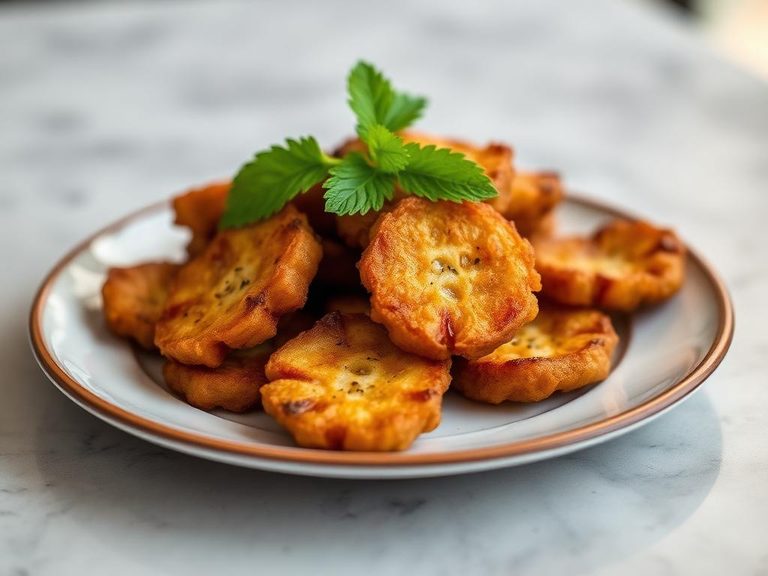
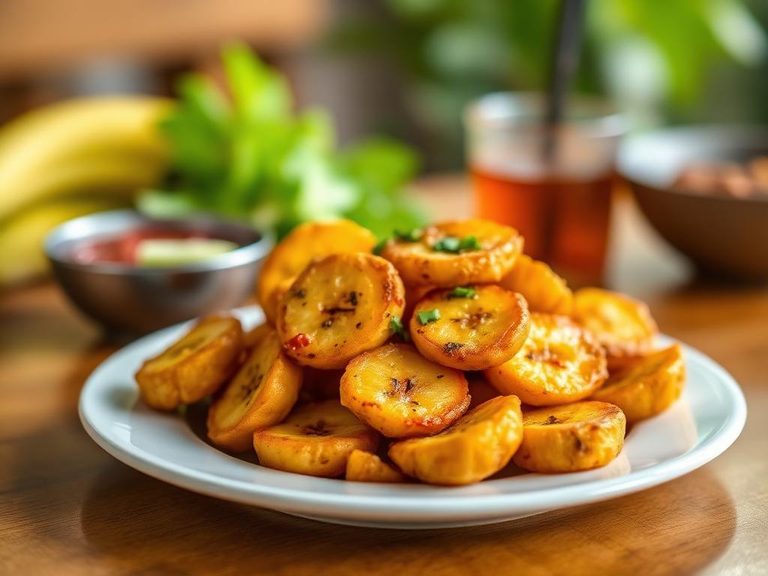
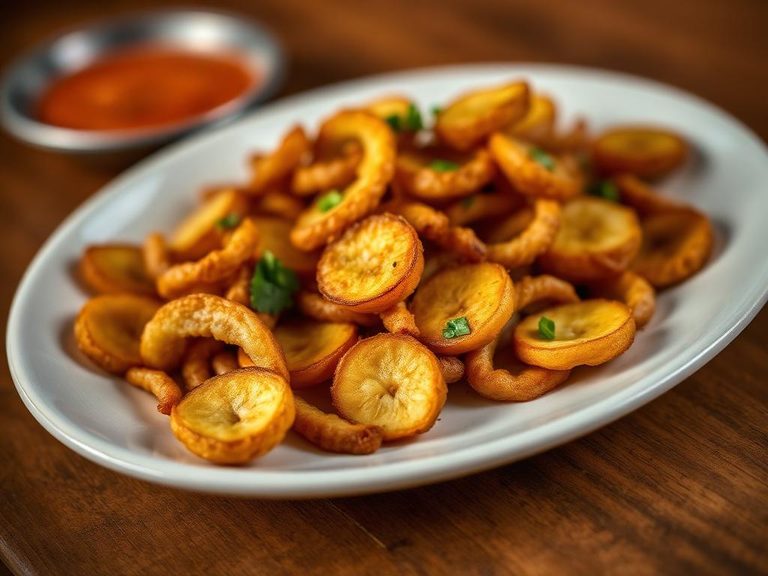
Green plantains, sliced and fried into tostones or patacones, transform from a starchy, potato-like vegetable into a golden, crispy, and savory delight. Their texture is a compelling contrast of a crunchy, salty exterior and a dense, chewy interior, with a flavor that is subtly earthy and mildly sweet. Nutritionally, they are a significant source of complex carbohydrates and dietary fiber, providing sustained energy.
Calorie split: 2% protein · 64% carbs · 34% fat
↓ Full nutrition💚 Why it's loved
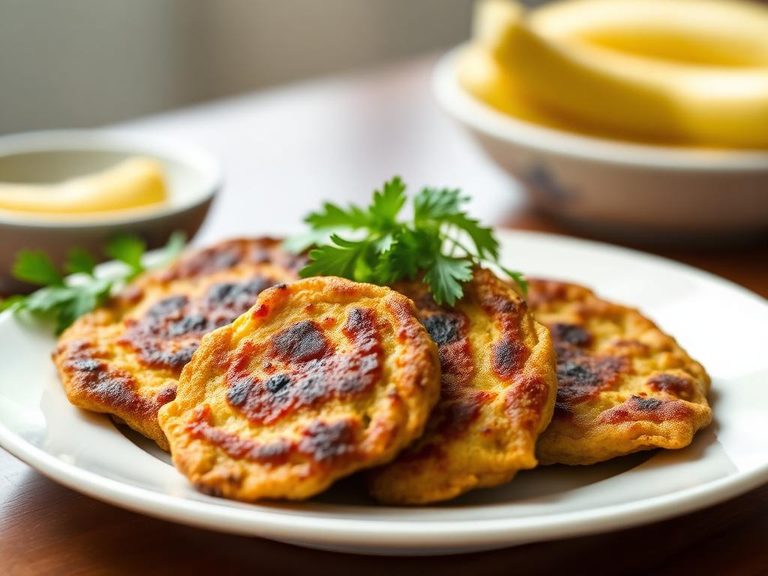
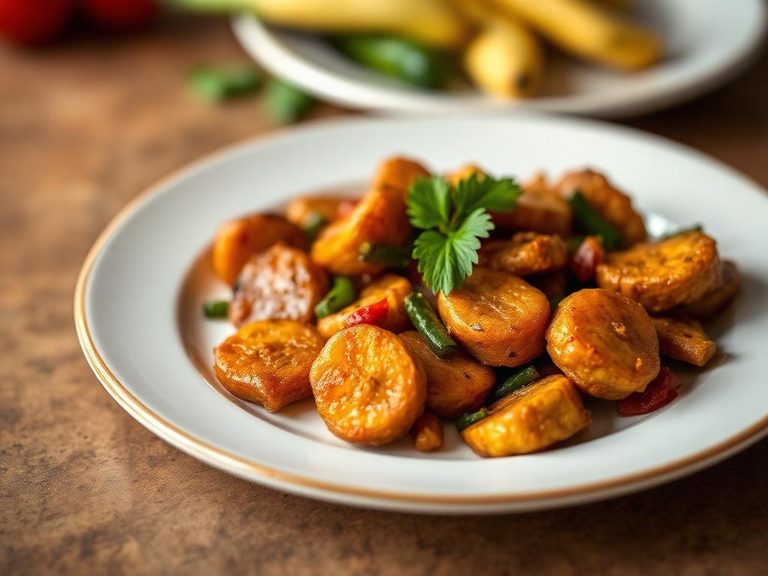
People adore fried green plantains for their irresistible crunch and deeply satisfying, savory flavor that complements a vast array of dishes. They are a beloved cultural cornerstone in Caribbean, Latin American, and West African cuisines, often served as a beloved side, snack, or base for other ingredients.
⚠️ Watch-outs & how to enjoy it better
The frying process adds significant calories and fat, and the high carbohydrate content can cause blood-sugar spikes, especially for those with insulin sensitivity. To mitigate this, pair them with a source of protein or healthy fat (like black beans or avocado) and practice portion control by enjoying them as a side rather than the main dish.
Key benefits
- Rich in resistant starch, which supports gut health.
- Good source of potassium for electrolyte balance.
- Provides vitamin B6 for metabolism and brain function.
- High in dietary fiber, promoting satiety.
- Naturally gluten-free and a versatile staple.
🍽️ Popular dishes
🌍 Where it's eaten
💡 Did you know?
Unlike sweet bananas, green plantains are considered a starchy vegetable and are almost always cooked before eating, as they are hard, bitter, and astringent when raw.
Full nutrition (USDA data · scales with serving)
| Water | 36.1 g |
| Energy | 309 kcal |
| Energy | 1293 kj |
| Protein | 1.5 g |
| Total lipid (fat) | 11.8 g |
| Ash | 1.4 g |
| Carbohydrate, by difference | 49.2 g |
| Fiber, total dietary | 3.5 g |
| Total Sugars | 3.6 g |
| Sucrose | 2.4 g |
| Glucose | 0.61 g |
| Fructose | 0.66 g |
| Lactose | 0.00 g |
| Maltose | 0.00 g |
| Galactose | 0.00 g |
| Starch | 40.7 g |
| Calcium, Ca | 4.0 mg |
| Iron, Fe | 0.67 mg |
| Magnesium, Mg | 58.0 mg |
| Phosphorus, P | 44.0 mg |
| Potassium, K | 482 mg |
| Sodium, Na | 2.0 mg |
| Zinc, Zn | 0.23 mg |
| Copper, Cu | 0.18 mg |
| Manganese, Mn | 0.19 mg |
| Vitamin C, total ascorbic acid | 3.4 mg |
| Thiamin | 0.05 mg |
| Riboflavin | 0.10 mg |
| Niacin | 0.82 mg |
| Pantothenic acid | 0.39 mg |
| Vitamin B-6 | 0.26 mg |
| Folate, total | 15.0 ug |
| Folate, food | 15.0 ug |
| Vitamin A, RAE | 60.0 ug |
| Carotene, beta | 548 ug |
| Carotene, alpha | 332 ug |
| Cryptoxanthin, beta | 2.0 ug |
| Vitamin A, IU | 1192 iu |
Fat & fatty acid profile (per 100g)
| Fatty acids, total saturated | 3.7 g |
| SFA 6:0 | 0.00 g |
| SFA 10:0 | 0.02 g |
| SFA 12:0 | 0.01 g |
| SFA 14:0 | 0.13 g |
| SFA 15:0 | 0.01 g |
| SFA 16:0 | 2.3 g |
| SFA 17:0 | 0.04 g |
| SFA 18:0 | 1.2 g |
| SFA 20:0 | 0.02 g |
| SFA 22:0 | 0.00 g |
| SFA 24:0 | 0.00 g |
| Fatty acids, total monounsaturated | 4.4 g |
| MUFA 14:1 | 0.00 g |
| MUFA 15:1 | 0.00 g |
| MUFA 16:1 | 0.19 g |
| MUFA 16:1 c | 0.19 g |
| MUFA 17:1 | 0.00 g |
| MUFA 18:1 | 4.1 g |
| MUFA 18:1 c | 4.0 g |
| MUFA 20:1 | 0.08 g |
| MUFA 22:1 | 0.00 g |
| MUFA 22:1 c | 0.00 g |
| MUFA 24:1 c | 0.00 g |
| Fatty acids, total polyunsaturated | 2.7 g |
| PUFA 18:2 | 2.3 g |
| PUFA 18:2 n-6 c,c | 2.3 g |
| PUFA 18:2 CLAs | 0.03 g |
| PUFA 18:3 | 0.21 g |
| PUFA 18:3 n-3 c,c,c (ALA) | 0.21 g |
| PUFA 18:3 n-6 c,c,c | 0.00 g |
| PUFA 18:4 | 0.00 g |
| PUFA 20:2 n-6 c,c | 0.07 g |
| PUFA 20:3 | 0.02 g |
| PUFA 20:3 n-3 | 0.01 g |
| PUFA 20:3 n-6 | 0.01 g |
| PUFA 20:4 | 0.02 g |
| PUFA 20:5 n-3 (EPA) | 0.00 g |
| PUFA 22:4 | 0.01 g |
| PUFA 22:5 n-3 (DPA) | 0.01 g |
| PUFA 22:6 n-3 (DHA) | 0.00 g |
| Fatty acids, total trans | 0.16 g |
| Fatty acids, total trans-monoenoic | 0.12 g |
| TFA 16:1 t | 0.00 g |
| TFA 18:1 t | 0.11 g |
| TFA 22:1 t | 0.00 g |
| TFA 18:2 t not further defined | 0.04 g |
| Fatty acids, total trans-polyenoic | 0.04 g |
Amino acid profile (per 100g)
Estimated from Plantains, green, boiled — USDA does not publish this profile for Plantains.
| Tryptophan | 0.01 g |
| Threonine | 0.02 g |
| Isoleucine | 0.02 g |
| Leucine | 0.04 g |
| Lysine | 0.05 g |
| Methionine | 0.01 g |
| Cystine | 0.02 g |
| Phenylalanine | 0.03 g |
| Tyrosine | 0.02 g |
| Valine | 0.02 g |
| Arginine | 0.06 g |
| Histidine | 0.06 g |
| Alanine | 0.03 g |
| Aspartic acid | 0.09 g |
| Glutamic acid | 0.08 g |
| Glycine | 0.03 g |
| Proline | 0.03 g |
| Serine | 0.03 g |
| Hydroxyproline | 0.00 g |
FAQ
What's the difference between green and ripe plantains?
Green plantains are starchy, firm, and savory, used like a potato. Ripe (yellow/black) plantains are sweet, soft, and caramelized when fried.
Are fried green plantains healthy?
They are a good source of fiber, potassium, and B6, but frying adds fat and calories. Enjoy in moderation as part of a balanced diet.
How do you make them crispy?
The key is to fry them twice: first at a lower temperature to cook through, then at a higher temperature to crisp up. Pressing them flat between fries is essential for tostones.
Nutrient density (calculated · NRF9.3)
Nutrient Rich Foods index: beneficial nutrients (protein, fiber, vitamins, minerals) minus saturated fat, added sugar & sodium, per 100 kcal.
NRF9.3 index — Fulgoni, Keast & Drewnowski, 2009. Computed from USDA nutrients.
Weight-loss friendliness (composite index)
Energy density 3.09 kcal/g · 2% calories from protein · 3.5 g fiber · 3.6 g sugar per 100 g.
Composite of energy density (Rolls et al., 1999), protein & fiber satiety, minus sugar. A calculated heuristic — ranks satiety-per-calorie, not a clinical measure.
Dietary load (calculated from USDA values)
Potential renal acid load. Positive = acid-forming, negative = alkaline-forming.
Sodium-to-potassium ratio: 0.00 (lower is better — aim for ≤ 1)
Sodium:potassium per WHO potassium guidance. Computed from USDA nutrients.