

Nuts, pecans
Whole food · Nut and Seed Products

Photo: Wikipedia
Pecans are rich, buttery nuts with a satisfyingly crisp yet tender texture and a deep, sweet, slightly smoky flavor. They are a nutritional powerhouse, notably high in heart-healthy monounsaturated fats, providing over 70g of fat per 100g. Their high calorie density is balanced by a good dose of fiber and minerals like manganese and zinc.
Calorie split: 5% protein · 7% carbs · 88% fat
↓ Full nutrition💚 Why it's loved
People adore pecans for their uniquely rich, sweet flavor and luxurious, buttery crunch that elevates both sweet and savory dishes. They are a cornerstone of classic Southern U.S. cuisine, symbolizing comfort and holiday feasts, especially in pecan pie.
⚠️ Watch-outs & how to enjoy it better
Their high calorie and fat content can be a concern for those monitoring energy intake. Pecans are a tree nut allergen, and their high phytate content can slightly reduce mineral absorption. To manage calories, practice strict portion control (a small handful is a serving). To mitigate phytates, they can be soaked or sprouted before use, though this is less common for pecans than other nuts.
Key benefits
- Excellent source of monounsaturated fats, particularly oleic acid.
- Very high in manganese, essential for bone health and metabolism.
- Provides a significant amount of dietary fiber.
- Rich in antioxidants, including ellagic acid and gamma-tocopherol.
- Contains plant-based protein and essential minerals like zinc.
🍽️ Popular dishes


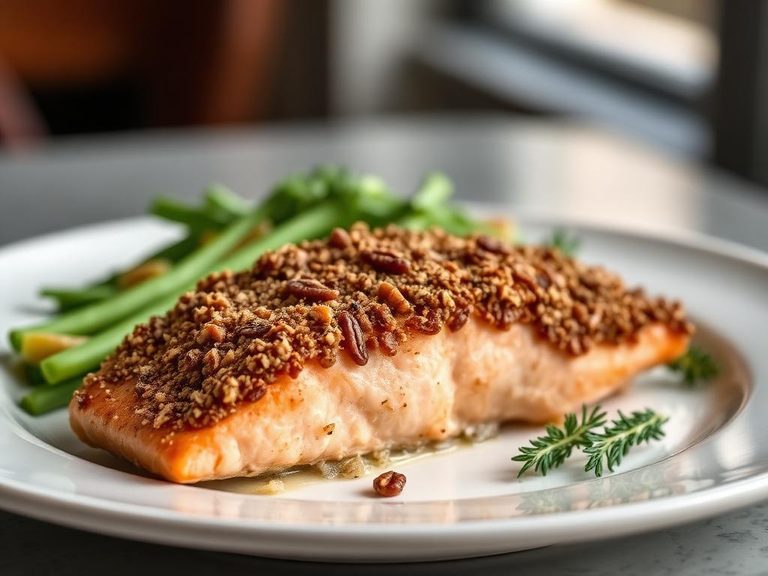
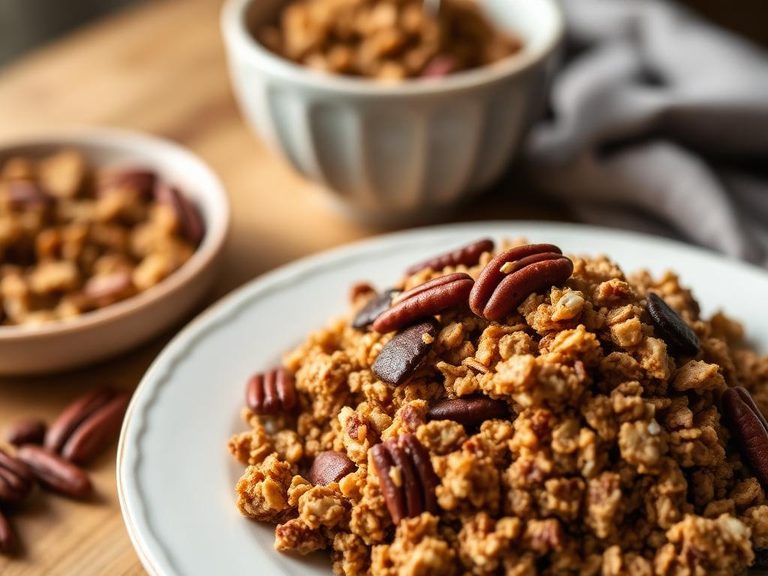

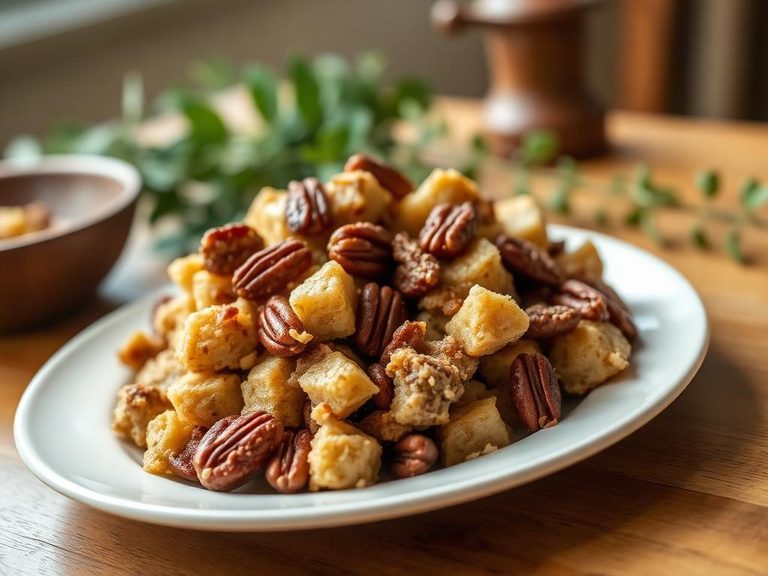
🌍 Where it's eaten
💡 Did you know?
Pecans are the only major tree nut indigenous to North America, with Native American tribes using them for food, medicine, and dye for centuries before European settlement.
Full nutrition (USDA data · scales with serving)
| Water | 3.5 g |
| Energy | 691 kcal |
| Energy | 2889 kj |
| Protein | 9.2 g |
| Total lipid (fat) | 72.0 g |
| Ash | 1.5 g |
| Carbohydrate, by difference | 13.9 g |
| Fiber, total dietary | 9.6 g |
| Total Sugars | 4.0 g |
| Sucrose | 3.9 g |
| Glucose | 0.04 g |
| Fructose | 0.04 g |
| Lactose | 0.00 g |
| Maltose | 0.00 g |
| Starch | 0.46 g |
| Calcium, Ca | 70.0 mg |
| Iron, Fe | 2.5 mg |
| Magnesium, Mg | 121 mg |
| Phosphorus, P | 277 mg |
| Potassium, K | 410 mg |
| Sodium, Na | 0.00 mg |
| Zinc, Zn | 4.5 mg |
| Copper, Cu | 1.2 mg |
| Manganese, Mn | 4.5 mg |
| Selenium, Se | 3.8 ug |
| Fluoride, F | 10.0 ug |
| Vitamin C, total ascorbic acid | 1.1 mg |
| Thiamin | 0.66 mg |
| Riboflavin | 0.13 mg |
| Niacin | 1.2 mg |
| Pantothenic acid | 0.86 mg |
| Vitamin B-6 | 0.21 mg |
| Folate, total | 22.0 ug |
| Folic acid | 0.00 ug |
| Folate, food | 22.0 ug |
| Folate, DFE | 22.0 ug |
| Choline, total | 40.5 mg |
| Betaine | 0.70 mg |
| Vitamin B-12 | 0.00 ug |
| Vitamin B-12, added | 0.00 ug |
| Vitamin A, RAE | 3.0 ug |
| Retinol | 0.00 ug |
| Carotene, beta | 29.0 ug |
| Carotene, alpha | 0.00 ug |
| Cryptoxanthin, beta | 9.0 ug |
| Vitamin A, IU | 56.0 iu |
| Lycopene | 0.00 ug |
| Lutein + zeaxanthin | 17.0 ug |
| Vitamin E (alpha-tocopherol) | 1.4 mg |
| Vitamin E, added | 0.00 mg |
| Tocopherol, beta | 0.39 mg |
| Tocopherol, gamma | 24.4 mg |
| Tocopherol, delta | 0.47 mg |
| Vitamin D (D2 + D3), International Units | 0.00 iu |
| Vitamin D (D2 + D3) | 0.00 ug |
| Vitamin K (phylloquinone) | 3.5 ug |
| Vitamin K (Dihydrophylloquinone) | 0.00 ug |
| Alcohol, ethyl | 0.00 g |
| Caffeine | 0.00 mg |
| Theobromine | 0.00 mg |
Fat & fatty acid profile (per 100g)
| Fatty acids, total saturated | 6.2 g |
| SFA 4:0 | 0.00 g |
| SFA 6:0 | 0.00 g |
| SFA 8:0 | 0.00 g |
| SFA 10:0 | 0.00 g |
| SFA 12:0 | 0.00 g |
| SFA 13:0 | 0.00 g |
| SFA 14:0 | 0.00 g |
| SFA 15:0 | 0.00 g |
| SFA 16:0 | 4.4 g |
| SFA 17:0 | 0.00 g |
| SFA 18:0 | 1.7 g |
| SFA 20:0 | 0.07 g |
| SFA 22:0 | 0.00 g |
| SFA 24:0 | 0.00 g |
| Fatty acids, total monounsaturated | 40.8 g |
| MUFA 14:1 | 0.00 g |
| MUFA 16:1 | 0.00 g |
| MUFA 18:1 | 40.6 g |
| MUFA 20:1 | 0.21 g |
| MUFA 22:1 | 0.00 g |
| MUFA 24:1 c | 0.00 g |
| Fatty acids, total polyunsaturated | 21.6 g |
| PUFA 18:2 | 20.6 g |
| PUFA 18:3 | 0.99 g |
| PUFA 18:4 | 0.00 g |
| PUFA 20:2 n-6 c,c | 0.00 g |
| PUFA 20:3 | 0.00 g |
| PUFA 20:4 | 0.00 g |
| PUFA 20:5 n-3 (EPA) | 0.00 g |
| PUFA 22:5 n-3 (DPA) | 0.00 g |
| PUFA 22:6 n-3 (DHA) | 0.00 g |
| Cholesterol | 0.00 mg |
| Stigmasterol | 3.0 mg |
| Campesterol | 6.0 mg |
| Beta-sitosterol | 117 mg |
Amino acid profile (per 100g)
| Tryptophan | 0.09 g |
| Threonine | 0.31 g |
| Isoleucine | 0.34 g |
| Leucine | 0.60 g |
| Lysine | 0.29 g |
| Methionine | 0.18 g |
| Cystine | 0.15 g |
| Phenylalanine | 0.43 g |
| Tyrosine | 0.21 g |
| Valine | 0.41 g |
| Arginine | 1.2 g |
| Histidine | 0.26 g |
| Alanine | 0.40 g |
| Aspartic acid | 0.93 g |
| Glutamic acid | 1.8 g |
| Glycine | 0.45 g |
| Proline | 0.36 g |
| Serine | 0.47 g |
FAQ
How do I store pecans to keep them fresh?
Due to their high oil content, pecans can go rancid. Store shelled pecans in an airtight container in the refrigerator for up to 6 months or in the freezer for up to a year. In-shell pecans can be kept in a cool, dry place for several months.
What's the difference between pecans and walnuts?
Pecans have a sweeter, milder, and more buttery flavor with a smoother texture. Walnuts are more tannic, earthy, and slightly bitter with a more pronounced crunch. Nutritionally, both are high in healthy fats, but walnuts are notably higher in omega-3 fatty acids (ALA).
Can I use pecans in savory cooking?
Absolutely. Their rich flavor pairs wonderfully with roasted vegetables (like Brussels sprouts or sweet potatoes), salads, cheese boards, and as a crust for fish or poultry. They can also be ground into a 'flour' for breading or used to make a savory pecan butter.
Nutrient density (calculated · NRF9.3)
Nutrient Rich Foods index: beneficial nutrients (protein, fiber, vitamins, minerals) minus saturated fat, added sugar & sodium, per 100 kcal.
NRF9.3 index — Fulgoni, Keast & Drewnowski, 2009. Computed from USDA nutrients.
Weight-loss friendliness (composite index)
Energy density 6.91 kcal/g · 5% calories from protein · 9.6 g fiber · 4.0 g sugar per 100 g.
Composite of energy density (Rolls et al., 1999), protein & fiber satiety, minus sugar. A calculated heuristic — ranks satiety-per-calorie, not a clinical measure.
Dietary load (calculated from USDA values)
Potential renal acid load. Positive = acid-forming, negative = alkaline-forming.
Sodium-to-potassium ratio: 0.00 (lower is better — aim for ≤ 1)
Sodium:potassium per WHO potassium guidance. Computed from USDA nutrients.