

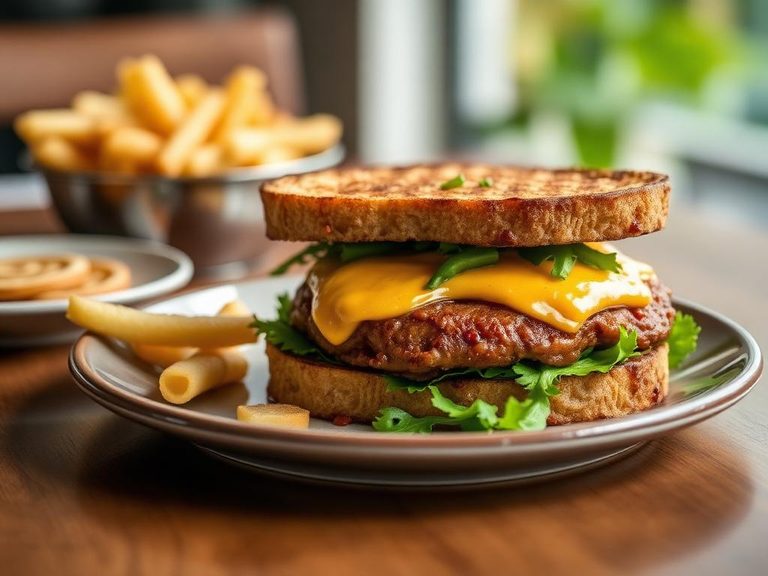
Fast foods, hamburger; double, large patty; with condiments, vegetables and mayonnaise
Whole food · Fast Foods
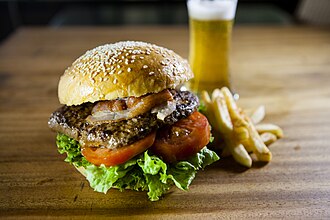
Photo: Wikipedia
This is a classic American double-patty hamburger, a towering stack of juicy, seared beef, crisp lettuce, ripe tomato, and tangy pickles, all bound together by creamy mayonnaise and a soft, toasted bun. Each 100-gram serving delivers a substantial 13.94 grams of protein, but it's a calorie-dense meal at 252 kcal, with a significant portion of its energy coming from fat.
Calorie split: 22% protein · 22% carbs · 56% fat
↓ Full nutrition💚 Why it's loved
People adore the satisfying contrast of textures—the juicy, savory beef against the crisp vegetables and the soft, yielding bun—and the harmonious blend of umami, salty, and tangy flavors. It's a cultural icon of comfort food, representing convenience, indulgence, and a shared culinary experience.
⚠️ Watch-outs & how to enjoy it better
The combination of refined carbohydrates, high fat, and potential sodium content can lead to blood-sugar spikes and isn't ideal for those managing heart health or blood pressure. To counteract this, pair it with a side salad or non-starchy vegetables to add fiber and volume, practice portion control by sharing or opting for a single patty, and drink water instead of sugary soda.
Key benefits
- Excellent source of high-quality protein for muscle maintenance and satiety.
- Provides essential minerals like iron and zinc from the beef patties.
- Contains some dietary fiber and vitamins from the vegetable components.
- Offers a quick, energy-dense meal for high-calorie needs.
🍽️ Popular dishes
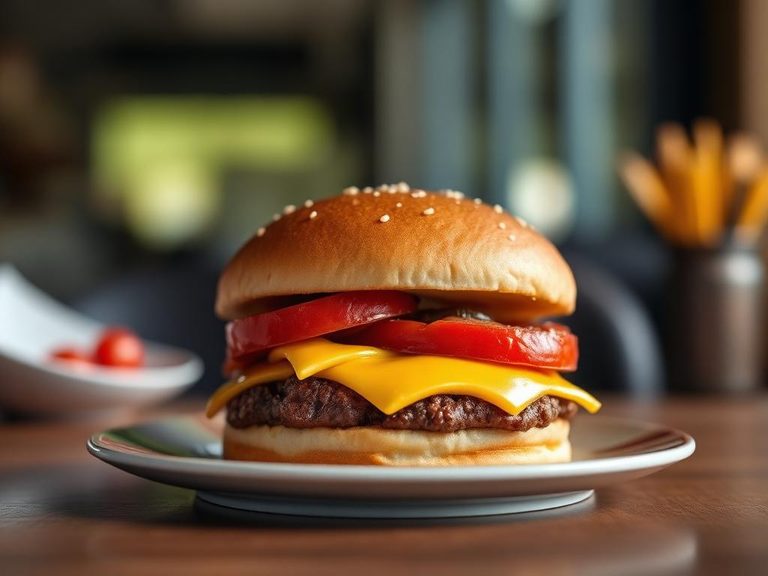
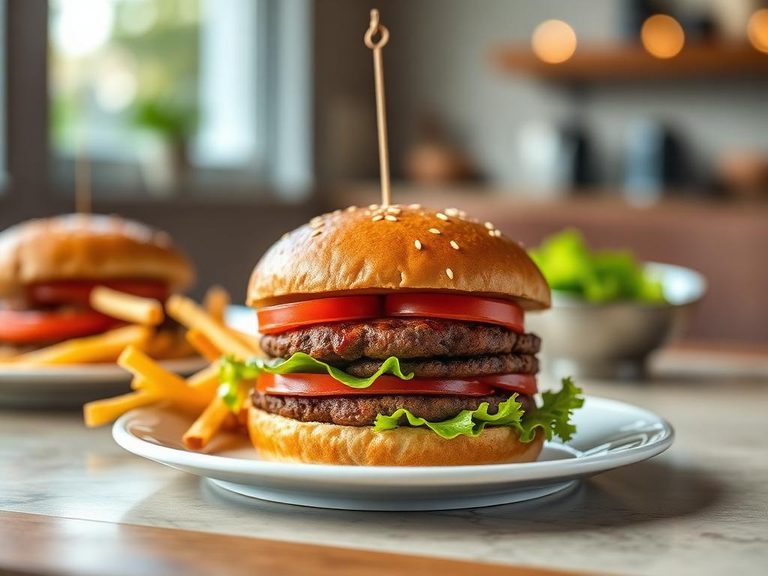

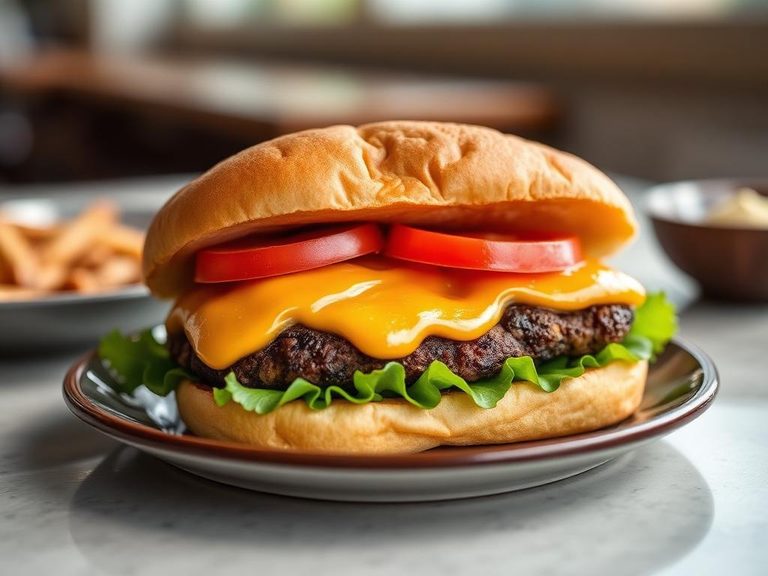
🌍 Where it's eaten
💡 Did you know?
The hamburger's name likely derives from the German city of Hamburg, which was famous for its beef products in the 19th century, though the modern sandwich form was popularized in the United States.
Full nutrition (USDA data · scales with serving)
| Water | 55.3 g |
| Energy | 252 kcal |
| Energy | 1053 kj |
| Protein | 13.9 g |
| Total lipid (fat) | 15.7 g |
| Ash | 1.4 g |
| Carbohydrate, by difference | 13.7 g |
| Fiber, total dietary | 1.4 g |
| Total Sugars | 3.5 g |
| Sucrose | 1.4 g |
| Glucose | 0.00 g |
| Fructose | 1.4 g |
| Lactose | 0.00 g |
| Maltose | 0.57 g |
| Galactose | 0.07 g |
| Starch | 10.3 g |
| Calcium, Ca | 35.0 mg |
| Iron, Fe | 2.8 mg |
| Magnesium, Mg | 18.0 mg |
| Phosphorus, P | 111 mg |
| Potassium, K | 192 mg |
| Sodium, Na | 289 mg |
| Zinc, Zn | 3.0 mg |
| Copper, Cu | 0.12 mg |
| Manganese, Mn | 0.20 mg |
| Selenium, Se | 20.1 ug |
| Vitamin C, total ascorbic acid | 0.20 mg |
| Thiamin | 0.19 mg |
| Riboflavin | 0.19 mg |
| Niacin | 3.2 mg |
| Pantothenic acid | 0.19 mg |
| Vitamin B-6 | 0.11 mg |
| Folate, total | 45.0 ug |
| Folic acid | 22.0 ug |
| Folate, food | 23.0 ug |
| Folate, DFE | 60.0 ug |
| Choline, total | 42.3 mg |
| Vitamin B-12 | 1.4 ug |
| Vitamin B-12, added | 0.00 ug |
| Vitamin A, RAE | 6.0 ug |
| Retinol | 0.00 ug |
| Carotene, beta | 62.0 ug |
| Carotene, alpha | 6.0 ug |
| Cryptoxanthin, beta | 2.0 ug |
| Vitamin A, IU | 111 iu |
| Lycopene | 806 ug |
| Lutein + zeaxanthin | 31.0 ug |
| Vitamin E (alpha-tocopherol) | 0.67 mg |
| Vitamin E, added | 0.00 mg |
| Vitamin D (D2 + D3), International Units | 4.0 iu |
| Vitamin D (D2 + D3) | 0.10 ug |
| Vitamin K (phylloquinone) | 14.1 ug |
| Vitamin K (Dihydrophylloquinone) | 0.00 ug |
| Alcohol, ethyl | 0.00 g |
| Caffeine | 0.00 mg |
| Theobromine | 0.00 mg |
Fat & fatty acid profile (per 100g)
| Fatty acids, total saturated | 5.8 g |
| SFA 4:0 | 0.01 g |
| SFA 6:0 | 0.01 g |
| SFA 8:0 | 0.01 g |
| SFA 10:0 | 0.01 g |
| SFA 12:0 | 0.06 g |
| SFA 14:0 | 0.37 g |
| SFA 15:0 | 0.06 g |
| SFA 16:0 | 3.2 g |
| SFA 17:0 | 0.15 g |
| SFA 18:0 | 1.8 g |
| SFA 20:0 | 0.03 g |
| SFA 22:0 | 0.02 g |
| SFA 24:0 | 0.01 g |
| Fatty acids, total monounsaturated | 6.1 g |
| MUFA 14:1 | 0.10 g |
| MUFA 16:1 | 0.46 g |
| MUFA 16:1 c | 0.43 g |
| MUFA 17:1 | 0.10 g |
| MUFA 18:1 | 5.4 g |
| MUFA 18:1 c | 5.1 g |
| MUFA 20:1 | 0.02 g |
| MUFA 22:1 | 0.00 g |
| Fatty acids, total polyunsaturated | 3.0 g |
| PUFA 18:2 | 2.7 g |
| PUFA 18:2 n-6 c,c | 2.6 g |
| PUFA 18:2 i | 0.06 g |
| PUFA 18:3 | 0.32 g |
| PUFA 18:3 n-3 c,c,c (ALA) | 0.32 g |
| PUFA 18:4 | 0.00 g |
| PUFA 20:2 n-6 c,c | 0.01 g |
| PUFA 20:3 | 0.01 g |
| PUFA 20:4 | 0.03 g |
| PUFA 20:5 n-3 (EPA) | 0.00 g |
| PUFA 22:5 n-3 (DPA) | 0.00 g |
| PUFA 22:6 n-3 (DHA) | 0.00 g |
| Fatty acids, total trans | 0.40 g |
| Fatty acids, total trans-monoenoic | 0.35 g |
| TFA 16:1 t | 0.03 g |
| TFA 18:1 t | 0.32 g |
| Fatty acids, total trans-polyenoic | 0.06 g |
| Cholesterol | 46.0 mg |
Amino acid profile (per 100g)
Estimated from Fast foods, miniature cinnamon rolls — USDA does not publish this profile for Fast foods.
| Tryptophan | 0.05 g |
| Threonine | 0.22 g |
| Isoleucine | 0.28 g |
| Leucine | 0.51 g |
| Lysine | 0.18 g |
| Methionine | 0.11 g |
| Cystine | 0.16 g |
| Phenylalanine | 0.33 g |
| Tyrosine | 0.21 g |
| Valine | 0.33 g |
| Arginine | 0.26 g |
| Histidine | 0.16 g |
| Alanine | 0.25 g |
| Aspartic acid | 0.36 g |
| Glutamic acid | 2.2 g |
| Glycine | 0.25 g |
| Proline | 0.71 g |
| Serine | 0.37 g |
FAQ
Is a double hamburger a good source of protein?
Yes, it is an excellent source. A typical double-patty serving provides around 30-40 grams of high-quality, complete protein, which is essential for muscle repair and overall body function.
How does the mayonnaise affect the nutrition?
Mayonnaise significantly increases the total fat and calorie content. While it adds flavor and moisture, it's calorie-dense, so using it sparingly or opting for a lighter version can reduce the overall caloric load.
Can I make a healthier version at home?
Absolutely. Use lean ground beef or a turkey/chicken blend, load up on extra vegetables like lettuce, tomato, and onions, choose a whole-grain bun, and consider Greek yogurt-based spreads instead of full-fat mayonnaise.
Nutrient density (calculated · NRF9.3)
Nutrient Rich Foods index: beneficial nutrients (protein, fiber, vitamins, minerals) minus saturated fat, added sugar & sodium, per 100 kcal.
NRF9.3 index — Fulgoni, Keast & Drewnowski, 2009. Computed from USDA nutrients.
Weight-loss friendliness (composite index)
Energy density 2.52 kcal/g · 22% calories from protein · 1.4 g fiber · 3.5 g sugar per 100 g.
Composite of energy density (Rolls et al., 1999), protein & fiber satiety, minus sugar. A calculated heuristic — ranks satiety-per-calorie, not a clinical measure.
Dietary load (calculated from USDA values)
Potential renal acid load. Positive = acid-forming, negative = alkaline-forming.
Sodium-to-potassium ratio: 1.51 (lower is better — aim for ≤ 1)
Sodium:potassium per WHO potassium guidance. Computed from USDA nutrients.