

Egg custards, dry mix, prepared with whole milk
Whole food · Sweets

Photo: Wikipedia
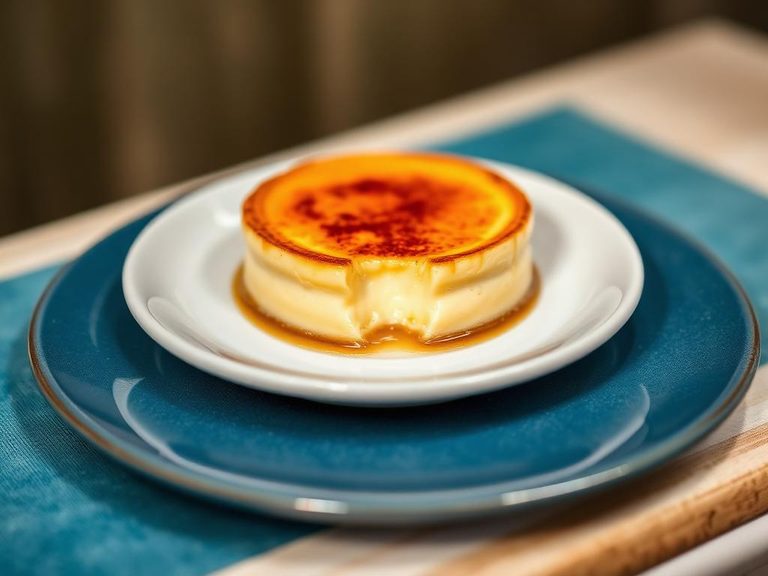
This is a smooth, wobbly custard made from a dry mix and whole milk, offering a rich, creamy texture with a comforting, sweet, and eggy flavor. Nutritionally, it provides a modest protein boost from the eggs and milk, alongside a noticeable carbohydrate content from added sugars. It's a classic, simple dessert that feels both nostalgic and satisfying.
Calorie split: 13% protein · 58% carbs · 29% fat
↓ Full nutrition💚 Why it's loved
People love it for its velvety, spoonable texture and the deep, comforting flavor of cooked eggs and vanilla. It's a versatile canvas that can be served warm or chilled, and is a nostalgic staple in many home kitchens and dessert menus.
⚠️ Watch-outs & how to enjoy it better
The primary downside is its significant sugar content, which can cause a rapid blood-sugar spike. To counteract this, enjoy a smaller portion alongside a source of protein or healthy fat (like a handful of nuts) to slow absorption. Those with dairy or egg allergies must avoid it entirely.
Key benefits
- Good source of high-quality protein from eggs and milk
- Provides calcium for bone health
- Offers energy-dense calories for quick fuel
- Contains essential vitamins like B12 and riboflavin
- Simple, digestible comfort food
🍽️ Popular dishes



🌍 Where it's eaten
💡 Did you know?
The 'wobble' of a perfectly set custard is due to the egg proteins forming a delicate, gel-like network that traps liquid; overcooking breaks this network, causing the custard to weep or curdle.
Full nutrition (USDA data · scales with serving)
| Water | 73.5 g |
| Energy | 122 kcal |
| Energy | 512 kj |
| Protein | 4.0 g |
| Total lipid (fat) | 4.0 g |
| Ash | 0.97 g |
| Carbohydrate, by difference | 17.6 g |
| Fiber, total dietary | 0.00 g |
| Total Sugars | 4.8 g |
| Sucrose | 0.00 g |
| Glucose | 0.00 g |
| Fructose | 0.00 g |
| Lactose | 4.6 g |
| Maltose | 0.00 g |
| Galactose | 0.00 g |
| Calcium, Ca | 139 mg |
| Iron, Fe | 0.34 mg |
| Magnesium, Mg | 16.0 mg |
| Phosphorus, P | 130 mg |
| Potassium, K | 207 mg |
| Sodium, Na | 84.0 mg |
| Zinc, Zn | 0.51 mg |
| Copper, Cu | 0.03 mg |
| Manganese, Mn | 0.01 mg |
| Selenium, Se | 6.0 ug |
| Vitamin C, total ascorbic acid | 0.10 mg |
| Thiamin | 0.06 mg |
| Riboflavin | 0.22 mg |
| Niacin | 0.13 mg |
| Pantothenic acid | 0.70 mg |
| Vitamin B-6 | 0.06 mg |
| Folate, total | 9.0 ug |
| Folic acid | 0.00 ug |
| Folate, food | 9.0 ug |
| Folate, DFE | 9.0 ug |
| Choline, total | 11.8 mg |
| Betaine | 0.60 mg |
| Vitamin B-12 | 0.52 ug |
| Vitamin B-12, added | 0.00 ug |
| Vitamin A, RAE | 52.0 ug |
| Retinol | 52.0 ug |
| Carotene, beta | 6.0 ug |
| Carotene, alpha | 0.00 ug |
| Cryptoxanthin, beta | 0.00 ug |
| Vitamin A, IU | 182 iu |
| Lycopene | 0.00 ug |
| Lutein + zeaxanthin | 0.00 ug |
| Vitamin E (alpha-tocopherol) | 0.06 mg |
| Vitamin E, added | 0.00 mg |
| Tocopherol, beta | 0.00 mg |
| Tocopherol, gamma | 0.00 mg |
| Tocopherol, delta | 0.00 mg |
| Tocotrienol, alpha | 0.00 mg |
| Tocotrienol, beta | 0.00 mg |
| Tocotrienol, gamma | 0.00 mg |
| Tocotrienol, delta | 0.00 mg |
| Vitamin D (D2 + D3), International Units | 47.0 iu |
| Vitamin D (D2 + D3) | 1.2 ug |
| Vitamin D3 (cholecalciferol) | 1.2 ug |
| Vitamin K (phylloquinone) | 0.20 ug |
| Vitamin K (Dihydrophylloquinone) | 0.00 ug |
| Vitamin K (Menaquinone-4) | 0.90 ug |
| Alcohol, ethyl | 0.00 g |
| Caffeine | 0.00 mg |
| Theobromine | 0.00 mg |
Fat & fatty acid profile (per 100g)
| Fatty acids, total saturated | 2.0 g |
| SFA 4:0 | 0.07 g |
| SFA 6:0 | 0.07 g |
| SFA 8:0 | 0.07 g |
| SFA 10:0 | 0.07 g |
| SFA 12:0 | 0.07 g |
| SFA 13:0 | 0.00 g |
| SFA 14:0 | 0.28 g |
| SFA 15:0 | 0.00 g |
| SFA 16:0 | 0.99 g |
| SFA 17:0 | 0.00 g |
| SFA 18:0 | 0.41 g |
| SFA 20:0 | 0.00 g |
| SFA 22:0 | 0.00 g |
| SFA 24:0 | 0.00 g |
| Fatty acids, total monounsaturated | 1.1 g |
| MUFA 14:1 | 0.00 g |
| MUFA 16:1 | 0.03 g |
| MUFA 18:1 | 1.1 g |
| MUFA 20:1 | 0.00 g |
| MUFA 22:1 | 0.00 g |
| Fatty acids, total polyunsaturated | 0.31 g |
| PUFA 18:2 | 0.22 g |
| PUFA 18:3 | 0.07 g |
| PUFA 20:4 | 0.01 g |
| PUFA 20:5 n-3 (EPA) | 0.00 g |
| PUFA 22:5 n-3 (DPA) | 0.00 g |
| PUFA 22:6 n-3 (DHA) | 0.00 g |
| Cholesterol | 51.0 mg |
Amino acid profile (per 100g)
| Tryptophan | 0.08 g |
| Threonine | 0.19 g |
| Isoleucine | 0.21 g |
| Leucine | 0.34 g |
| Lysine | 0.21 g |
| Methionine | 0.09 g |
| Cystine | 0.04 g |
| Phenylalanine | 0.17 g |
| Tyrosine | 0.18 g |
| Valine | 0.23 g |
| Arginine | 0.13 g |
| Histidine | 0.09 g |
| Alanine | 0.15 g |
| Aspartic acid | 0.32 g |
| Glutamic acid | 0.74 g |
| Glycine | 0.10 g |
| Proline | 0.36 g |
| Serine | 0.17 g |
FAQ
Can I use low-fat milk instead of whole milk?
Yes, but the custard will be less rich and creamy, and may have a slightly leaner, less stable set. Whole milk contributes to a smoother, more luxurious texture.
Why did my custard turn out grainy?
Graininess usually means the eggs were cooked too quickly or at too high a heat, causing the proteins to scramble. Use a gentle, indirect heat (like a water bath) and stir constantly.
Is this the same as pudding?
It depends on the region. In the UK, 'pudding' often refers to this type of egg custard. In the US, 'pudding' typically means a starch-thickened, eggless dessert, which is different.
Nutrient density (calculated · NRF9.3)
Nutrient Rich Foods index: beneficial nutrients (protein, fiber, vitamins, minerals) minus saturated fat, added sugar & sodium, per 100 kcal.
NRF9.3 index — Fulgoni, Keast & Drewnowski, 2009. Computed from USDA nutrients.
Weight-loss friendliness (composite index)
Energy density 1.22 kcal/g · 13% calories from protein · 0.0 g fiber · 4.8 g sugar per 100 g.
Composite of energy density (Rolls et al., 1999), protein & fiber satiety, minus sugar. A calculated heuristic — ranks satiety-per-calorie, not a clinical measure.
Dietary load (calculated from USDA values)
Potential renal acid load. Positive = acid-forming, negative = alkaline-forming.
Sodium-to-potassium ratio: 0.41 (lower is better — aim for ≤ 1)
Sodium:potassium per WHO potassium guidance. Computed from USDA nutrients.