

BURGER KING, french fries
Whole food · Fast Foods
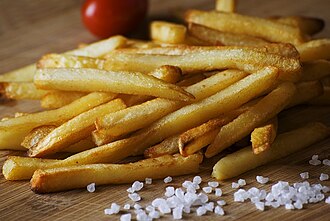
Photo: Wikipedia
Burger King's french fries are golden, crispy on the outside with a fluffy, starchy interior, offering a satisfying salty crunch with each bite. Nutritionally, they are a significant source of quick energy from carbohydrates, with a moderate fat content from frying. A 100g serving provides a notable 2.9g of dietary fiber, contributing to daily intake.
Calorie split: 5% protein · 55% carbs · 40% fat
↓ Full nutrition💚 Why it's loved
People love them for the irresistible combination of a crispy, salty exterior and a soft, potatoey inside. They are a universal comfort food, perfectly versatile as a standalone snack or the essential side to a burger.
⚠️ Watch-outs & how to enjoy it better
The high glycemic load can cause rapid blood-sugar spikes, and the frying process adds significant fat and calories. Those monitoring sodium, blood sugar, or fat intake should be cautious. To counteract, pair with a protein source (like a grilled chicken sandwich) to slow digestion, practice portion control, and consider sharing a larger size.
Key benefits
- Provides quick, accessible energy from carbohydrates
- Contains dietary fiber (2.9g per 100g)
- Offers a small amount of plant-based protein (3.23g per 100g)
- A familiar, comforting food for many cultures
🍽️ Popular dishes
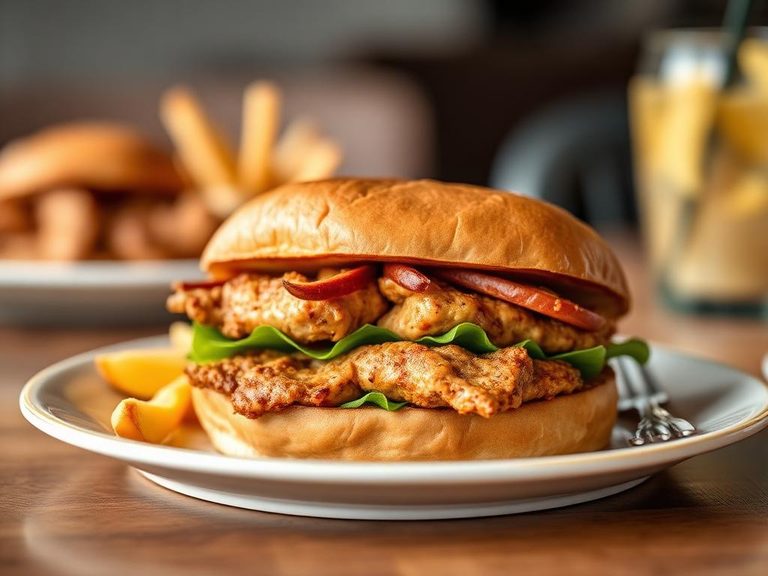

🌍 Where it's eaten
💡 Did you know?
Burger King's fries were reformulated in 2011 to be coated in a thin layer of potato-based batter to maintain crispiness longer, a technique different from their previous recipe.
Full nutrition (USDA data · scales with serving)
| Water | 44.0 g |
| Energy | 280 kcal |
| Energy | 1172 kj |
| Protein | 3.2 g |
| Total lipid (fat) | 12.5 g |
| Ash | 1.6 g |
| Carbohydrate, by difference | 38.7 g |
| Fiber, total dietary | 2.9 g |
| Total Sugars | 0.51 g |
| Sucrose | 0.00 g |
| Glucose | 0.51 g |
| Fructose | 0.00 g |
| Lactose | 0.00 g |
| Maltose | 0.00 g |
| Galactose | 0.00 g |
| Starch | 36.0 g |
| Calcium, Ca | 17.0 mg |
| Iron, Fe | 0.73 mg |
| Magnesium, Mg | 27.0 mg |
| Phosphorus, P | 119 mg |
| Potassium, K | 467 mg |
| Sodium, Na | 279 mg |
| Zinc, Zn | 0.44 mg |
| Copper, Cu | 0.13 mg |
| Manganese, Mn | 0.21 mg |
| Vitamin C, total ascorbic acid | 2.2 mg |
| Thiamin | 0.14 mg |
| Riboflavin | 0.03 mg |
| Niacin | 2.2 mg |
| Pantothenic acid | 0.49 mg |
| Vitamin B-6 | 0.33 mg |
| Choline, total | 28.9 mg |
| Betaine | 0.50 mg |
| Vitamin E (alpha-tocopherol) | 2.5 mg |
| Tocopherol, beta | 0.06 mg |
| Tocopherol, gamma | 4.8 mg |
| Tocopherol, delta | 0.52 mg |
| Tocotrienol, alpha | 0.08 mg |
| Tocotrienol, beta | 0.00 mg |
| Tocotrienol, gamma | 0.10 mg |
| Tocotrienol, delta | 0.00 mg |
| Vitamin K (phylloquinone) | 11.1 ug |
| Vitamin K (Dihydrophylloquinone) | 58.4 ug |
Fat & fatty acid profile (per 100g)
| Fatty acids, total saturated | 2.1 g |
| SFA 4:0 | 0.01 g |
| SFA 6:0 | 0.00 g |
| SFA 8:0 | 0.01 g |
| SFA 10:0 | 0.01 g |
| SFA 12:0 | 0.00 g |
| SFA 14:0 | 0.03 g |
| SFA 15:0 | 0.00 g |
| SFA 16:0 | 1.7 g |
| SFA 17:0 | 0.01 g |
| SFA 18:0 | 0.31 g |
| SFA 20:0 | 0.04 g |
| SFA 22:0 | 0.02 g |
| SFA 24:0 | 0.02 g |
| Fatty acids, total monounsaturated | 3.3 g |
| MUFA 14:1 | 0.00 g |
| MUFA 15:1 | 0.00 g |
| MUFA 16:1 | 0.03 g |
| MUFA 16:1 c | 0.03 g |
| MUFA 17:1 | 0.01 g |
| MUFA 18:1 | 3.2 g |
| MUFA 18:1 c | 3.2 g |
| MUFA 20:1 | 0.04 g |
| MUFA 22:1 | 0.00 g |
| MUFA 22:1 c | 0.00 g |
| MUFA 24:1 c | 0.00 g |
| Fatty acids, total polyunsaturated | 5.9 g |
| PUFA 18:2 | 5.6 g |
| PUFA 18:2 n-6 c,c | 5.6 g |
| PUFA 18:2 CLAs | 0.01 g |
| PUFA 18:3 | 0.29 g |
| PUFA 18:3 n-3 c,c,c (ALA) | 0.27 g |
| PUFA 18:3 n-6 c,c,c | 0.02 g |
| PUFA 18:4 | 0.00 g |
| PUFA 20:2 n-6 c,c | 0.00 g |
| PUFA 20:3 | 0.00 g |
| PUFA 20:3 n-3 | 0.00 g |
| PUFA 20:3 n-6 | 0.00 g |
| PUFA 20:4 | 0.00 g |
| PUFA 20:5 n-3 (EPA) | 0.00 g |
| PUFA 22:4 | 0.00 g |
| PUFA 22:5 n-3 (DPA) | 0.00 g |
| PUFA 22:6 n-3 (DHA) | 0.00 g |
| Fatty acids, total trans | 0.05 g |
| Fatty acids, total trans-monoenoic | 0.01 g |
| TFA 16:1 t | 0.00 g |
| TFA 18:1 t | 0.01 g |
| TFA 22:1 t | 0.00 g |
| TFA 18:2 t not further defined | 0.03 g |
| Fatty acids, total trans-polyenoic | 0.03 g |
Amino acid profile (per 100g)
| Tryptophan | 0.03 g |
| Threonine | 0.11 g |
| Isoleucine | 0.11 g |
| Leucine | 0.17 g |
| Lysine | 0.27 g |
| Methionine | 0.06 g |
| Cystine | 0.01 g |
| Phenylalanine | 0.15 g |
| Tyrosine | 0.10 g |
| Valine | 0.16 g |
| Arginine | 0.18 g |
| Histidine | 0.07 g |
| Alanine | 0.10 g |
| Aspartic acid | 0.68 g |
| Glutamic acid | 0.50 g |
| Glycine | 0.10 g |
| Proline | 0.13 g |
| Serine | 0.11 g |
| Hydroxyproline | 0.00 g |
FAQ
Are Burger King fries vegan?
In the United States, Burger King's fries are cooked in a shared fryer with products that contain milk, so they are not certified vegan. In some other countries, they may be cooked in dedicated fryers and are considered vegan.
Why are they sometimes soggy?
Sogginess typically occurs when fries are left in a closed container (like a bag or box) after frying. The steam from the hot fries gets trapped, softening the crispy exterior. Eating them immediately is best.
Do they contain gluten?
The fries themselves are made from potatoes, which are gluten-free. However, Burger King's standard recipe includes a wheat-based coating for crispiness, so they contain gluten and are not safe for those with celiac disease.
Nutrient density (calculated · NRF9.3)
Nutrient Rich Foods index: beneficial nutrients (protein, fiber, vitamins, minerals) minus saturated fat, added sugar & sodium, per 100 kcal.
NRF9.3 index — Fulgoni, Keast & Drewnowski, 2009. Computed from USDA nutrients.
Weight-loss friendliness (composite index)
Energy density 2.80 kcal/g · 5% calories from protein · 2.9 g fiber · 0.5 g sugar per 100 g.
Composite of energy density (Rolls et al., 1999), protein & fiber satiety, minus sugar. A calculated heuristic — ranks satiety-per-calorie, not a clinical measure.
Dietary load (calculated from USDA values)
Potential renal acid load. Positive = acid-forming, negative = alkaline-forming.
Sodium-to-potassium ratio: 0.60 (lower is better — aim for ≤ 1)
Sodium:potassium per WHO potassium guidance. Computed from USDA nutrients.