

Beef, variety meats and by-products, tongue, cooked, simmered
Whole food · Beef Products

Photo: Wikipedia
Beef tongue is a rich, muscular organ meat with a surprisingly tender, velvety texture when simmered low and slow. Its flavor is deeply beefy but milder and more delicate than a steak, with a clean, savory finish. Nutritionally, it's a powerhouse of protein and healthy fats, containing virtually no carbohydrates.
Calorie split: 28% protein · 0% carbs · 72% fat
↓ Full nutrition💚 Why it's loved
People love it for its unique, melt-in-your-mouth texture and profound umami flavor that absorbs seasonings beautifully. It's a prized delicacy in many cultures, celebrated for its versatility in everything from tacos to sandwiches.
⚠️ Watch-outs & how to enjoy it better
The primary concern is its high cholesterol and saturated fat content, which may require moderation for some individuals. To balance this, pair it with fiber-rich vegetables or legumes and practice portion control. The initial preparation (peeling the skin) can also be intimidating for beginners.
Key benefits
- Excellent source of complete protein for muscle maintenance.
- Rich in iron, zinc, and B vitamins, especially B12.
- High in healthy monounsaturated fats.
- Zero carbohydrates, suitable for ketogenic diets.
🍽️ Popular dishes
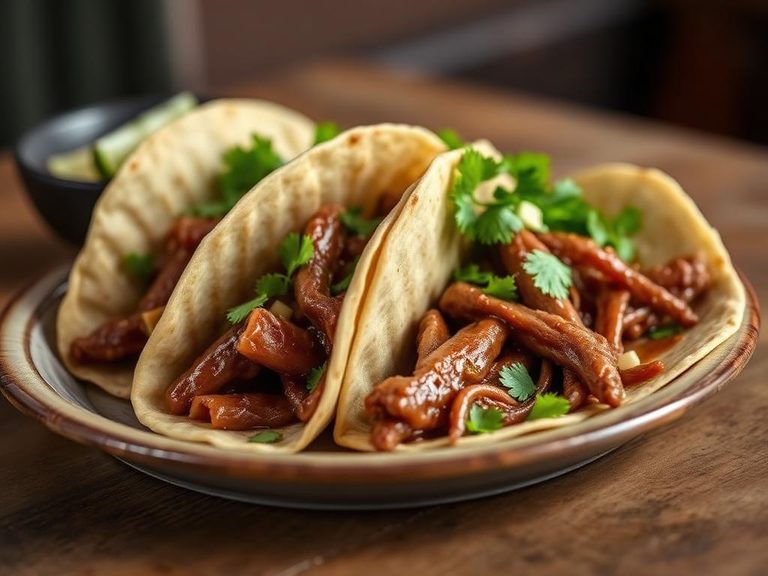
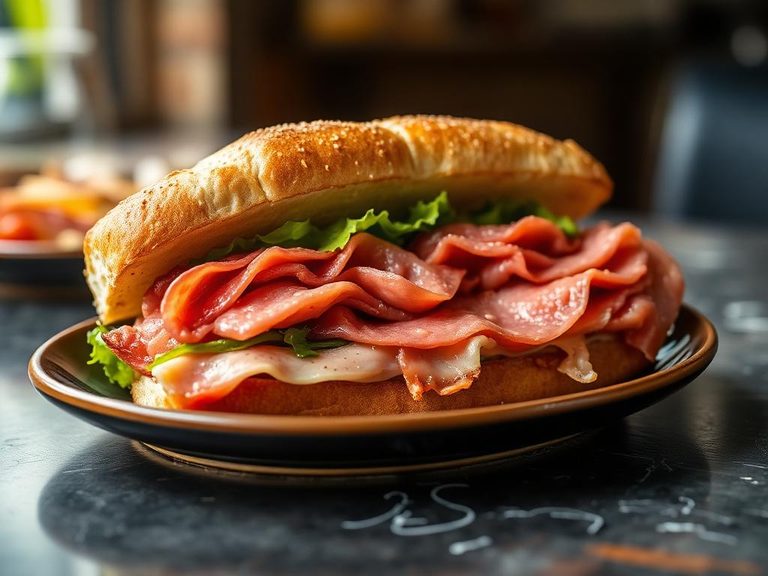
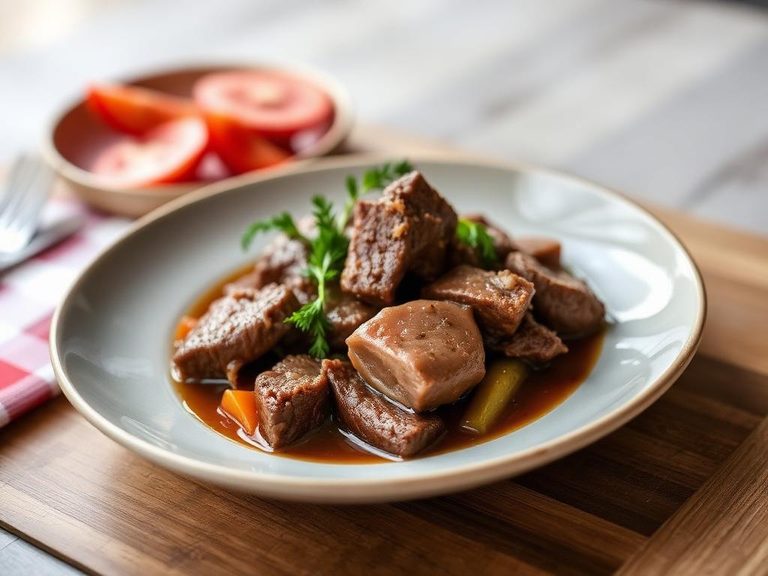

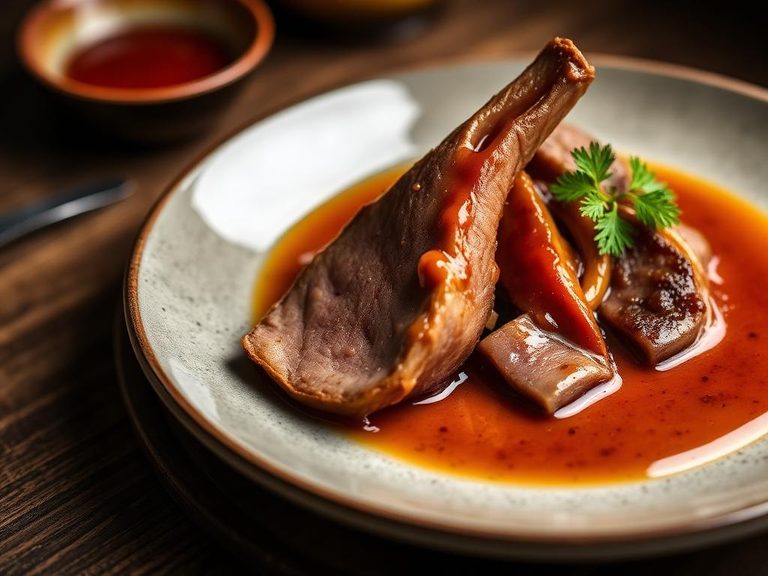
🌍 Where it's eaten
💡 Did you know?
The bumpy texture on the surface of a beef tongue is made of thousands of tiny taste buds, just like a human tongue.
Full nutrition (USDA data · scales with serving)
| Water | 57.9 g |
| Energy | 284 kcal |
| Energy | 1186 kj |
| Protein | 19.3 g |
| Total lipid (fat) | 22.3 g |
| Ash | 0.69 g |
| Carbohydrate, by difference | 0.00 g |
| Fiber, total dietary | 0.00 g |
| Total Sugars | 0.00 g |
| Calcium, Ca | 5.0 mg |
| Iron, Fe | 2.6 mg |
| Magnesium, Mg | 15.0 mg |
| Phosphorus, P | 145 mg |
| Potassium, K | 184 mg |
| Sodium, Na | 65.0 mg |
| Zinc, Zn | 4.1 mg |
| Copper, Cu | 0.15 mg |
| Manganese, Mn | 0.02 mg |
| Selenium, Se | 13.2 ug |
| Vitamin C, total ascorbic acid | 1.3 mg |
| Thiamin | 0.02 mg |
| Riboflavin | 0.29 mg |
| Niacin | 3.5 mg |
| Pantothenic acid | 0.74 mg |
| Vitamin B-6 | 0.15 mg |
| Folate, total | 7.0 ug |
| Folic acid | 0.00 ug |
| Folate, food | 7.0 ug |
| Folate, DFE | 7.0 ug |
| Choline, total | 155 mg |
| Betaine | 2.8 mg |
| Vitamin B-12 | 3.1 ug |
| Vitamin B-12, added | 0.00 ug |
| Vitamin A, RAE | 0.00 ug |
| Retinol | 0.00 ug |
| Carotene, beta | 0.00 ug |
| Carotene, alpha | 0.00 ug |
| Cryptoxanthin, beta | 0.00 ug |
| Vitamin A, IU | 0.00 iu |
| Lycopene | 0.00 ug |
| Lutein + zeaxanthin | 0.00 ug |
| Vitamin E (alpha-tocopherol) | 0.30 mg |
| Vitamin E, added | 0.00 mg |
| Tocopherol, beta | 0.00 mg |
| Tocopherol, gamma | 0.03 mg |
| Tocopherol, delta | 0.00 mg |
| Tocotrienol, alpha | 0.05 mg |
| Tocotrienol, beta | 0.00 mg |
| Tocotrienol, gamma | 0.00 mg |
| Tocotrienol, delta | 0.00 mg |
| Vitamin D (D2 + D3), International Units | 15.0 iu |
| Vitamin D (D2 + D3) | 0.40 ug |
| Vitamin D3 (cholecalciferol) | 0.40 ug |
| Vitamin K (phylloquinone) | 1.2 ug |
| Alcohol, ethyl | 0.00 g |
| Caffeine | 0.00 mg |
| Theobromine | 0.00 mg |
Fat & fatty acid profile (per 100g)
| Fatty acids, total saturated | 8.1 g |
| SFA 4:0 | 0.00 g |
| SFA 6:0 | 0.00 g |
| SFA 8:0 | 0.00 g |
| SFA 10:0 | 0.00 g |
| SFA 12:0 | 0.02 g |
| SFA 14:0 | 0.73 g |
| SFA 15:0 | 0.13 g |
| SFA 16:0 | 4.6 g |
| SFA 17:0 | 0.25 g |
| SFA 18:0 | 2.3 g |
| SFA 20:0 | 0.00 g |
| SFA 22:0 | 0.00 g |
| Fatty acids, total monounsaturated | 10.1 g |
| MUFA 14:1 | 0.19 g |
| MUFA 15:1 | 0.00 g |
| MUFA 16:1 | 0.93 g |
| MUFA 18:1 | 8.9 g |
| MUFA 20:1 | 0.08 g |
| MUFA 22:1 | 0.00 g |
| Fatty acids, total polyunsaturated | 0.75 g |
| PUFA 18:2 | 0.53 g |
| PUFA 18:3 | 0.09 g |
| PUFA 18:3 n-3 c,c,c (ALA) | 0.07 g |
| PUFA 18:3 n-6 c,c,c | 0.00 g |
| PUFA 18:4 | 0.00 g |
| PUFA 20:2 n-6 c,c | 0.00 g |
| PUFA 20:3 | 0.00 g |
| PUFA 20:4 | 0.06 g |
| PUFA 20:5 n-3 (EPA) | 0.00 g |
| PUFA 22:5 n-3 (DPA) | 0.00 g |
| PUFA 22:6 n-3 (DHA) | 0.00 g |
| Fatty acids, total trans | 0.84 g |
| Cholesterol | 132 mg |
Amino acid profile (per 100g)
Estimated from Beef, variety meats and by-products, mechanically separated beef, raw — USDA does not publish this profile for Beef.
| Tryptophan | 0.17 g |
| Threonine | 0.47 g |
| Isoleucine | 0.58 g |
| Leucine | 1.2 g |
| Lysine | 1.2 g |
| Methionine | 0.43 g |
| Cystine | 0.23 g |
| Phenylalanine | 0.64 g |
| Tyrosine | 0.38 g |
| Valine | 0.92 g |
| Arginine | 1.2 g |
| Histidine | 0.44 g |
| Alanine | 1.0 g |
| Aspartic acid | 1.3 g |
| Glutamic acid | 2.1 g |
| Glycine | 1.2 g |
| Proline | 0.92 g |
| Serine | 0.57 g |
FAQ
How do you prepare beef tongue?
It must be simmered for 2-3 hours until tender, then the thick outer skin is peeled off while still warm. It can then be sliced and used in various recipes.
Is beef tongue fatty?
Yes, it has a significant fat content (about 22g per 100g cooked), which contributes to its tender texture and rich flavor. Most of this is monounsaturated fat.
What does beef tongue taste like?
It has a very beefy flavor, but it's milder and more delicate than a steak. Its signature characteristic is its exceptionally smooth, tender, and almost buttery texture.
Nutrient density (calculated · NRF9.3)
Nutrient Rich Foods index: beneficial nutrients (protein, fiber, vitamins, minerals) minus saturated fat, added sugar & sodium, per 100 kcal.
NRF9.3 index — Fulgoni, Keast & Drewnowski, 2009. Computed from USDA nutrients.
Weight-loss friendliness (composite index)
Energy density 2.84 kcal/g · 27% calories from protein · 0.0 g fiber · 0.0 g sugar per 100 g.
Composite of energy density (Rolls et al., 1999), protein & fiber satiety, minus sugar. A calculated heuristic — ranks satiety-per-calorie, not a clinical measure.
Dietary load (calculated from USDA values)
Potential renal acid load. Positive = acid-forming, negative = alkaline-forming.
Sodium-to-potassium ratio: 0.35 (lower is better — aim for ≤ 1)
Sodium:potassium per WHO potassium guidance. Computed from USDA nutrients.