

Beef, New Zealand, imported, brisket navel end, separable lean and fat, cooked, braised
Whole food · Beef Products

Photo: Wikipedia
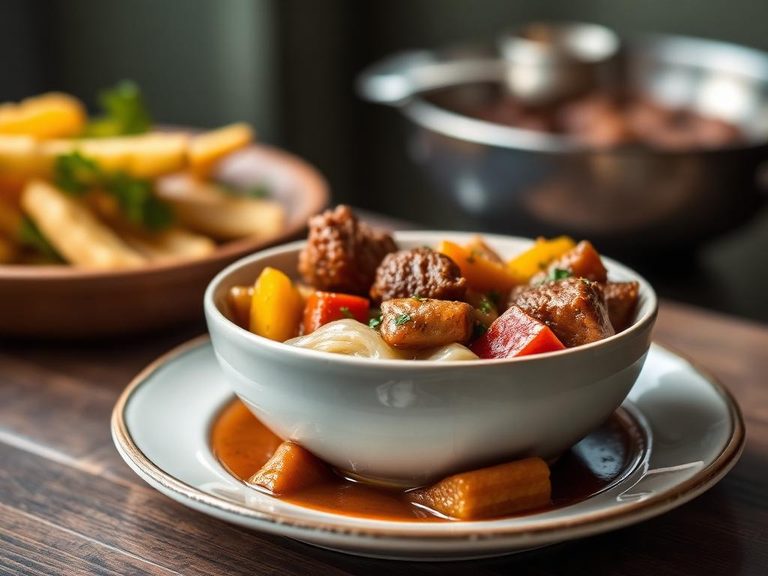
This is the rich, fatty navel end of a New Zealand beef brisket, slow-braised to melting tenderness. The result is a deeply savory, beefy flavor with a luxuriously soft, almost unctuous texture where the fat has rendered and infused the lean meat. It's a high-energy, protein-packed cut with virtually no carbohydrates.
Calorie split: 18% protein · 0% carbs · 82% fat
↓ Full nutrition💚 Why it's loved
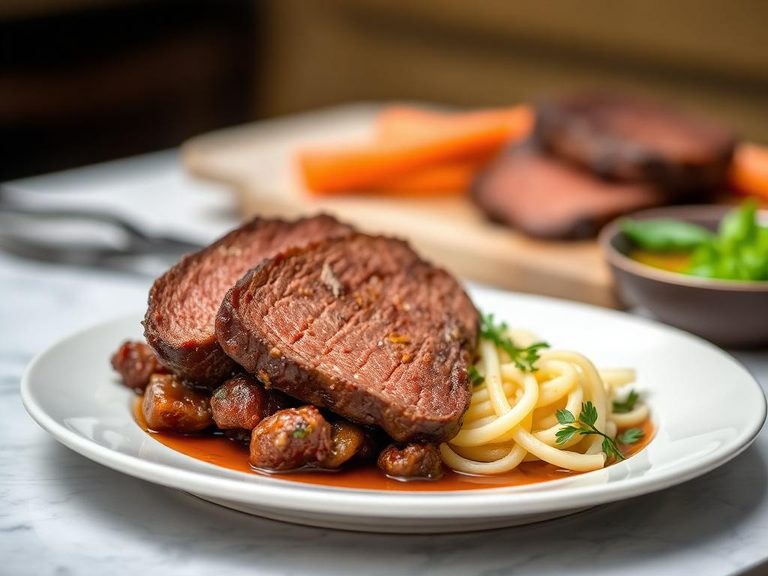
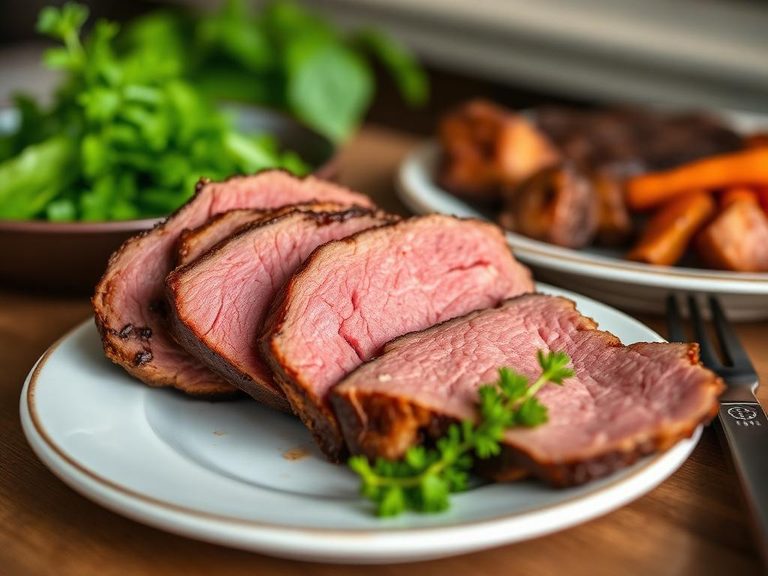
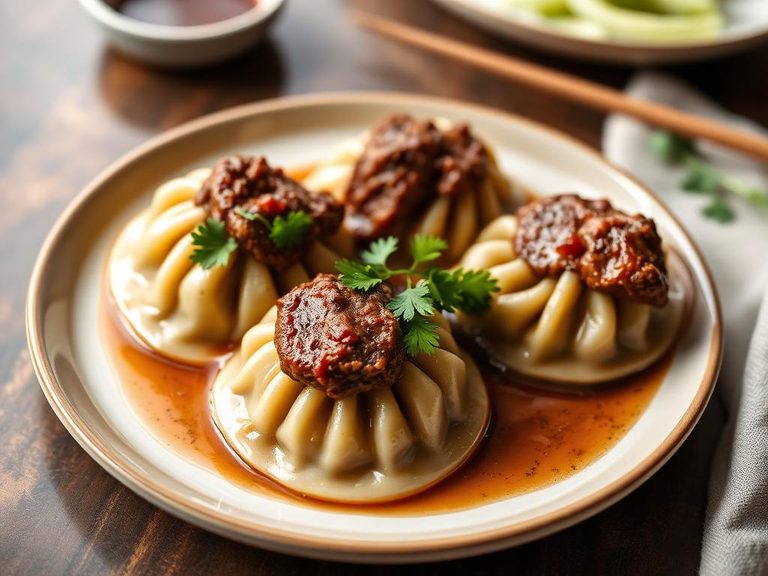
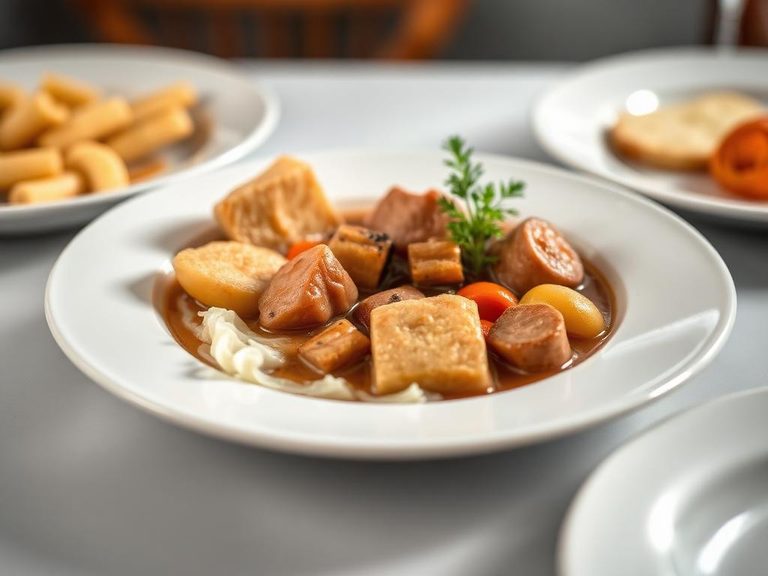
People adore it for its profound, beefy flavor and the luxurious, melt-in-your-mouth texture achieved only through slow cooking. It's a versatile centerpiece, equally at home in a rustic stew, a refined braise, or shredded for sandwiches.
⚠️ Watch-outs & how to enjoy it better
The high saturated fat content means it's calorie-dense, so portion control is key for those managing energy intake. Its richness can feel heavy to some palates. To counteract this, pair it with a generous portion of fibrous, non-starchy vegetables (like braised greens or roasted carrots) to add volume and balance the meal.
Key benefits
- Excellent source of high-quality protein for muscle maintenance.
- Rich in bioavailable iron, zinc, and B vitamins (especially B12).
- Provides conjugated linoleic acid (CLA), a beneficial fatty acid found in grass-fed beef.
- The high fat content makes it very satiating, helping with fullness.
🍽️ Popular dishes

🌍 Where it's eaten
💡 Did you know?
The 'navel' end gets its name from its resemblance to a belly button, and this specific cut is prized in barbecue for its higher fat content which keeps the meat moist during long, slow smoking.
Full nutrition (USDA data · scales with serving)
| Water | 39.0 g |
| Energy | 453 kcal |
| Energy | 1893 kj |
| Protein | 20.1 g |
| Total lipid (fat) | 41.3 g |
| Ash | 0.66 g |
| Carbohydrate, by difference | 0.00 g |
| Fiber, total dietary | 0.00 g |
| Total Sugars | 0.00 g |
| Calcium, Ca | 11.0 mg |
| Iron, Fe | 1.3 mg |
| Magnesium, Mg | 11.0 mg |
| Phosphorus, P | 94.0 mg |
| Potassium, K | 137 mg |
| Sodium, Na | 33.0 mg |
| Zinc, Zn | 3.6 mg |
| Copper, Cu | 0.05 mg |
| Manganese, Mn | 0.00 mg |
| Selenium, Se | 3.1 ug |
| Vitamin C, total ascorbic acid | 0.00 mg |
| Thiamin | 0.04 mg |
| Riboflavin | 0.07 mg |
| Niacin | 2.0 mg |
| Pantothenic acid | 0.04 mg |
| Vitamin B-6 | 0.08 mg |
| Vitamin B-12 | 0.94 ug |
| Vitamin B-12, added | 0.00 ug |
| Vitamin A, RAE | 10.0 ug |
| Retinol | 10.0 ug |
| Carotene, beta | 0.00 ug |
| Carotene, alpha | 0.00 ug |
| Cryptoxanthin, beta | 0.00 ug |
| Vitamin A, IU | 32.0 iu |
| Lycopene | 0.00 ug |
| Lutein + zeaxanthin | 0.00 ug |
| Vitamin E (alpha-tocopherol) | 0.43 mg |
| Vitamin E, added | 0.00 mg |
| Vitamin D (D2 + D3), International Units | 10.0 iu |
| Vitamin D (D2 + D3) | 0.30 ug |
| Vitamin D3 (cholecalciferol) | 0.30 ug |
| Alcohol, ethyl | 0.00 g |
| Caffeine | 0.00 mg |
| Theobromine | 0.00 mg |
Fat & fatty acid profile (per 100g)
| Fatty acids, total saturated | 15.5 g |
| SFA 4:0 | 0.00 g |
| SFA 6:0 | 0.00 g |
| SFA 8:0 | 0.00 g |
| SFA 10:0 | 0.01 g |
| SFA 12:0 | 0.04 g |
| SFA 14:0 | 1.0 g |
| SFA 16:0 | 8.0 g |
| SFA 17:0 | 0.53 g |
| SFA 18:0 | 5.9 g |
| SFA 20:0 | 0.04 g |
| SFA 22:0 | 0.02 g |
| SFA 24:0 | 0.00 g |
| Fatty acids, total monounsaturated | 14.4 g |
| MUFA 14:1 | 0.28 g |
| MUFA 15:1 | 0.00 g |
| MUFA 16:1 | 1.3 g |
| MUFA 16:1 c | 1.2 g |
| MUFA 17:1 | 0.00 g |
| MUFA 18:1 | 12.8 g |
| MUFA 18:1 c | 11.6 g |
| MUFA 20:1 | 0.03 g |
| MUFA 22:1 | 0.00 g |
| MUFA 22:1 c | 0.00 g |
| MUFA 24:1 c | 0.00 g |
| Fatty acids, total polyunsaturated | 0.99 g |
| PUFA 18:2 | 0.65 g |
| PUFA 18:2 n-6 c,c | 0.27 g |
| PUFA 18:2 CLAs | 0.36 g |
| PUFA 18:3 | 0.27 g |
| PUFA 18:3 n-3 c,c,c (ALA) | 0.27 g |
| PUFA 18:3 n-6 c,c,c | 0.00 g |
| PUFA 18:4 | 0.00 g |
| PUFA 20:2 n-6 c,c | 0.00 g |
| PUFA 20:3 | 0.01 g |
| PUFA 20:3 n-3 | 0.00 g |
| PUFA 20:3 n-6 | 0.01 g |
| PUFA 20:4 | 0.02 g |
| PUFA 20:4 n-6 | 0.02 g |
| PUFA 20:5 n-3 (EPA) | 0.01 g |
| PUFA 22:5 n-3 (DPA) | 0.04 g |
| PUFA 22:6 n-3 (DHA) | 0.00 g |
| Fatty acids, total trans | 1.3 g |
| Fatty acids, total trans-monoenoic | 1.2 g |
| TFA 16:1 t | 0.07 g |
| TFA 18:1 t | 1.2 g |
| TFA 18:2 t,t | 0.01 g |
| Fatty acids, total trans-polyenoic | 0.01 g |
| Cholesterol | 72.0 mg |
Amino acid profile (per 100g)
| Tryptophan | 0.21 g |
| Threonine | 0.73 g |
| Isoleucine | 0.84 g |
| Leucine | 1.5 g |
| Lysine | 1.6 g |
| Methionine | 0.66 g |
| Phenylalanine | 0.78 g |
| Tyrosine | 0.68 g |
| Valine | 0.89 g |
| Arginine | 1.3 g |
| Histidine | 0.73 g |
| Alanine | 1.0 g |
| Glutamic acid | 2.8 g |
| Glycine | 1.1 g |
| Proline | 0.65 g |
| Serine | 0.71 g |
FAQ
No. Corned beef is brisket that has been cured in a salt brine (the 'corns' refer to coarse salt). This is fresh, uncured brisket that has been braised.
The navel end is the fattier portion of the brisket. This intramuscular fat (marbling) and the surrounding fat cap are what make it ideal for slow, moist cooking methods, as the fat renders and bastes the meat, creating tenderness.
Low and slow is the rule. Braise it in liquid (like stock, wine, or tomatoes) in a covered pot at a low oven temperature (around 300°F / 150°C) for several hours, or use a pressure cooker/Instant Pot to dramatically reduce cooking time while achieving similar tenderness.
Nutrient density (calculated · NRF9.3)
Nutrient Rich Foods index: beneficial nutrients (protein, fiber, vitamins, minerals) minus saturated fat, added sugar & sodium, per 100 kcal.
NRF9.3 index — Fulgoni, Keast & Drewnowski, 2009. Computed from USDA nutrients.
Weight-loss friendliness (composite index)
Energy density 4.53 kcal/g · 18% calories from protein · 0.0 g fiber · 0.0 g sugar per 100 g.
Composite of energy density (Rolls et al., 1999), protein & fiber satiety, minus sugar. A calculated heuristic — ranks satiety-per-calorie, not a clinical measure.
Dietary load (calculated from USDA values)
Potential renal acid load. Positive = acid-forming, negative = alkaline-forming.
Sodium-to-potassium ratio: 0.24 (lower is better — aim for ≤ 1)
Sodium:potassium per WHO potassium guidance. Computed from USDA nutrients.