

Snacks, vegetable chips, made from garden vegetables
Whole food · Snacks

Photo: Wikipedia
These are crispy, dehydrated or fried slices of mixed garden vegetables, such as beets, carrots, and parsnips, offering a satisfying crunch with an earthy, slightly sweet flavor. Nutritionally, they are a calorie-dense snack, packing 473 kcal per 100g with a significant carbohydrate content from the vegetables themselves. The fiber content of 4.7g per 100g provides some digestive benefit, but they are best enjoyed in moderation.
Calorie split: 5% protein · 51% carbs · 44% fat
↓ Full nutrition💚 Why it's loved
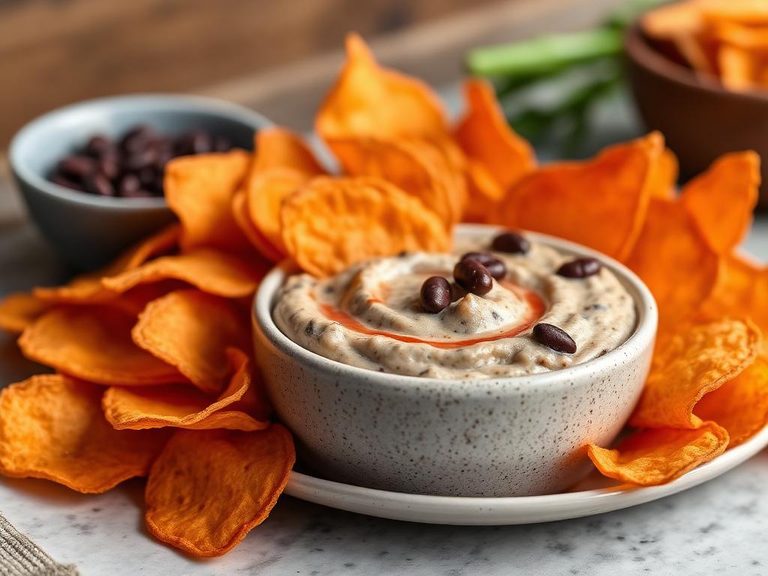
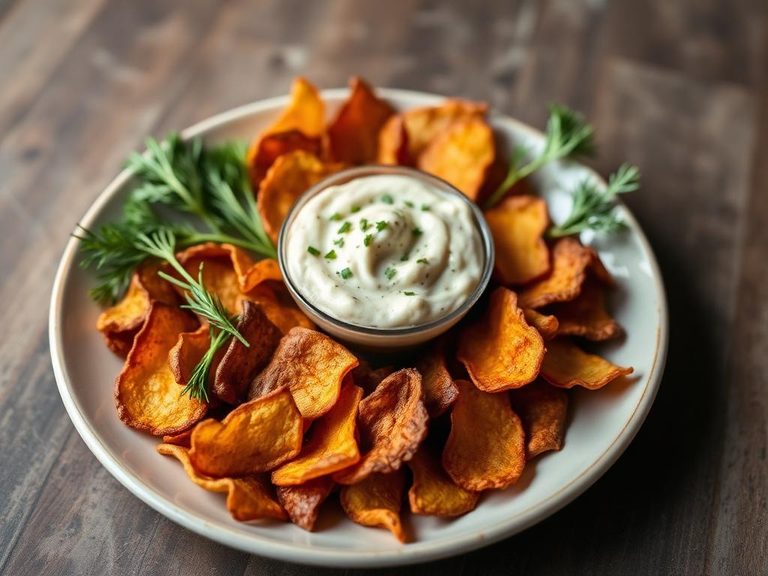
People love them for their satisfying, shattering crunch and the natural, earthy sweetness of root vegetables like beets and sweet potatoes, which provides a more complex flavor profile than standard chips. Their versatility makes them a popular pairing for dips like hummus or guacamole, and they are often seen as a more 'wholesome' snack option for parties and casual gatherings.
⚠️ Watch-outs & how to enjoy it better
The primary downside is the high caloric density (473 kcal/100g) and carbohydrate content, which can lead to blood sugar spikes if consumed in large portions, especially for those monitoring their intake. To counteract this, practice strict portion control by measuring out a single serving (about 118g) and pair them with a protein or healthy fat source like a handful of nuts or a cheese stick to slow digestion and promote satiety.
Key benefits
- Provides a crunchy, savory alternative to potato chips
- Contains dietary fiber from whole vegetables
- Offers a source of plant-based carbohydrates for energy
- Can be a fun way to increase vegetable variety in a snack format
- Often made from a blend of root vegetables, offering diverse micronutrients
🍽️ Popular dishes

🌍 Where it's eaten
💡 Did you know?
The vibrant colors of vegetable chips, like the deep purple of beet chips or the orange of carrot chips, come from natural pigments called betalains and carotenoids, which are also powerful antioxidants.
Full nutrition (USDA data · scales with serving)
| Water | 6.3 g |
| Energy | 473 kcal |
| Energy | 1978 kj |
| Protein | 5.3 g |
| Total lipid (fat) | 23.3 g |
| Ash | 4.6 g |
| Carbohydrate, by difference | 60.4 g |
| Fiber, total dietary | 4.7 g |
| Total Sugars | 4.0 g |
| Calcium, Ca | 52.0 mg |
| Iron, Fe | 1.6 mg |
| Magnesium, Mg | 53.0 mg |
| Phosphorus, P | 130 mg |
| Potassium, K | 838 mg |
| Sodium, Na | 412 mg |
| Zinc, Zn | 0.50 mg |
| Copper, Cu | 0.23 mg |
| Manganese, Mn | 0.28 mg |
| Selenium, Se | 1.0 ug |
| Fluoride, F | 0.00 ug |
| Vitamin C, total ascorbic acid | 4.9 mg |
| Thiamin | 0.13 mg |
| Riboflavin | 0.06 mg |
| Niacin | 2.8 mg |
| Pantothenic acid | 0.47 mg |
| Vitamin B-6 | 0.55 mg |
| Folate, total | 16.0 ug |
| Folic acid | 0.00 ug |
| Folate, food | 16.0 ug |
| Folate, DFE | 16.0 ug |
| Choline, total | 31.5 mg |
| Betaine | 0.10 mg |
| Vitamin B-12 | 0.00 ug |
| Vitamin B-12, added | 0.00 ug |
| Vitamin A, RAE | 9.0 ug |
| Retinol | 0.00 ug |
| Carotene, beta | 102 ug |
| Carotene, alpha | 0.00 ug |
| Cryptoxanthin, beta | 0.00 ug |
| Vitamin A, IU | 170 iu |
| Lycopene | 7248 ug |
| Lutein + zeaxanthin | 0.00 ug |
| Vitamin E (alpha-tocopherol) | 4.8 mg |
| Vitamin E, added | 0.00 mg |
| Tocopherol, beta | 0.00 mg |
| Tocopherol, gamma | 6.4 mg |
| Tocopherol, delta | 0.23 mg |
| Tocotrienol, alpha | 0.01 mg |
| Tocotrienol, beta | 0.00 mg |
| Tocotrienol, gamma | 0.00 mg |
| Tocotrienol, delta | 0.00 mg |
| Vitamin D (D2 + D3), International Units | 0.00 iu |
| Vitamin D (D2 + D3) | 0.00 ug |
| Vitamin K (phylloquinone) | 17.5 ug |
| Vitamin K (Dihydrophylloquinone) | 0.00 ug |
| Vitamin K (Menaquinone-4) | 0.00 ug |
| Alcohol, ethyl | 0.00 g |
| Caffeine | 0.00 mg |
| Theobromine | 0.00 mg |
Fat & fatty acid profile (per 100g)
| Fatty acids, total saturated | 1.8 g |
| SFA 4:0 | 0.00 g |
| SFA 6:0 | 0.00 g |
| SFA 8:0 | 0.00 g |
| SFA 10:0 | 0.00 g |
| SFA 12:0 | 0.01 g |
| SFA 14:0 | 0.00 g |
| SFA 15:0 | 0.00 g |
| SFA 16:0 | 1.0 g |
| SFA 17:0 | 0.00 g |
| SFA 18:0 | 0.49 g |
| SFA 20:0 | 0.15 g |
| SFA 22:0 | 0.08 g |
| Fatty acids, total monounsaturated | 14.6 g |
| MUFA 14:1 | 0.00 g |
| MUFA 15:1 | 0.00 g |
| MUFA 16:1 | 0.05 g |
| MUFA 17:1 | 0.00 g |
| MUFA 18:1 | 14.2 g |
| MUFA 20:1 | 0.30 g |
| MUFA 22:1 | 0.00 g |
| Fatty acids, total polyunsaturated | 6.6 g |
| PUFA 18:2 | 4.5 g |
| PUFA 18:3 | 2.1 g |
| PUFA 18:4 | 0.00 g |
| PUFA 20:2 n-6 c,c | 0.00 g |
| PUFA 20:3 | 0.00 g |
| PUFA 20:4 | 0.00 g |
| PUFA 20:5 n-3 (EPA) | 0.00 g |
| PUFA 22:5 n-3 (DPA) | 0.00 g |
| PUFA 22:6 n-3 (DHA) | 0.00 g |
| Fatty acids, total trans | 0.09 g |
| Cholesterol | 0.00 mg |
| Phytosterols | 150 mg |
| Stigmasterol | 1.0 mg |
| Campesterol | 55.0 mg |
| Beta-sitosterol | 95.0 mg |
Amino acid profile (per 100g)
| Tryptophan | 0.08 g |
| Threonine | 0.21 g |
| Isoleucine | 0.22 g |
| Leucine | 0.31 g |
| Lysine | 0.30 g |
| Methionine | 0.08 g |
| Cystine | 0.05 g |
| Phenylalanine | 0.23 g |
| Tyrosine | 0.16 g |
| Valine | 0.26 g |
| Arginine | 0.27 g |
| Histidine | 0.12 g |
| Alanine | 0.24 g |
| Aspartic acid | 0.90 g |
| Glutamic acid | 0.92 g |
| Glycine | 0.19 g |
| Proline | 0.20 g |
| Serine | 0.17 g |
FAQ
Are vegetable chips healthier than regular potato chips?
Not necessarily. While they may contain a wider variety of vegetables and slightly more fiber, they are often fried or baked with added oil and salt, making their calorie and fat content comparable to or even higher than standard potato chips. The key difference is in the micronutrient profile, but portion control remains essential.
What vegetables are commonly used in vegetable chips?
Common vegetables include beets, sweet potatoes, carrots, parsnips, taro, and kale. Some mixes also include zucchini, turnips, or squash, depending on the brand and regional availability.
Can I make vegetable chips at home?
Yes, you can make them by thinly slicing vegetables (using a mandoline for uniformity), tossing them with a small amount of oil and salt, and baking them at a low temperature (around 300°F or 150°C) until crisp. This method allows you to control the oil and salt content, making them a healthier option.
Nutrient density (calculated · NRF9.3)
Nutrient Rich Foods index: beneficial nutrients (protein, fiber, vitamins, minerals) minus saturated fat, added sugar & sodium, per 100 kcal.
NRF9.3 index — Fulgoni, Keast & Drewnowski, 2009. Computed from USDA nutrients.
Weight-loss friendliness (composite index)
Energy density 4.73 kcal/g · 4% calories from protein · 4.7 g fiber · 4.0 g sugar per 100 g.
Composite of energy density (Rolls et al., 1999), protein & fiber satiety, minus sugar. A calculated heuristic — ranks satiety-per-calorie, not a clinical measure.
Dietary load (calculated from USDA values)
Potential renal acid load. Positive = acid-forming, negative = alkaline-forming.
Sodium-to-potassium ratio: 0.49 (lower is better — aim for ≤ 1)
Sodium:potassium per WHO potassium guidance. Computed from USDA nutrients.