

Restaurant, Latino, tripe soup
Whole food · Restaurant Foods

Photo: Wikipedia
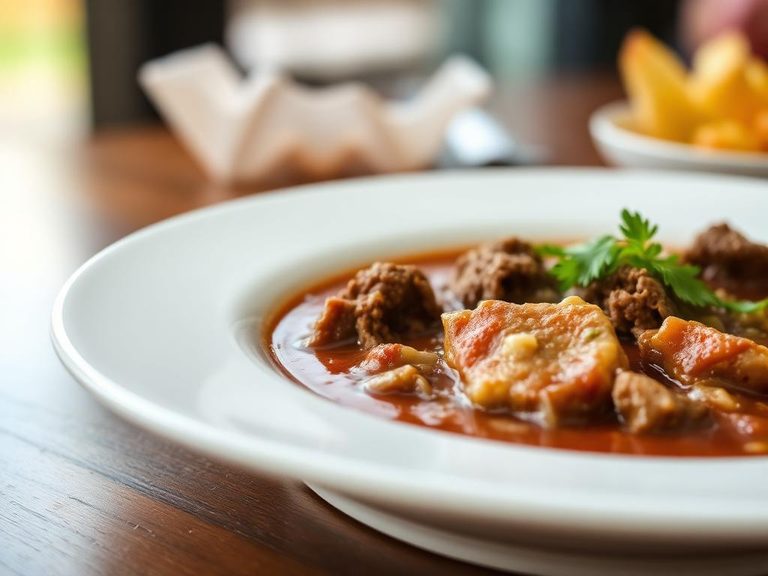
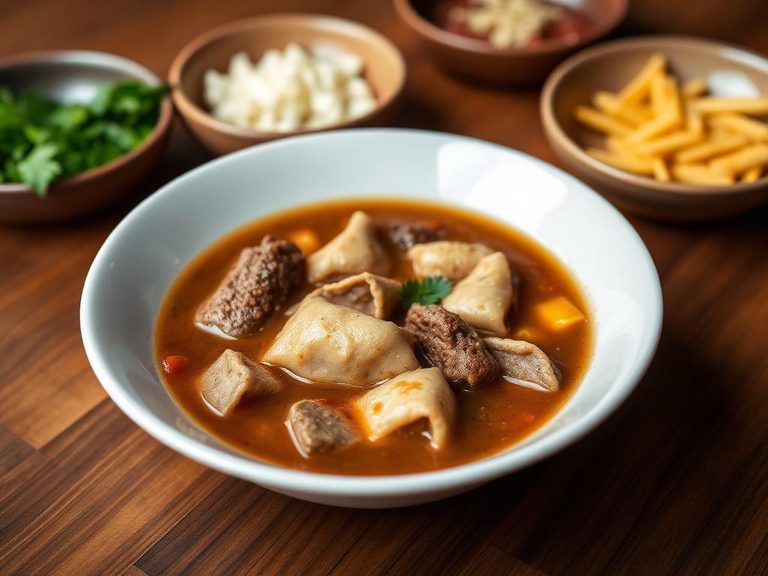
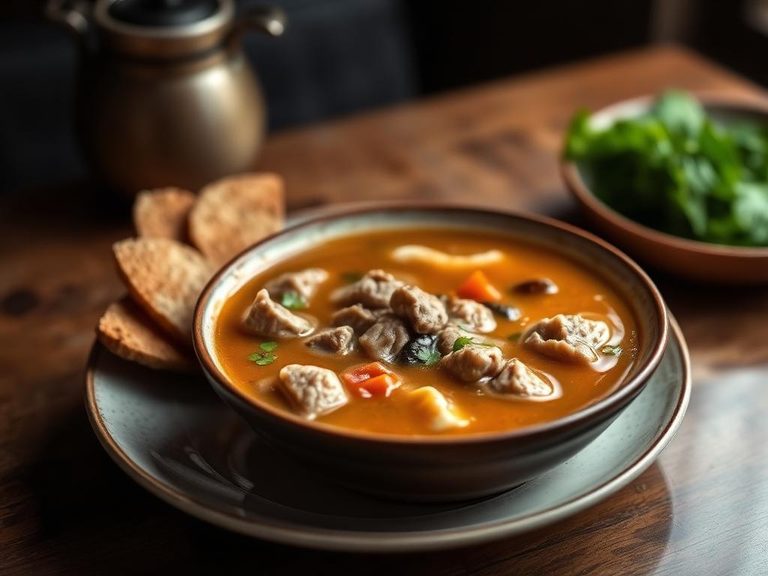
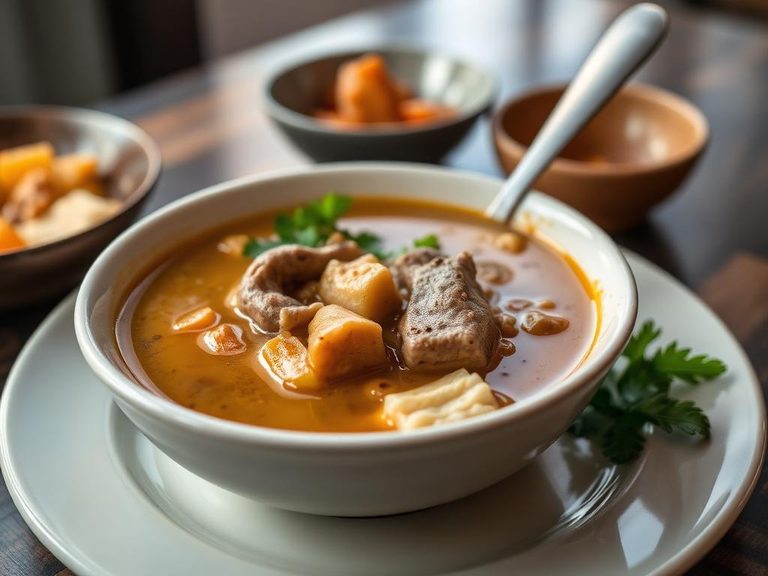
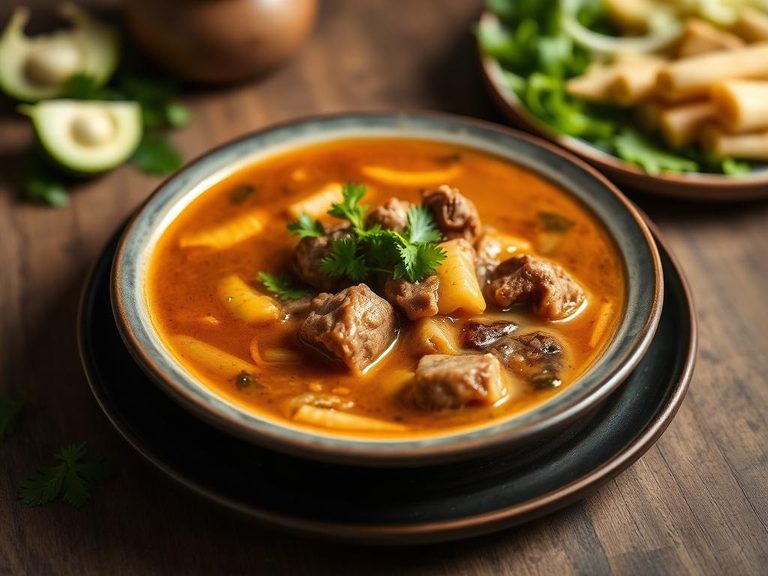
This is a savory, aromatic soup made from slow-simmered beef tripe (stomach lining), typically seasoned with garlic, cumin, and cilantro. The tripe offers a unique, slightly chewy yet tender texture, while the broth is rich, savory, and deeply comforting. Nutritionally, it is a lean, high-protein option with very low calories and minimal fat, making it a light yet satisfying meal.
Calorie split: 47% protein · 22% carbs · 31% fat
↓ Full nutrition💚 Why it's loved
People love it for its deeply savory, umami-rich flavor and the comforting, warming sensation it provides, especially in cooler weather. It is a cultural staple in many Latino households, often enjoyed as a restorative meal or a traditional weekend breakfast, connecting diners to family and heritage.
⚠️ Watch-outs & how to enjoy it better
The texture of tripe can be off-putting to some, and the soup may be high in sodium depending on the preparation. To counteract sodium, you can request it be prepared with less salt or pair it with a side of fresh, unsalted vegetables like avocado or a simple salad to balance the meal. If you have a sensitive stomach, start with a smaller portion to see how you tolerate it.
Key benefits
- High in protein for muscle maintenance and satiety
- Very low in calories, ideal for weight management
- Rich in B vitamins, especially B12, from organ meat
- Contains collagen, which may support joint and skin health
- Naturally low in carbohydrates and sugar
🍽️ Popular dishes
🌍 Where it's eaten
💡 Did you know?
In Mexico, menudo is famously considered a hangover cure, with its rich broth and protein believed to help restore electrolytes and settle the stomach after a night of celebration.
Full nutrition (USDA data · scales with serving)
| Water | 83.4 g |
| Energy | 74.0 kcal |
| Energy | 309 kj |
| Protein | 8.6 g |
| Total lipid (fat) | 2.6 g |
| Ash | 1.3 g |
| Carbohydrate, by difference | 4.1 g |
| Calcium, Ca | 22.0 mg |
| Iron, Fe | 0.68 mg |
| Magnesium, Mg | 10.0 mg |
| Phosphorus, P | 42.0 mg |
| Potassium, K | 81.0 mg |
| Sodium, Na | 411 mg |
| Zinc, Zn | 1.1 mg |
| Copper, Cu | 0.02 mg |
| Manganese, Mn | 0.06 mg |
| Selenium, Se | 5.6 ug |
| Thiamin | 0.01 mg |
| Riboflavin | 0.02 mg |
| Niacin | 0.52 mg |
| Pantothenic acid | 0.13 mg |
| Vitamin B-6 | 0.04 mg |
| Choline, total | 12.7 mg |
| Betaine | 0.40 mg |
| Vitamin B-12 | 0.45 ug |
| Vitamin A, RAE | 0.00 ug |
| Retinol | 0.00 ug |
| Vitamin A, IU | 0.00 iu |
| Vitamin E (alpha-tocopherol) | 0.38 mg |
| Tocopherol, beta | 0.01 mg |
| Tocopherol, gamma | 0.16 mg |
| Tocopherol, delta | 0.01 mg |
| Tocotrienol, alpha | 0.04 mg |
| Tocotrienol, beta | 0.01 mg |
| Tocotrienol, gamma | 0.05 mg |
| Tocotrienol, delta | 0.01 mg |
| Vitamin K (phylloquinone) | 2.3 ug |
| Vitamin K (Menaquinone-4) | 2.4 ug |
Fat & fatty acid profile (per 100g)
| Fatty acids, total saturated | 1.0 g |
| SFA 4:0 | 0.00 g |
| SFA 6:0 | 0.00 g |
| SFA 8:0 | 0.00 g |
| SFA 10:0 | 0.00 g |
| SFA 12:0 | 0.00 g |
| SFA 14:0 | 0.06 g |
| SFA 15:0 | 0.01 g |
| SFA 16:0 | 0.55 g |
| SFA 17:0 | 0.04 g |
| SFA 18:0 | 0.36 g |
| SFA 20:0 | 0.01 g |
| SFA 22:0 | 0.00 g |
| SFA 24:0 | 0.00 g |
| Fatty acids, total monounsaturated | 1.1 g |
| MUFA 14:1 | 0.01 g |
| MUFA 15:1 | 0.00 g |
| MUFA 16:1 | 0.08 g |
| MUFA 16:1 c | 0.07 g |
| MUFA 17:1 | 0.02 g |
| MUFA 18:1 | 1.00 g |
| MUFA 18:1 c | 0.91 g |
| MUFA 20:1 | 0.01 g |
| MUFA 22:1 | 0.00 g |
| MUFA 22:1 c | 0.00 g |
| MUFA 24:1 c | 0.00 g |
| Fatty acids, total polyunsaturated | 0.31 g |
| PUFA 18:2 | 0.24 g |
| PUFA 18:2 n-6 c,c | 0.21 g |
| PUFA 18:2 CLAs | 0.01 g |
| PUFA 18:3 | 0.02 g |
| PUFA 18:3 n-3 c,c,c (ALA) | 0.02 g |
| PUFA 18:3 n-6 c,c,c | 0.00 g |
| PUFA 18:4 | 0.00 g |
| PUFA 20:2 n-6 c,c | 0.00 g |
| PUFA 20:3 | 0.01 g |
| PUFA 20:3 n-3 | 0.00 g |
| PUFA 20:3 n-6 | 0.01 g |
| PUFA 20:4 | 0.02 g |
| PUFA 20:5 n-3 (EPA) | 0.00 g |
| PUFA 22:4 | 0.00 g |
| PUFA 22:5 n-3 (DPA) | 0.01 g |
| PUFA 22:6 n-3 (DHA) | 0.00 g |
| Fatty acids, total trans | 0.11 g |
| Fatty acids, total trans-monoenoic | 0.09 g |
| TFA 16:1 t | 0.01 g |
| TFA 18:1 t | 0.09 g |
| TFA 22:1 t | 0.00 g |
| TFA 18:2 t not further defined | 0.02 g |
| Fatty acids, total trans-polyenoic | 0.02 g |
| Cholesterol | 59.0 mg |
Amino acid profile (per 100g)
| Tryptophan | 0.06 g |
| Threonine | 0.29 g |
| Isoleucine | 0.27 g |
| Leucine | 0.54 g |
| Lysine | 0.45 g |
| Methionine | 0.16 g |
| Cystine | 0.06 g |
| Phenylalanine | 0.27 g |
| Tyrosine | 0.22 g |
| Valine | 0.35 g |
| Arginine | 0.59 g |
| Histidine | 0.15 g |
| Alanine | 0.59 g |
| Aspartic acid | 0.65 g |
| Glutamic acid | 1.2 g |
| Glycine | 0.98 g |
| Proline | 0.61 g |
| Serine | 0.34 g |
FAQ
What is tripe made from?
Tripe is the edible lining from the stomachs of various farm animals, most commonly beef, and is prized for its unique texture and ability to absorb flavors.
Is this soup high in cholesterol?
While tripe is an organ meat, it is relatively low in cholesterol compared to other organs like liver, and the soup itself is lean, making it a moderate option when consumed in reasonable portions.
How is tripe prepared before cooking?
Tripe must be thoroughly cleaned and often pre-boiled or blanched to remove impurities and tenderize it before being added to the soup, which can take several hours of slow cooking.
Can I make this soup at home?
Yes, it is a home-cooked staple in many cultures, but it requires patience due to the long simmering time needed to make the tripe tender and flavorful.
Nutrient density (calculated · NRF9.3)
Nutrient Rich Foods index: beneficial nutrients (protein, fiber, vitamins, minerals) minus saturated fat, added sugar & sodium, per 100 kcal.
NRF9.3 index — Fulgoni, Keast & Drewnowski, 2009. Computed from USDA nutrients.
Weight-loss friendliness (composite index)
Energy density 0.74 kcal/g · 47% calories from protein · 0.0 g fiber · 0.0 g sugar per 100 g.
Composite of energy density (Rolls et al., 1999), protein & fiber satiety, minus sugar. A calculated heuristic — ranks satiety-per-calorie, not a clinical measure.
Dietary load (calculated from USDA values)
Potential renal acid load. Positive = acid-forming, negative = alkaline-forming.
Sodium-to-potassium ratio: 5.07 (lower is better — aim for ≤ 1)
Sodium:potassium per WHO potassium guidance. Computed from USDA nutrients.