

DOMINO'S 14" Pepperoni Pizza, Ultimate Deep Dish Crust
Whole food · Fast Foods

Photo: Wikipedia
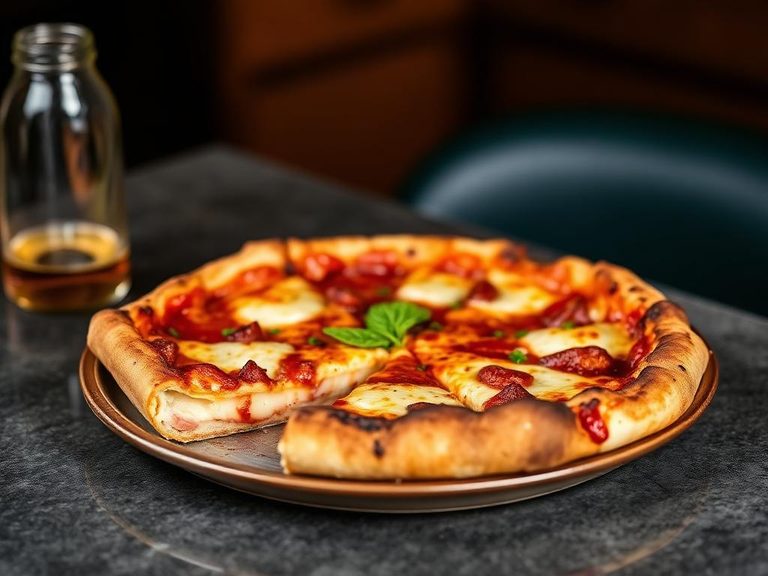
A thick, buttery deep-dish crust loaded with tomato sauce, mozzarella, and pepperoni, creating a hearty, savory bite with a satisfying chew and crispy edges. Each 100g provides 283 kcal with a balanced macro profile of 11.52g protein, 31.89g carbs, and 12.1g fat, making it a calorie-dense but protein-containing meal option.
Calorie split: 16% protein · 45% carbs · 39% fat
↓ Full nutrition💚 Why it's loved
People love it for its indulgent, comforting combination of rich tomato sauce, melted cheese, and savory pepperoni on a thick, buttery crust that delivers a satisfying, hearty eating experience. It's a classic social food that brings people together for casual gatherings and celebrations.
⚠️ Watch-outs & how to enjoy it better
The high calorie density (283 kcal/100g) and refined carbs can cause blood sugar spikes, while the sodium from pepperoni and cheese may concern those watching intake. To counteract, pair a smaller portion with a large side salad or steamed vegetables to increase fiber and volume, and choose thin crust if available to reduce overall carb load.
Key benefits
- Provides a complete protein source from cheese and pepperoni
- Offers quick energy from carbohydrate-rich crust
- Contains calcium from mozzarella cheese
- Satisfying texture and flavor for satiety
- Convenient meal option for groups or families
🍽️ Popular dishes
🌍 Where it's eaten
💡 Did you know?
The deep-dish pizza was invented in Chicago in 1943 at Pizzeria Uno, specifically designed to accommodate large amounts of cheese and toppings that would slide off thinner crusts.
Full nutrition (USDA data · scales with serving)
| Water | 41.9 g |
| Energy | 283 kcal |
| Energy | 1182 kj |
| Protein | 11.5 g |
| Total lipid (fat) | 12.1 g |
| Ash | 2.6 g |
| Carbohydrate, by difference | 31.9 g |
| Fiber, total dietary | 2.4 g |
| Total Sugars | 3.9 g |
| Sucrose | 0.33 g |
| Glucose | 0.60 g |
| Fructose | 0.93 g |
| Lactose | 0.67 g |
| Maltose | 1.3 g |
| Galactose | 0.07 g |
| Starch | 23.0 g |
| Calcium, Ca | 149 mg |
| Iron, Fe | 2.5 mg |
| Magnesium, Mg | 24.0 mg |
| Phosphorus, P | 197 mg |
| Potassium, K | 190 mg |
| Sodium, Na | 693 mg |
| Zinc, Zn | 1.3 mg |
| Copper, Cu | 0.11 mg |
| Manganese, Mn | 0.30 mg |
| Selenium, Se | 24.5 ug |
| Vitamin C, total ascorbic acid | 0.40 mg |
| Thiamin | 0.36 mg |
| Riboflavin | 0.19 mg |
| Niacin | 3.3 mg |
| Vitamin B-6 | 0.07 mg |
| Vitamin B-12 | 0.52 ug |
| Vitamin E (alpha-tocopherol) | 0.88 mg |
| Tocopherol, beta | 0.06 mg |
| Tocopherol, gamma | 2.1 mg |
| Tocopherol, delta | 0.67 mg |
| Tocotrienol, alpha | 0.07 mg |
| Tocotrienol, beta | 0.00 mg |
| Tocotrienol, gamma | 0.00 mg |
| Tocotrienol, delta | 0.00 mg |
| Vitamin K (phylloquinone) | 5.9 ug |
| Vitamin K (Dihydrophylloquinone) | 3.2 ug |
Fat & fatty acid profile (per 100g)
| Fatty acids, total saturated | 4.9 g |
| SFA 4:0 | 0.09 g |
| SFA 6:0 | 0.07 g |
| SFA 8:0 | 0.05 g |
| SFA 10:0 | 0.12 g |
| SFA 12:0 | 0.14 g |
| SFA 14:0 | 0.56 g |
| SFA 15:0 | 0.06 g |
| SFA 16:0 | 2.5 g |
| SFA 17:0 | 0.06 g |
| SFA 18:0 | 1.1 g |
| SFA 20:0 | 0.02 g |
| SFA 22:0 | 0.02 g |
| SFA 24:0 | 0.01 g |
| Fatty acids, total monounsaturated | 3.6 g |
| MUFA 14:1 | 0.05 g |
| MUFA 15:1 | 0.00 g |
| MUFA 16:1 | 0.18 g |
| MUFA 16:1 c | 0.16 g |
| MUFA 17:1 | 0.03 g |
| MUFA 18:1 | 3.3 g |
| MUFA 18:1 c | 3.0 g |
| MUFA 20:1 | 0.06 g |
| MUFA 22:1 | 0.01 g |
| MUFA 22:1 c | 0.01 g |
| MUFA 24:1 c | 0.00 g |
| Fatty acids, total polyunsaturated | 2.5 g |
| PUFA 18:2 | 2.2 g |
| PUFA 18:2 n-6 c,c | 2.1 g |
| PUFA 18:2 CLAs | 0.04 g |
| PUFA 18:3 | 0.26 g |
| PUFA 18:3 n-3 c,c,c (ALA) | 0.25 g |
| PUFA 18:3 n-6 c,c,c | 0.00 g |
| PUFA 18:4 | 0.00 g |
| PUFA 20:2 n-6 c,c | 0.02 g |
| PUFA 20:3 | 0.01 g |
| PUFA 20:3 n-3 | 0.00 g |
| PUFA 20:3 n-6 | 0.01 g |
| PUFA 20:4 | 0.02 g |
| PUFA 20:5 n-3 (EPA) | 0.00 g |
| PUFA 22:4 | 0.01 g |
| PUFA 22:5 n-3 (DPA) | 0.01 g |
| PUFA 22:6 n-3 (DHA) | 0.00 g |
| Fatty acids, total trans | 0.36 g |
| Fatty acids, total trans-monoenoic | 0.29 g |
| TFA 16:1 t | 0.02 g |
| TFA 18:1 t | 0.27 g |
| TFA 22:1 t | 0.00 g |
| TFA 18:2 t not further defined | 0.07 g |
| Fatty acids, total trans-polyenoic | 0.07 g |
| Cholesterol | 24.0 mg |
Amino acid profile (per 100g)
| Tryptophan | 0.11 g |
| Threonine | 0.36 g |
| Isoleucine | 0.47 g |
| Leucine | 0.96 g |
| Lysine | 0.66 g |
| Methionine | 0.25 g |
| Cystine | 0.19 g |
| Phenylalanine | 0.60 g |
| Tyrosine | 0.36 g |
| Valine | 0.59 g |
| Arginine | 0.48 g |
| Histidine | 0.30 g |
| Alanine | 0.40 g |
| Aspartic acid | 0.79 g |
| Glutamic acid | 3.4 g |
| Glycine | 0.40 g |
| Proline | 1.6 g |
| Serine | 0.68 g |
FAQ
How does deep-dish crust differ from regular pizza crust?
Deep-dish crust is thicker, buttery, and baked in a deep pan, creating a pie-like structure that holds more toppings and sauce, while regular crust is thinner and crispier.
Is pepperoni pizza a good source of protein?
Yes, each 100g provides 11.52g of protein from the cheese and pepperoni, making it a moderate protein source, though it's also high in fat and calories.
Can I freeze leftover deep-dish pizza?
Yes, wrap slices tightly in plastic wrap and foil, then freeze for up to 1-2 months. Reheat in the oven at 375°F (190°C) for 10-15 minutes to restore crispiness.
Nutrient density (calculated · NRF9.3)
Nutrient Rich Foods index: beneficial nutrients (protein, fiber, vitamins, minerals) minus saturated fat, added sugar & sodium, per 100 kcal.
NRF9.3 index — Fulgoni, Keast & Drewnowski, 2009. Computed from USDA nutrients.
Weight-loss friendliness (composite index)
Energy density 2.83 kcal/g · 16% calories from protein · 2.4 g fiber · 3.9 g sugar per 100 g.
Composite of energy density (Rolls et al., 1999), protein & fiber satiety, minus sugar. A calculated heuristic — ranks satiety-per-calorie, not a clinical measure.
Dietary load (calculated from USDA values)
Potential renal acid load. Positive = acid-forming, negative = alkaline-forming.
Sodium-to-potassium ratio: 3.65 (lower is better — aim for ≤ 1)
Sodium:potassium per WHO potassium guidance. Computed from USDA nutrients.