

Plums, raw
Whole food · Fruits and Fruit Juices

Photo: Wikipedia
A raw plum is a stone fruit with a smooth, often waxy skin and juicy, tender flesh that ranges from golden yellow to deep red or purple. Its flavor is a delightful balance of sweet and tart, with the tartness often concentrated near the skin and pit. Nutritionally, it's a low-calorie, hydrating snack that provides a quick source of natural sugars and dietary fiber.
Calorie split: 5% protein · 90% carbs · 5% fat
↓ Full nutrition💚 Why it's loved
People love plums for their vibrant, juicy burst of sweet-tart flavor, which is incredibly refreshing when eaten fresh. They are also cherished for their versatility, being equally delicious in baked goods, preserves, or savory sauces.
⚠️ Watch-outs & how to enjoy it better
The natural sugars in plums can cause a rapid blood sugar spike if eaten in large quantities alone, especially for those monitoring their glucose levels. To counteract this, pair a plum with a source of protein or fat, like a handful of nuts or a piece of cheese, to slow sugar absorption. Additionally, some individuals may experience digestive discomfort like bloating from the fiber and sorbitol; starting with a smaller portion and ensuring adequate water intake can help.
Key benefits
- Low in calories and fat, supporting weight management.
- Good source of dietary fiber for digestive health.
- Contains vitamins C and K, as well as antioxidants like anthocyanins.
- High water content aids in hydration.
- Provides natural sugars for a quick energy boost.
🍽️ Popular dishes

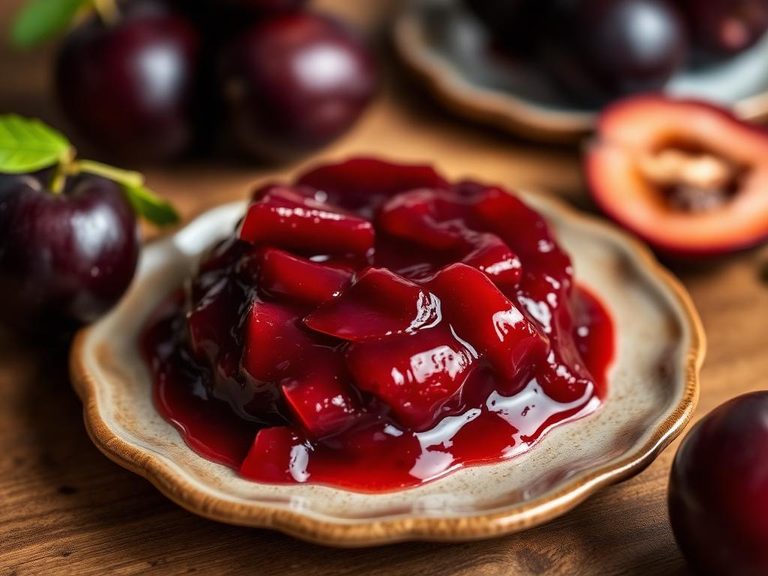
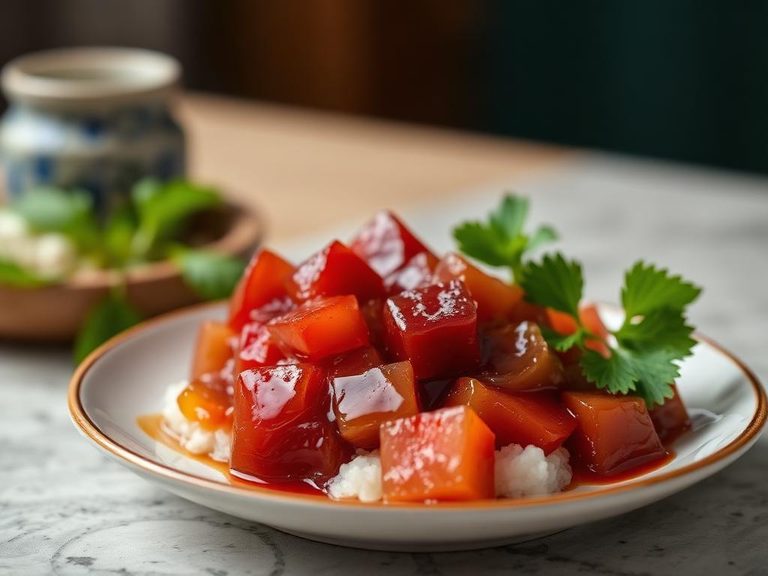

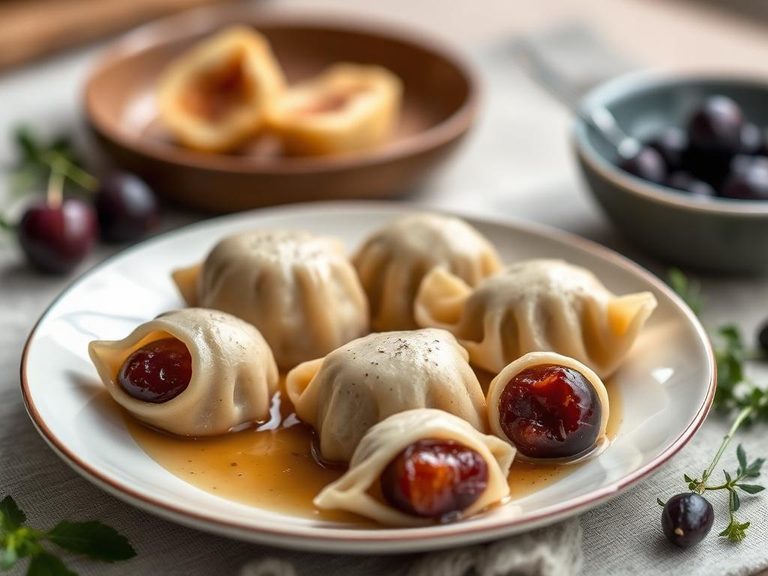
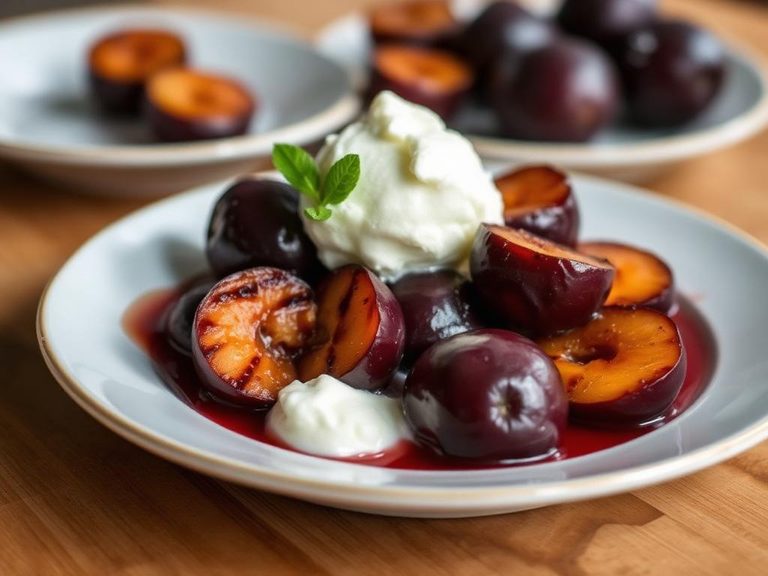
🌍 Where it's eaten
💡 Did you know?
The waxy, dusty-looking coating on a plum's skin is called the 'bloom,' a natural protective barrier produced by the fruit itself to prevent moisture loss and deter insects.
Full nutrition (USDA data · scales with serving)
| Water | 87.2 g |
| Energy | 46.0 kcal |
| Energy | 192 kj |
| Protein | 0.70 g |
| Total lipid (fat) | 0.28 g |
| Ash | 0.37 g |
| Carbohydrate, by difference | 11.4 g |
| Fiber, total dietary | 1.4 g |
| Total Sugars | 9.9 g |
| Sucrose | 1.6 g |
| Glucose | 5.1 g |
| Fructose | 3.1 g |
| Lactose | 0.00 g |
| Maltose | 0.08 g |
| Galactose | 0.14 g |
| Starch | 0.00 g |
| Calcium, Ca | 6.0 mg |
| Iron, Fe | 0.17 mg |
| Magnesium, Mg | 7.0 mg |
| Phosphorus, P | 16.0 mg |
| Potassium, K | 157 mg |
| Sodium, Na | 0.00 mg |
| Zinc, Zn | 0.10 mg |
| Copper, Cu | 0.06 mg |
| Manganese, Mn | 0.05 mg |
| Selenium, Se | 0.00 ug |
| Fluoride, F | 2.0 ug |
| Vitamin C, total ascorbic acid | 9.5 mg |
| Thiamin | 0.03 mg |
| Riboflavin | 0.03 mg |
| Niacin | 0.42 mg |
| Pantothenic acid | 0.14 mg |
| Vitamin B-6 | 0.03 mg |
| Folate, total | 5.0 ug |
| Folic acid | 0.00 ug |
| Folate, food | 5.0 ug |
| Folate, DFE | 5.0 ug |
| Choline, total | 1.9 mg |
| Vitamin B-12 | 0.00 ug |
| Vitamin B-12, added | 0.00 ug |
| Vitamin A, RAE | 17.0 ug |
| Retinol | 0.00 ug |
| Carotene, beta | 190 ug |
| Carotene, alpha | 0.00 ug |
| Cryptoxanthin, beta | 35.0 ug |
| Vitamin A, IU | 345 iu |
| Lycopene | 0.00 ug |
| Lutein + zeaxanthin | 73.0 ug |
| Vitamin E (alpha-tocopherol) | 0.26 mg |
| Vitamin E, added | 0.00 mg |
| Tocopherol, beta | 0.00 mg |
| Tocopherol, gamma | 0.08 mg |
| Tocopherol, delta | 0.00 mg |
| Tocotrienol, alpha | 0.04 mg |
| Tocotrienol, beta | 0.00 mg |
| Tocotrienol, gamma | 0.01 mg |
| Tocotrienol, delta | 0.00 mg |
| Vitamin D (D2 + D3), International Units | 0.00 iu |
| Vitamin D (D2 + D3) | 0.00 ug |
| Vitamin K (phylloquinone) | 6.4 ug |
| Vitamin K (Dihydrophylloquinone) | 0.00 ug |
| Alcohol, ethyl | 0.00 g |
| Caffeine | 0.00 mg |
| Theobromine | 0.00 mg |
Fat & fatty acid profile (per 100g)
| Fatty acids, total saturated | 0.02 g |
| SFA 4:0 | 0.00 g |
| SFA 6:0 | 0.00 g |
| SFA 8:0 | 0.00 g |
| SFA 10:0 | 0.00 g |
| SFA 12:0 | 0.00 g |
| SFA 14:0 | 0.00 g |
| SFA 16:0 | 0.01 g |
| SFA 18:0 | 0.00 g |
| Fatty acids, total monounsaturated | 0.13 g |
| MUFA 16:1 | 0.00 g |
| MUFA 18:1 | 0.13 g |
| MUFA 20:1 | 0.00 g |
| MUFA 22:1 | 0.00 g |
| Fatty acids, total polyunsaturated | 0.04 g |
| PUFA 18:2 | 0.04 g |
| PUFA 18:3 | 0.00 g |
| PUFA 18:4 | 0.00 g |
| PUFA 20:4 | 0.00 g |
| PUFA 20:5 n-3 (EPA) | 0.00 g |
| PUFA 22:5 n-3 (DPA) | 0.00 g |
| PUFA 22:6 n-3 (DHA) | 0.00 g |
| Fatty acids, total trans | 0.00 g |
| Cholesterol | 0.00 mg |
| Phytosterols | 7.0 mg |
Amino acid profile (per 100g)
| Tryptophan | 0.01 g |
| Threonine | 0.01 g |
| Isoleucine | 0.01 g |
| Leucine | 0.01 g |
| Lysine | 0.02 g |
| Methionine | 0.01 g |
| Cystine | 0.00 g |
| Phenylalanine | 0.01 g |
| Tyrosine | 0.01 g |
| Valine | 0.02 g |
| Arginine | 0.01 g |
| Histidine | 0.01 g |
| Alanine | 0.03 g |
| Aspartic acid | 0.35 g |
| Glutamic acid | 0.04 g |
| Glycine | 0.01 g |
| Proline | 0.03 g |
| Serine | 0.02 g |
FAQ
What's the difference between a plum and a prune?
A prune is simply a dried plum, typically from specific freestone varieties like the Italian Prune or d'Agen plum, which are bred to dry well while retaining a sweet, rich flavor.
How do I know when a plum is ripe?
A ripe plum should yield slightly to gentle pressure near the stem. It should have a rich, developed color for its variety and a sweet, fruity aroma at the stem end. Avoid rock-hard or mushy fruit.
Can I eat the skin of a plum?
Yes, the skin is edible and contains much of the fruit's fiber and antioxidants. Simply wash it well before eating. If the skin is very thick or tart, you can peel it with a vegetable peeler or blanch it in boiling water for 30 seconds.
Nutrient density (calculated · NRF9.3)
Nutrient Rich Foods index: beneficial nutrients (protein, fiber, vitamins, minerals) minus saturated fat, added sugar & sodium, per 100 kcal.
NRF9.3 index — Fulgoni, Keast & Drewnowski, 2009. Computed from USDA nutrients.
Weight-loss friendliness (composite index)
Energy density 0.46 kcal/g · 6% calories from protein · 1.4 g fiber · 9.9 g sugar per 100 g.
Composite of energy density (Rolls et al., 1999), protein & fiber satiety, minus sugar. A calculated heuristic — ranks satiety-per-calorie, not a clinical measure.
Dietary load (calculated from USDA values)
Potential renal acid load. Positive = acid-forming, negative = alkaline-forming.
Sodium-to-potassium ratio: 0.00 (lower is better — aim for ≤ 1)
Sodium:potassium per WHO potassium guidance. Computed from USDA nutrients.