

Lamb, New Zealand, imported, rack - partly frenched, separable lean only, raw
Whole food · Lamb, Veal, and Game Products

Photo: Wikipedia
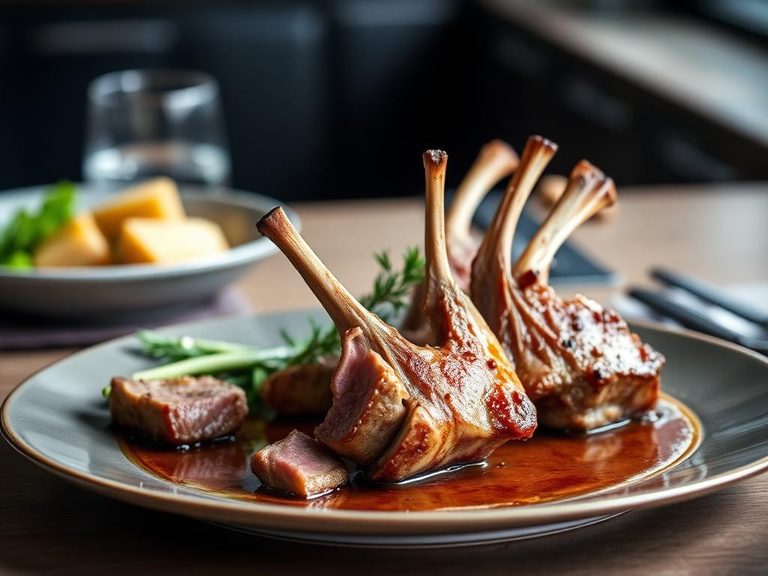
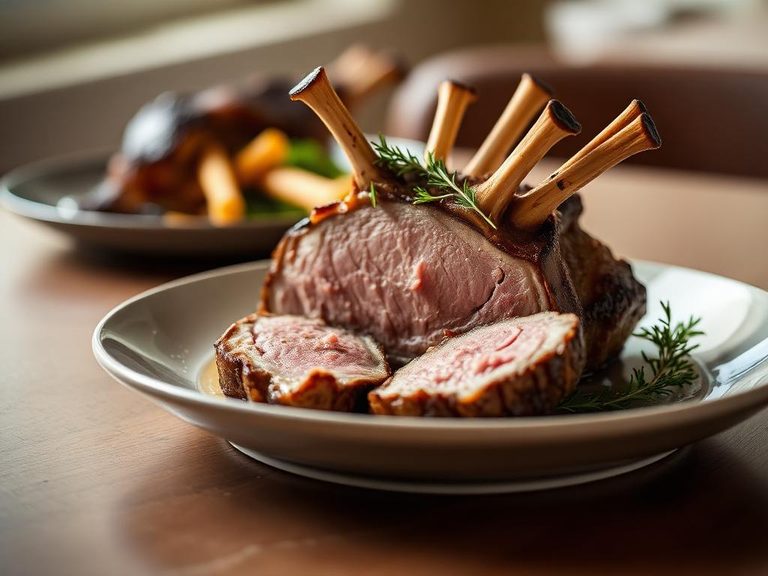
This is the premium, lean section of a New Zealand lamb rack, with the ribs 'partly frenched' for an elegant presentation. The raw meat is a deep, rosy red with fine marbling, promising a tender, buttery texture and a clean, mildly gamey flavor once cooked. It's a nutritional powerhouse, delivering over 20 grams of high-quality protein per 100 grams with virtually no carbohydrates.
Calorie split: 52% protein · 0% carbs · 48% fat
↓ Full nutrition💚 Why it's loved
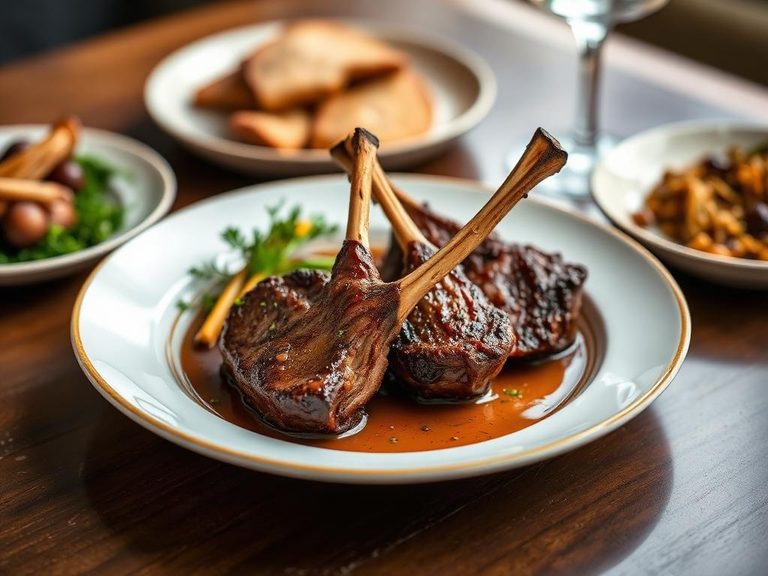
People adore it for its exceptional tenderness and rich, yet refined, lamb flavor that isn't overly strong. It's the centerpiece of celebratory meals, prized for its dramatic presentation and ability to be cooked to a perfect, juicy medium-rare.
⚠️ Watch-outs & how to enjoy it better
The primary downside is its high cost and the need for precise cooking to avoid drying out the lean meat. Those sensitive to saturated fat should enjoy it in moderation; pairing it with a fiber-rich vegetable side can create a more balanced plate.
Key benefits
- Excellent source of complete protein for muscle maintenance.
- Rich in bioavailable heme iron, crucial for energy and red blood cells.
- Provides essential minerals like zinc and selenium for immune function.
- Naturally zero carbohydrates, fitting for low-carb and ketogenic diets.
🍽️ Popular dishes
🌍 Where it's eaten
💡 Did you know?
The term 'frenched' comes from the French culinary technique of scraping the meat and fat from the rib bones to create a clean, elegant handle for eating.
Full nutrition (USDA data · scales with serving)
| Water | 70.2 g |
| Energy | 160 kcal |
| Energy | 670 kj |
| Protein | 20.6 g |
| Total lipid (fat) | 8.6 g |
| Ash | 0.94 g |
| Carbohydrate, by difference | 0.00 g |
| Fiber, total dietary | 0.00 g |
| Total Sugars | 0.00 g |
| Calcium, Ca | 12.0 mg |
| Iron, Fe | 1.4 mg |
| Magnesium, Mg | 22.0 mg |
| Phosphorus, P | 185 mg |
| Potassium, K | 309 mg |
| Sodium, Na | 67.0 mg |
| Zinc, Zn | 2.7 mg |
| Copper, Cu | 0.11 mg |
| Manganese, Mn | 0.01 mg |
| Selenium, Se | 3.6 ug |
| Vitamin C, total ascorbic acid | 0.00 mg |
| Thiamin | 0.08 mg |
| Riboflavin | 0.19 mg |
| Niacin | 5.7 mg |
| Pantothenic acid | 0.45 mg |
| Vitamin B-6 | 0.18 mg |
| Folic acid | 0.00 ug |
| Vitamin B-12 | 1.3 ug |
| Vitamin A, RAE | 5.0 ug |
| Retinol | 5.0 ug |
| Carotene, beta | 0.00 ug |
| Carotene, alpha | 0.00 ug |
| Cryptoxanthin, beta | 0.00 ug |
| Vitamin A, IU | 17.0 iu |
| Lycopene | 0.00 ug |
| Lutein + zeaxanthin | 0.00 ug |
| Vitamin E (alpha-tocopherol) | 0.28 mg |
| Vitamin D (D2 + D3), International Units | 1.0 iu |
| Vitamin D (D2 + D3) | 0.00 ug |
| Vitamin D3 (cholecalciferol) | 0.00 ug |
| Alcohol, ethyl | 0.00 g |
| Caffeine | 0.00 mg |
| Theobromine | 0.00 mg |
Fat & fatty acid profile (per 100g)
| Fatty acids, total saturated | 2.8 g |
| SFA 4:0 | 0.00 g |
| SFA 6:0 | 0.00 g |
| SFA 8:0 | 0.00 g |
| SFA 10:0 | 0.01 g |
| SFA 12:0 | 0.01 g |
| SFA 14:0 | 0.14 g |
| SFA 16:0 | 1.2 g |
| SFA 17:0 | 0.11 g |
| SFA 18:0 | 1.3 g |
| SFA 20:0 | 0.01 g |
| SFA 22:0 | 0.01 g |
| SFA 24:0 | 0.00 g |
| Fatty acids, total monounsaturated | 2.0 g |
| MUFA 14:1 | 0.01 g |
| MUFA 15:1 | 0.00 g |
| MUFA 16:1 | 0.07 g |
| MUFA 16:1 c | 0.06 g |
| MUFA 17:1 | 0.00 g |
| MUFA 18:1 | 2.0 g |
| MUFA 18:1 c | 1.7 g |
| MUFA 20:1 | 0.00 g |
| MUFA 22:1 | 0.00 g |
| MUFA 22:1 c | 0.00 g |
| MUFA 24:1 c | 0.00 g |
| Fatty acids, total polyunsaturated | 0.43 g |
| PUFA 18:2 | 0.24 g |
| PUFA 18:2 n-6 c,c | 0.12 g |
| PUFA 18:2 CLAs | 0.13 g |
| PUFA 18:3 | 0.11 g |
| PUFA 18:3 n-3 c,c,c (ALA) | 0.11 g |
| PUFA 18:3 n-6 c,c,c | 0.00 g |
| PUFA 18:4 | 0.00 g |
| PUFA 20:2 n-6 c,c | 0.00 g |
| PUFA 20:3 | 0.00 g |
| PUFA 20:3 n-3 | 0.00 g |
| PUFA 20:3 n-6 | 0.00 g |
| PUFA 20:4 | 0.03 g |
| PUFA 20:4 n-6 | 0.03 g |
| PUFA 20:5 n-3 (EPA) | 0.02 g |
| PUFA 22:5 n-3 (DPA) | 0.02 g |
| PUFA 22:6 n-3 (DHA) | 0.00 g |
| Fatty acids, total trans | 0.31 g |
| Fatty acids, total trans-monoenoic | 0.31 g |
| TFA 16:1 t | 0.01 g |
| TFA 18:1 t | 0.30 g |
| TFA 18:2 t,t | 0.00 g |
| Fatty acids, total trans-polyenoic | 0.00 g |
| Cholesterol | 64.0 mg |
Amino acid profile (per 100g)
| Tryptophan | 0.23 g |
| Threonine | 0.98 g |
| Isoleucine | 0.92 g |
| Leucine | 1.6 g |
| Lysine | 1.8 g |
| Methionine | 0.67 g |
| Cystine | 0.27 g |
| Phenylalanine | 0.81 g |
| Tyrosine | 0.71 g |
| Valine | 1.1 g |
| Arginine | 1.4 g |
| Histidine | 0.44 g |
| Alanine | 1.0 g |
| Glutamic acid | 2.9 g |
| Glycine | 0.88 g |
| Proline | 0.66 g |
| Serine | 0.70 g |
FAQ
What does 'partly frenched' mean?
It means the rib bones have been scraped clean of meat and fat partway down, creating a neat 'handle' while leaving some meat attached for flavor and presentation.
How is this different from a lamb loin chop?
A rack is a series of rib chops still connected, while a loin chop is a single, cross-cut steak from the loin. Racks are generally more tender and prized for roasting whole.
Why is New Zealand lamb often highlighted?
New Zealand lamb is renowned for its consistent quality, typically grass-fed, which contributes to a distinct, clean flavor and a leaner profile compared to grain-fed lamb.
Nutrient density (calculated · NRF9.3)
Nutrient Rich Foods index: beneficial nutrients (protein, fiber, vitamins, minerals) minus saturated fat, added sugar & sodium, per 100 kcal.
NRF9.3 index — Fulgoni, Keast & Drewnowski, 2009. Computed from USDA nutrients.
Weight-loss friendliness (composite index)
Energy density 1.60 kcal/g · 52% calories from protein · 0.0 g fiber · 0.0 g sugar per 100 g.
Composite of energy density (Rolls et al., 1999), protein & fiber satiety, minus sugar. A calculated heuristic — ranks satiety-per-calorie, not a clinical measure.
Dietary load (calculated from USDA values)
Potential renal acid load. Positive = acid-forming, negative = alkaline-forming.
Sodium-to-potassium ratio: 0.22 (lower is better — aim for ≤ 1)
Sodium:potassium per WHO potassium guidance. Computed from USDA nutrients.