

Beef, New Zealand, imported, striploin, separable lean and fat, raw
Whole food · Beef Products

Photo: Wikipedia
This is a premium cut of raw beef from New Zealand, prized for its rich, beefy flavor and a satisfying balance of tender lean meat and a distinct fat cap. With a high protein content and a robust fat profile, it offers a deeply savory, melt-in-your-mouth experience when cooked properly. Nutritionally, it's a powerhouse of high-quality protein and energy-dense fats, with virtually no carbohydrates.
Calorie split: 29% protein · 1% carbs · 70% fat
↓ Full nutrition💚 Why it's loved
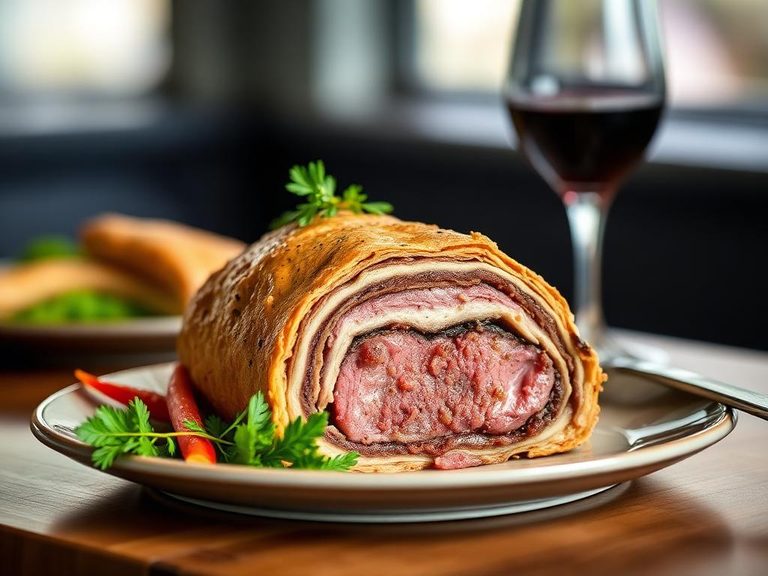
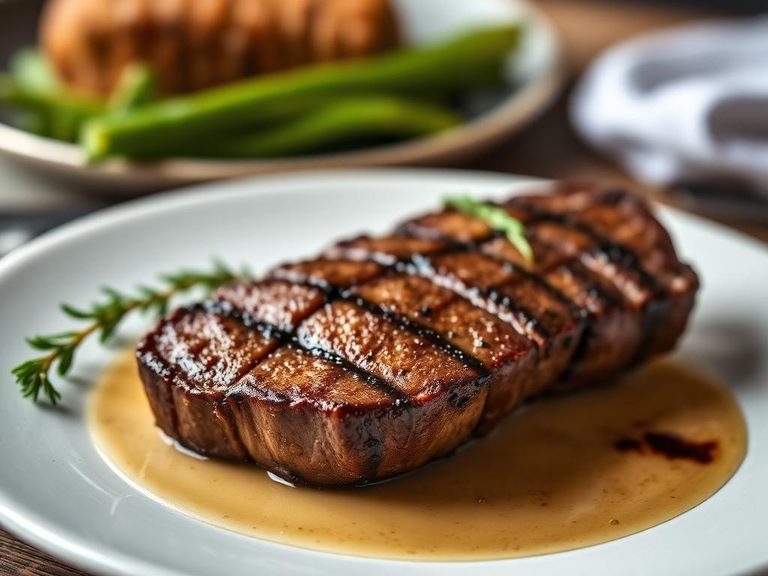
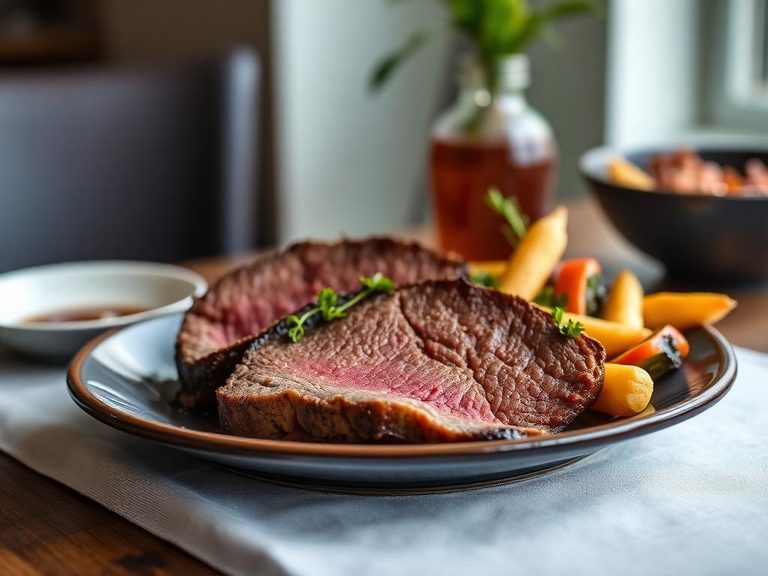
People adore it for its deep, umami-rich flavor and luxurious marbling that bastes the meat from within during cooking, resulting in exceptional juiciness. It's a versatile centerpiece, perfect for everything from a simple, elegant pan-sear to a slow-roasted Sunday dinner.
⚠️ Watch-outs & how to enjoy it better
The significant fat content, while flavorful, makes it a high-calorie choice and may not suit low-fat dietary plans. For those monitoring saturated fat intake, portion control is key. To counterbalance, pair a modest portion with a large serving of fibrous vegetables like roasted broccoli or a fresh salad to enhance satiety and add micronutrients.
Key benefits
- Excellent source of complete, high-quality protein for muscle maintenance.
- Rich in bioavailable iron, crucial for oxygen transport in the blood.
- Provides essential B vitamins, especially B12, for nerve function and energy metabolism.
- Contains zinc, which supports immune system health.
- Offers conjugated linoleic acid (CLA), a naturally occurring fatty acid.
🍽️ Popular dishes
🌍 Where it's eaten
💡 Did you know?
The 'striploin' is the same primal cut that, when cut into individual steaks with the bone attached, is known as a New York Strip or a Kansas City Strip steak.
Full nutrition (USDA data · scales with serving)
| Water | 60.8 g |
| Energy | 252 kcal |
| Energy | 1055 kj |
| Protein | 18.5 g |
| Total lipid (fat) | 19.5 g |
| Ash | 0.76 g |
| Carbohydrate, by difference | 0.60 g |
| Fiber, total dietary | 0.00 g |
| Total Sugars | 0.00 g |
| Calcium, Ca | 7.0 mg |
| Iron, Fe | 1.4 mg |
| Magnesium, Mg | 17.0 mg |
| Phosphorus, P | 153 mg |
| Potassium, K | 268 mg |
| Sodium, Na | 43.0 mg |
| Zinc, Zn | 2.3 mg |
| Copper, Cu | 0.05 mg |
| Manganese, Mn | 0.01 mg |
| Selenium, Se | 2.8 ug |
| Vitamin C, total ascorbic acid | 0.00 mg |
| Thiamin | 0.06 mg |
| Riboflavin | 0.07 mg |
| Niacin | 3.6 mg |
| Pantothenic acid | 0.26 mg |
| Vitamin B-6 | 0.27 mg |
| Vitamin B-12 | 0.61 ug |
| Vitamin B-12, added | 0.00 ug |
| Vitamin A, RAE | 10.0 ug |
| Retinol | 10.0 ug |
| Carotene, beta | 0.00 ug |
| Carotene, alpha | 0.00 ug |
| Cryptoxanthin, beta | 0.00 ug |
| Vitamin A, IU | 33.0 iu |
| Lycopene | 0.00 ug |
| Lutein + zeaxanthin | 0.00 ug |
| Vitamin E (alpha-tocopherol) | 0.28 mg |
| Vitamin E, added | 0.00 mg |
| Vitamin D (D2 + D3), International Units | 8.0 iu |
| Vitamin D (D2 + D3) | 0.20 ug |
| Vitamin D3 (cholecalciferol) | 0.20 ug |
| Alcohol, ethyl | 0.00 g |
| Caffeine | 0.00 mg |
| Theobromine | 0.00 mg |
Fat & fatty acid profile (per 100g)
| Fatty acids, total saturated | 8.1 g |
| SFA 4:0 | 0.00 g |
| SFA 6:0 | 0.00 g |
| SFA 8:0 | 0.00 g |
| SFA 10:0 | 0.01 g |
| SFA 12:0 | 0.01 g |
| SFA 14:0 | 0.51 g |
| SFA 16:0 | 4.0 g |
| SFA 17:0 | 0.27 g |
| SFA 18:0 | 3.2 g |
| SFA 20:0 | 0.02 g |
| SFA 22:0 | 0.01 g |
| SFA 24:0 | 0.00 g |
| Fatty acids, total monounsaturated | 6.9 g |
| MUFA 14:1 | 0.12 g |
| MUFA 15:1 | 0.00 g |
| MUFA 16:1 | 0.57 g |
| MUFA 16:1 c | 0.54 g |
| MUFA 17:1 | 0.00 g |
| MUFA 18:1 | 6.2 g |
| MUFA 18:1 c | 5.7 g |
| MUFA 20:1 | 0.02 g |
| MUFA 22:1 | 0.00 g |
| MUFA 22:1 c | 0.00 g |
| MUFA 24:1 c | 0.00 g |
| Fatty acids, total polyunsaturated | 0.52 g |
| PUFA 18:2 | 0.30 g |
| PUFA 18:2 n-6 c,c | 0.14 g |
| PUFA 18:2 CLAs | 0.16 g |
| PUFA 18:3 | 0.14 g |
| PUFA 18:3 n-3 c,c,c (ALA) | 0.14 g |
| PUFA 18:3 n-6 c,c,c | 0.00 g |
| PUFA 18:4 | 0.00 g |
| PUFA 20:2 n-6 c,c | 0.00 g |
| PUFA 20:3 | 0.01 g |
| PUFA 20:3 n-3 | 0.00 g |
| PUFA 20:3 n-6 | 0.01 g |
| PUFA 20:4 | 0.02 g |
| PUFA 20:4 n-6 | 0.02 g |
| PUFA 20:5 n-3 (EPA) | 0.01 g |
| PUFA 22:5 n-3 (DPA) | 0.02 g |
| PUFA 22:6 n-3 (DHA) | 0.00 g |
| Fatty acids, total trans | 0.62 g |
| Fatty acids, total trans-monoenoic | 0.61 g |
| TFA 16:1 t | 0.04 g |
| TFA 18:1 t | 0.57 g |
| TFA 18:2 t,t | 0.01 g |
| Fatty acids, total trans-polyenoic | 0.01 g |
| Cholesterol | 57.0 mg |
Amino acid profile (per 100g)
| Tryptophan | 0.19 g |
| Threonine | 0.67 g |
| Isoleucine | 0.77 g |
| Leucine | 1.4 g |
| Lysine | 1.5 g |
| Methionine | 0.61 g |
| Phenylalanine | 0.72 g |
| Tyrosine | 0.62 g |
| Valine | 0.82 g |
| Arginine | 1.2 g |
| Histidine | 0.67 g |
| Alanine | 0.96 g |
| Glutamic acid | 2.6 g |
| Glycine | 1.0 g |
| Proline | 0.59 g |
| Serine | 0.65 g |
FAQ
What's the best way to cook a New Zealand striploin steak?
For the best results, bring the steak to room temperature, pat it dry, and season generously with salt and pepper. Sear it in a very hot, heavy skillet (cast iron is ideal) with a high-smoke-point oil for 2-3 minutes per side for medium-rare, then rest it for 5-10 minutes before slicing against the grain.
How does New Zealand beef differ from other types?
New Zealand cattle are predominantly grass-fed and pasture-raised year-round, which often results in a leaner, more mineral-rich flavor profile compared to grain-finished beef, with a distinct 'clean' taste.
Is this cut suitable for slow cooking?
While striploin is best for quick, high-heat methods, it can be used in slow cooking if cut into cubes for stews. However, its inherent tenderness and marbling mean it's more economical and traditional to use tougher, more collagen-rich cuts (like chuck) for long, slow braises.
Nutrient density (calculated · NRF9.3)
Nutrient Rich Foods index: beneficial nutrients (protein, fiber, vitamins, minerals) minus saturated fat, added sugar & sodium, per 100 kcal.
NRF9.3 index — Fulgoni, Keast & Drewnowski, 2009. Computed from USDA nutrients.
Weight-loss friendliness (composite index)
Energy density 2.52 kcal/g · 29% calories from protein · 0.0 g fiber · 0.0 g sugar per 100 g.
Composite of energy density (Rolls et al., 1999), protein & fiber satiety, minus sugar. A calculated heuristic — ranks satiety-per-calorie, not a clinical measure.
Dietary load (calculated from USDA values)
Potential renal acid load. Positive = acid-forming, negative = alkaline-forming.
Sodium-to-potassium ratio: 0.16 (lower is better — aim for ≤ 1)
Sodium:potassium per WHO potassium guidance. Computed from USDA nutrients.