

Beef, New Zealand, imported, flat, separable lean only, raw
Whole food · Beef Products

Photo: Wikipedia
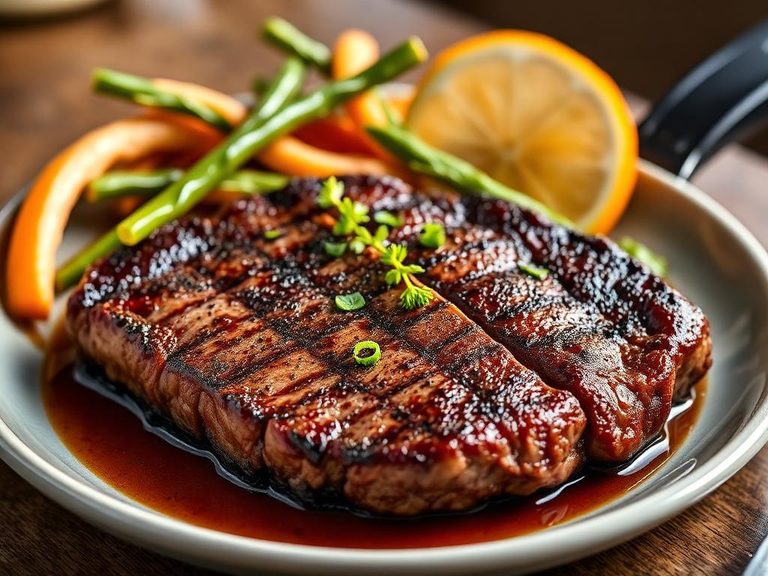
This is a lean, raw cut of imported New Zealand beef, specifically the flat iron or similar flat muscle, prized for its fine grain and buttery tenderness. It boasts a clean, beefy flavor with a subtle sweetness and a texture that melts in the mouth when cooked properly. Nutritionally, it's a powerhouse of high-quality protein with virtually no carbohydrates and a moderate, healthy fat content.
Calorie split: 55% protein · 0% carbs · 45% fat
↓ Full nutrition💚 Why it's loved
People love it for its exceptional tenderness and rich, umami-packed beef flavor that shines with simple seasoning. Its uniform, flat shape makes it incredibly versatile for quick, high-heat cooking methods that deliver a perfect sear.
⚠️ Watch-outs & how to enjoy it better
As a red meat, it should be consumed in moderation by those managing saturated fat intake or certain health conditions. To counteract this, practice portion control (stick to a 3-4 oz serving) and pair it with fiber-rich vegetables like roasted broccoli or a fresh salad to balance the meal.
Key benefits
- Excellent source of complete, high-quality protein for muscle maintenance.
- Naturally zero carbohydrates and sugars, ideal for low-carb diets.
- Rich in essential minerals like iron, zinc, and B vitamins (especially B12).
- Contains conjugated linoleic acid (CLA), a fatty acid linked to various health benefits.
- Lean cut with a favorable protein-to-fat ratio.
🍽️ Popular dishes
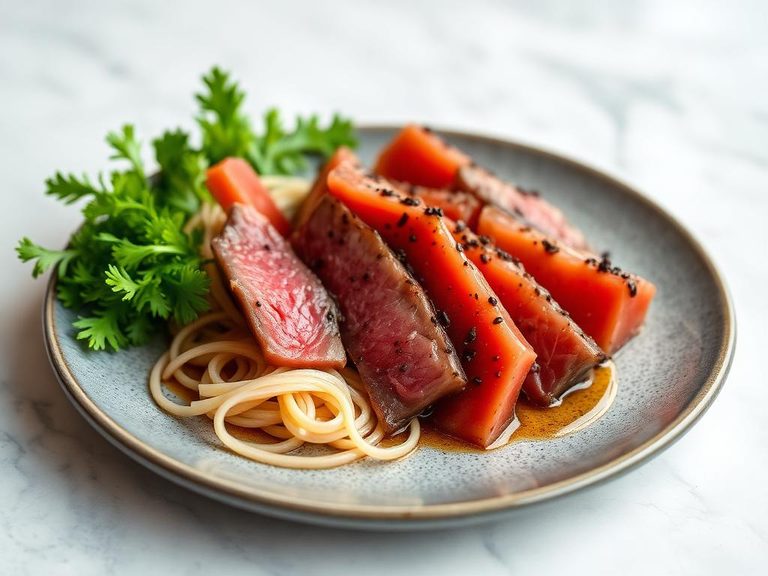
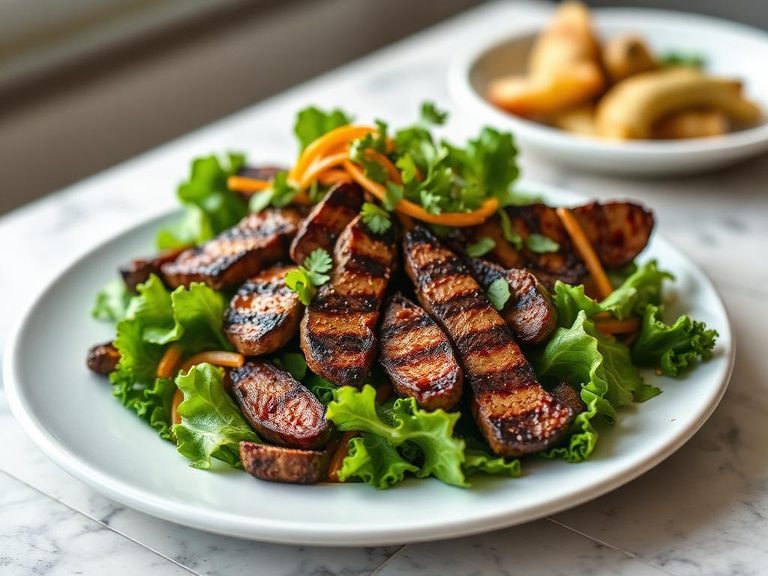
🌍 Where it's eaten
💡 Did you know?
The 'flat iron' cut gets its name from its resemblance to an old-fashioned metal flat iron, and it was only named and popularized in the early 2000s after the beef industry identified it as an underutilized, premium muscle.
Full nutrition (USDA data · scales with serving)
| Water | 70.8 g |
| Energy | 154 kcal |
| Energy | 646 kj |
| Protein | 21.3 g |
| Total lipid (fat) | 7.7 g |
| Ash | 0.92 g |
| Carbohydrate, by difference | 0.00 g |
| Fiber, total dietary | 0.00 g |
| Total Sugars | 0.00 g |
| Calcium, Ca | 5.0 mg |
| Iron, Fe | 1.9 mg |
| Magnesium, Mg | 20.0 mg |
| Phosphorus, P | 175 mg |
| Potassium, K | 291 mg |
| Sodium, Na | 50.0 mg |
| Zinc, Zn | 5.4 mg |
| Copper, Cu | 0.12 mg |
| Manganese, Mn | 0.01 mg |
| Selenium, Se | 1.0 ug |
| Vitamin C, total ascorbic acid | 0.00 mg |
| Thiamin | 0.04 mg |
| Riboflavin | 0.14 mg |
| Niacin | 3.3 mg |
| Pantothenic acid | 0.32 mg |
| Vitamin B-6 | 0.28 mg |
| Vitamin B-12 | 2.9 ug |
| Vitamin B-12, added | 0.00 ug |
| Vitamin A, RAE | 11.0 ug |
| Retinol | 11.0 ug |
| Carotene, beta | 0.00 ug |
| Carotene, alpha | 0.00 ug |
| Cryptoxanthin, beta | 0.00 ug |
| Vitamin A, IU | 36.0 iu |
| Lycopene | 0.00 ug |
| Lutein + zeaxanthin | 0.00 ug |
| Vitamin E (alpha-tocopherol) | 0.52 mg |
| Vitamin E, added | 0.00 mg |
| Vitamin D (D2 + D3), International Units | 0.00 iu |
| Vitamin D (D2 + D3) | 0.00 ug |
| Vitamin D3 (cholecalciferol) | 0.00 ug |
| Alcohol, ethyl | 0.00 g |
| Caffeine | 0.00 mg |
| Theobromine | 0.00 mg |
Fat & fatty acid profile (per 100g)
| Fatty acids, total saturated | 2.5 g |
| SFA 4:0 | 0.00 g |
| SFA 6:0 | 0.00 g |
| SFA 8:0 | 0.00 g |
| SFA 10:0 | 0.00 g |
| SFA 12:0 | 0.00 g |
| SFA 14:0 | 0.15 g |
| SFA 16:0 | 1.5 g |
| SFA 17:0 | 0.09 g |
| SFA 18:0 | 0.78 g |
| SFA 20:0 | 0.01 g |
| SFA 22:0 | 0.00 g |
| SFA 24:0 | 0.00 g |
| Fatty acids, total monounsaturated | 3.1 g |
| MUFA 14:1 | 0.06 g |
| MUFA 15:1 | 0.00 g |
| MUFA 16:1 | 0.31 g |
| MUFA 16:1 c | 0.28 g |
| MUFA 17:1 | 0.00 g |
| MUFA 18:1 | 2.8 g |
| MUFA 18:1 c | 2.6 g |
| MUFA 20:1 | 0.01 g |
| MUFA 22:1 | 0.00 g |
| MUFA 22:1 c | 0.00 g |
| MUFA 24:1 c | 0.00 g |
| Fatty acids, total polyunsaturated | 0.33 g |
| PUFA 18:2 | 0.16 g |
| PUFA 18:2 n-6 c,c | 0.11 g |
| PUFA 18:2 CLAs | 0.05 g |
| PUFA 18:3 | 0.07 g |
| PUFA 18:3 n-3 c,c,c (ALA) | 0.07 g |
| PUFA 18:3 n-6 c,c,c | 0.00 g |
| PUFA 18:4 | 0.00 g |
| PUFA 20:2 n-6 c,c | 0.00 g |
| PUFA 20:3 | 0.01 g |
| PUFA 20:3 n-3 | 0.00 g |
| PUFA 20:3 n-6 | 0.01 g |
| PUFA 20:4 | 0.03 g |
| PUFA 20:4 n-6 | 0.03 g |
| PUFA 20:5 n-3 (EPA) | 0.02 g |
| PUFA 22:5 n-3 (DPA) | 0.02 g |
| PUFA 22:6 n-3 (DHA) | 0.00 g |
| Fatty acids, total trans | 0.15 g |
| Fatty acids, total trans-monoenoic | 0.15 g |
| TFA 16:1 t | 0.03 g |
| TFA 18:1 t | 0.12 g |
| TFA 18:2 t,t | 0.00 g |
| Fatty acids, total trans-polyenoic | 0.00 g |
| Cholesterol | 55.0 mg |
Amino acid profile (per 100g)
| Tryptophan | 0.22 g |
| Threonine | 0.77 g |
| Isoleucine | 0.89 g |
| Leucine | 1.6 g |
| Lysine | 1.7 g |
| Methionine | 0.70 g |
| Phenylalanine | 0.83 g |
| Tyrosine | 0.72 g |
| Valine | 0.94 g |
| Arginine | 1.4 g |
| Histidine | 0.77 g |
| Alanine | 1.1 g |
| Glutamic acid | 3.0 g |
| Glycine | 1.2 g |
| Proline | 0.68 g |
| Serine | 0.75 g |
FAQ
What is the best way to cook this cut?
High-heat, quick cooking is ideal. Pan-sear, grill, or broil it to medium-rare or medium (130-145°F internal temp) to preserve its tenderness and juices. Let it rest for 5-10 minutes before slicing against the grain.
Is this cut the same as flank steak?
No, they are different muscles. Flat iron (from the shoulder) is generally more marbled and tender than flank steak (from the abdominal). Flank is leaner and has a more pronounced grain, making it better for dishes like carne asada or fajitas where it's sliced thin.
Why is it imported from New Zealand?
New Zealand is renowned for its grass-fed beef production, which often results in a leaner product with a distinct flavor profile. Importing allows for year-round availability and offers consumers a specific taste and quality associated with that region.
Nutrient density (calculated · NRF9.3)
Nutrient Rich Foods index: beneficial nutrients (protein, fiber, vitamins, minerals) minus saturated fat, added sugar & sodium, per 100 kcal.
NRF9.3 index — Fulgoni, Keast & Drewnowski, 2009. Computed from USDA nutrients.
Weight-loss friendliness (composite index)
Energy density 1.54 kcal/g · 55% calories from protein · 0.0 g fiber · 0.0 g sugar per 100 g.
Composite of energy density (Rolls et al., 1999), protein & fiber satiety, minus sugar. A calculated heuristic — ranks satiety-per-calorie, not a clinical measure.
Dietary load (calculated from USDA values)
Potential renal acid load. Positive = acid-forming, negative = alkaline-forming.
Sodium-to-potassium ratio: 0.17 (lower is better — aim for ≤ 1)
Sodium:potassium per WHO potassium guidance. Computed from USDA nutrients.