

Sweet potato, cooked, baked in skin, flesh, with salt
Whole food · Vegetables and Vegetable Products
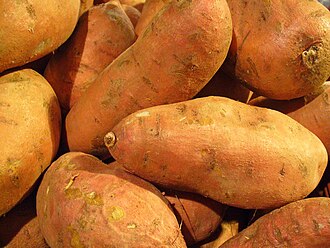
Photo: Wikipedia
A whole sweet potato, baked until its skin crisps and its flesh turns into a sweet, creamy, caramelized custard. The simple addition of salt amplifies its natural, earthy sweetness and creates a deeply satisfying, comforting flavor profile. It's a nutrient-dense powerhouse, offering significant fiber and vitamins for very few calories.
Calorie split: 9% protein · 90% carbs · 1% fat
↓ Full nutrition💚 Why it's loved
People adore it for its naturally sweet, almost dessert-like flavor and velvety texture that requires minimal preparation. It's a beloved comfort food that bridges the gap between a wholesome snack and a satisfying side dish.
⚠️ Watch-outs & how to enjoy it better
The high carbohydrate content can cause blood sugar spikes, particularly for those with diabetes or insulin resistance. To mitigate this, pair it with a source of protein (like Greek yogurt) or healthy fat (like nuts) to slow digestion. The added salt in this preparation is a consideration for those monitoring sodium intake.
Key benefits
- Excellent source of beta-carotene (vitamin A precursor)
- High in dietary fiber for digestive health
- Provides sustained energy from complex carbohydrates
- Rich in potassium, supporting heart and muscle function
- Contains antioxidants that combat oxidative stress
🍽️ Popular dishes



🌍 Where it's eaten
💡 Did you know?
The flesh color is not just for show; the deeper the orange, the higher the concentration of beta-carotene, which your body converts to vitamin A.
Full nutrition (USDA data · scales with serving)
| Water | 75.8 g |
| Energy | 90.0 kcal |
| Energy | 378 kj |
| Protein | 2.0 g |
| Total lipid (fat) | 0.15 g |
| Ash | 1.4 g |
| Carbohydrate, by difference | 20.7 g |
| Fiber, total dietary | 3.3 g |
| Total Sugars | 6.5 g |
| Sucrose | 2.3 g |
| Glucose | 0.57 g |
| Fructose | 0.50 g |
| Lactose | 0.00 g |
| Maltose | 3.1 g |
| Galactose | 0.00 g |
| Starch | 7.0 g |
| Calcium, Ca | 38.0 mg |
| Iron, Fe | 0.69 mg |
| Magnesium, Mg | 27.0 mg |
| Phosphorus, P | 54.0 mg |
| Potassium, K | 475 mg |
| Sodium, Na | 246 mg |
| Zinc, Zn | 0.32 mg |
| Copper, Cu | 0.16 mg |
| Manganese, Mn | 0.50 mg |
| Selenium, Se | 0.20 ug |
| Vitamin C, total ascorbic acid | 19.6 mg |
| Thiamin | 0.11 mg |
| Riboflavin | 0.11 mg |
| Niacin | 1.5 mg |
| Pantothenic acid | 0.88 mg |
| Vitamin B-6 | 0.29 mg |
| Folate, total | 6.0 ug |
| Folic acid | 0.00 ug |
| Folate, food | 6.0 ug |
| Folate, DFE | 6.0 ug |
| Choline, total | 13.1 mg |
| Betaine | 34.6 mg |
| Vitamin B-12 | 0.00 ug |
| Vitamin B-12, added | 0.00 ug |
| Retinol | 0.00 ug |
| Vitamin E (alpha-tocopherol) | 0.71 mg |
| Vitamin E, added | 0.00 mg |
| Tocopherol, beta | 0.00 mg |
| Tocopherol, gamma | 0.01 mg |
| Tocopherol, delta | 0.00 mg |
| Tocotrienol, alpha | 0.02 mg |
| Tocotrienol, beta | 0.00 mg |
| Tocotrienol, gamma | 0.00 mg |
| Tocotrienol, delta | 0.00 mg |
| Vitamin D (D2 + D3), International Units | 0.00 iu |
| Vitamin D (D2 + D3) | 0.00 ug |
| Vitamin K (phylloquinone) | 2.3 ug |
| Vitamin K (Dihydrophylloquinone) | 0.00 ug |
| Alcohol, ethyl | 0.00 g |
| Caffeine | 0.00 mg |
| Theobromine | 0.00 mg |
Fat & fatty acid profile (per 100g)
| Fatty acids, total saturated | 0.05 g |
| SFA 8:0 | 0.00 g |
| SFA 10:0 | 0.00 g |
| SFA 12:0 | 0.00 g |
| SFA 14:0 | 0.00 g |
| SFA 15:0 | 0.00 g |
| SFA 16:0 | 0.05 g |
| SFA 17:0 | 0.00 g |
| SFA 18:0 | 0.00 g |
| SFA 20:0 | 0.00 g |
| SFA 22:0 | 0.00 g |
| SFA 24:0 | 0.00 g |
| Fatty acids, total monounsaturated | 0.00 g |
| MUFA 14:1 | 0.00 g |
| MUFA 15:1 | 0.00 g |
| MUFA 16:1 | 0.00 g |
| MUFA 17:1 | 0.00 g |
| MUFA 18:1 | 0.00 g |
| MUFA 20:1 | 0.00 g |
| MUFA 22:1 | 0.00 g |
| Fatty acids, total polyunsaturated | 0.09 g |
| PUFA 18:2 | 0.09 g |
| PUFA 18:3 | 0.01 g |
| PUFA 18:4 | 0.00 g |
| PUFA 20:2 n-6 c,c | 0.00 g |
| PUFA 20:3 | 0.00 g |
| PUFA 20:4 | 0.00 g |
| PUFA 20:5 n-3 (EPA) | 0.00 g |
| PUFA 22:5 n-3 (DPA) | 0.00 g |
| PUFA 22:6 n-3 (DHA) | 0.00 g |
| Fatty acids, total trans | 0.00 g |
| Cholesterol | 0.00 mg |
Amino acid profile (per 100g)
| Tryptophan | 0.04 g |
| Threonine | 0.11 g |
| Isoleucine | 0.07 g |
| Leucine | 0.12 g |
| Lysine | 0.08 g |
| Methionine | 0.04 g |
| Cystine | 0.03 g |
| Phenylalanine | 0.11 g |
| Tyrosine | 0.04 g |
| Valine | 0.11 g |
| Arginine | 0.07 g |
| Histidine | 0.04 g |
| Alanine | 0.10 g |
| Aspartic acid | 0.49 g |
| Glutamic acid | 0.20 g |
| Glycine | 0.08 g |
| Proline | 0.07 g |
| Serine | 0.11 g |
FAQ
Is the skin edible when baked?
Yes, the skin is completely edible and contains a good amount of fiber and nutrients. It becomes slightly crispy when baked and can be easily scooped out with the flesh.
How does baking compare to boiling for nutrition?
Baking, especially in the skin, helps retain more water-soluble vitamins (like some B vitamins) and concentrates the natural sugars, enhancing flavor without added fats. Boiling can cause some nutrients to leach into the water.
Can I reduce the glycemic impact?
Yes. Eating it cooled (as in a salad) increases resistant starch, which lowers the glycemic response. Also, consuming it with protein or fat (like a fried egg or avocado) significantly blunts the blood sugar spike.
Nutrient density (calculated · NRF9.3)
Nutrient Rich Foods index: beneficial nutrients (protein, fiber, vitamins, minerals) minus saturated fat, added sugar & sodium, per 100 kcal.
NRF9.3 index — Fulgoni, Keast & Drewnowski, 2009. Computed from USDA nutrients.
Weight-loss friendliness (composite index)
Energy density 0.90 kcal/g · 9% calories from protein · 3.3 g fiber · 6.5 g sugar per 100 g.
Composite of energy density (Rolls et al., 1999), protein & fiber satiety, minus sugar. A calculated heuristic — ranks satiety-per-calorie, not a clinical measure.
Dietary load (calculated from USDA values)
Potential renal acid load. Positive = acid-forming, negative = alkaline-forming.
Sodium-to-potassium ratio: 0.52 (lower is better — aim for ≤ 1)
Sodium:potassium per WHO potassium guidance. Computed from USDA nutrients.