

Sausage, beef, fresh, cooked
Whole food · Sausages and Luncheon Meats

Photo: Wikipedia
Fresh beef sausage is a savory, coarsely ground meat product, typically seasoned with salt, pepper, and spices like garlic or paprika. When cooked, it develops a juicy, slightly crumbly texture with a rich, beefy flavor and a satisfying sear. Nutritionally, it's a dense source of protein and fat, with virtually no carbohydrates.
Calorie split: 22% protein · 0% carbs · 77% fat
↓ Full nutrition💚 Why it's loved
People love beef sausage for its robust, savory umami flavor and satisfying, hearty texture that anchors a meal. Its versatility makes it a staple in everything from a simple breakfast fry-up to complex stews and grilled dishes.
⚠️ Watch-outs & how to enjoy it better
The high saturated fat and sodium content can be a concern for heart health and blood pressure. To mitigate this, choose lower-sodium varieties, drain excess fat after cooking, and pair it with high-fiber vegetables like roasted broccoli or a fresh salad to balance the meal.
Key benefits
- High-quality complete protein for muscle maintenance
- Excellent source of heme iron, which is highly absorbable
- Provides essential B vitamins like B12 and niacin
- Contains zinc, important for immune function
- Offers a concentrated source of energy from fats
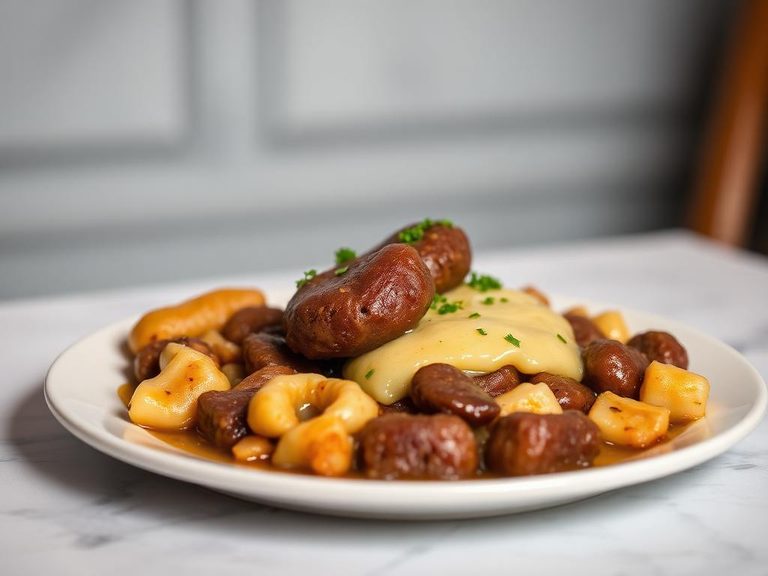
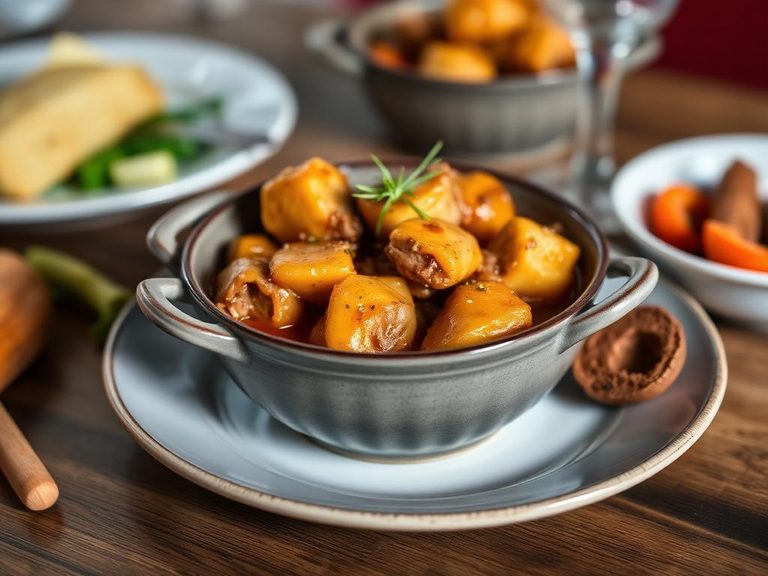
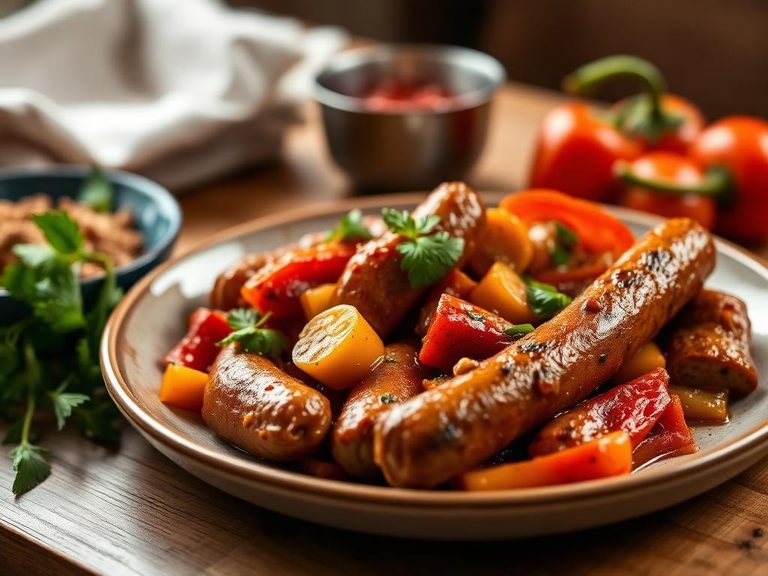
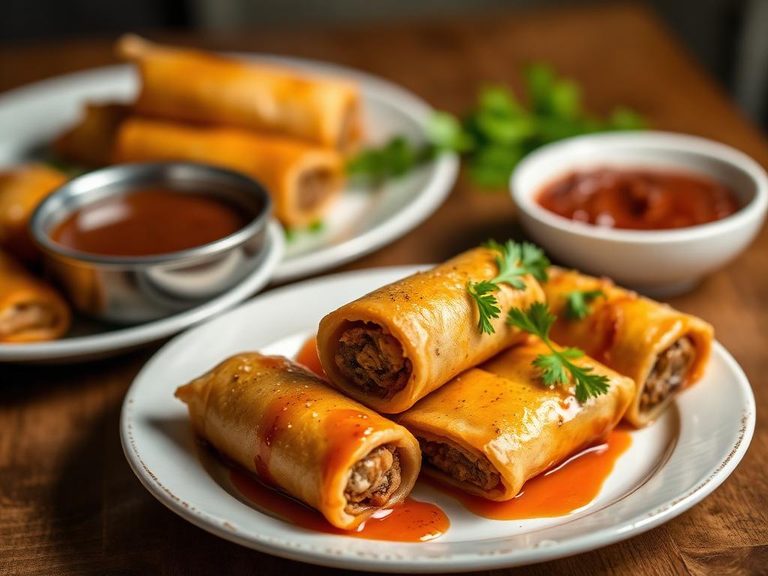
🍽️ Popular dishes

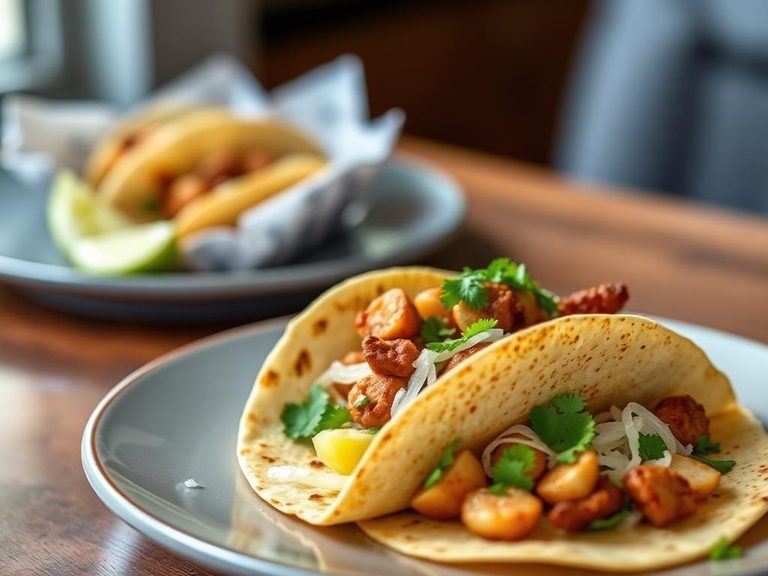
🌍 Where it's eaten
💡 Did you know?
The natural casing for traditional sausages is made from cleaned animal intestines, a practice that dates back thousands of years to ancient Sumeria.
Full nutrition (USDA data · scales with serving)
| Water | 51.1 g |
| Energy | 332 kcal |
| Energy | 1387 kj |
| Protein | 18.2 g |
| Total lipid (fat) | 28.0 g |
| Ash | 2.3 g |
| Carbohydrate, by difference | 0.35 g |
| Fiber, total dietary | 0.00 g |
| Total Sugars | 0.00 g |
| Calcium, Ca | 11.0 mg |
| Iron, Fe | 1.6 mg |
| Magnesium, Mg | 14.0 mg |
| Phosphorus, P | 141 mg |
| Potassium, K | 258 mg |
| Sodium, Na | 813 mg |
| Zinc, Zn | 4.4 mg |
| Copper, Cu | 0.07 mg |
| Manganese, Mn | 0.00 mg |
| Selenium, Se | 0.00 ug |
| Vitamin C, total ascorbic acid | 0.00 mg |
| Thiamin | 0.05 mg |
| Riboflavin | 0.15 mg |
| Niacin | 3.6 mg |
| Pantothenic acid | 0.52 mg |
| Vitamin B-6 | 0.31 mg |
| Folate, total | 3.0 ug |
| Folic acid | 0.00 ug |
| Folate, food | 3.0 ug |
| Folate, DFE | 3.0 ug |
| Choline, total | 51.4 mg |
| Betaine | 10.4 mg |
| Vitamin B-12 | 2.0 ug |
| Vitamin B-12, added | 0.00 ug |
| Vitamin A, RAE | 13.0 ug |
| Retinol | 11.0 ug |
| Carotene, beta | 15.0 ug |
| Carotene, alpha | 11.0 ug |
| Cryptoxanthin, beta | 11.0 ug |
| Vitamin A, IU | 81.0 iu |
| Lycopene | 11.0 ug |
| Lutein + zeaxanthin | 0.00 ug |
| Vitamin E (alpha-tocopherol) | 0.24 mg |
| Vitamin E, added | 0.00 mg |
| Tocopherol, beta | 0.00 mg |
| Tocopherol, gamma | 0.08 mg |
| Tocopherol, delta | 0.00 mg |
| Tocotrienol, alpha | 0.09 mg |
| Tocotrienol, beta | 0.00 mg |
| Tocotrienol, gamma | 0.00 mg |
| Tocotrienol, delta | 0.00 mg |
| Vitamin D (D2 + D3), International Units | 18.0 iu |
| Vitamin D (D2 + D3) | 0.50 ug |
| Vitamin D3 (cholecalciferol) | 0.50 ug |
| Vitamin K (phylloquinone) | 1.1 ug |
| Alcohol, ethyl | 0.00 g |
| Caffeine | 0.00 mg |
| Theobromine | 0.00 mg |
Fat & fatty acid profile (per 100g)
| Fatty acids, total saturated | 10.9 g |
| SFA 4:0 | 0.00 g |
| SFA 6:0 | 0.00 g |
| SFA 8:0 | 0.00 g |
| SFA 10:0 | 0.00 g |
| SFA 12:0 | 0.00 g |
| SFA 14:0 | 0.00 g |
| SFA 15:0 | 0.13 g |
| SFA 16:0 | 6.3 g |
| SFA 18:0 | 3.3 g |
| SFA 20:0 | 0.00 g |
| SFA 22:0 | 0.00 g |
| Fatty acids, total monounsaturated | 12.6 g |
| MUFA 14:1 | 0.26 g |
| MUFA 15:1 | 0.03 g |
| MUFA 16:1 | 0.00 g |
| MUFA 18:1 | 11.2 g |
| MUFA 20:1 | 0.10 g |
| MUFA 22:1 | 0.00 g |
| Fatty acids, total polyunsaturated | 0.66 g |
| PUFA 18:2 | 0.57 g |
| PUFA 18:3 | 0.00 g |
| PUFA 18:3 n-3 c,c,c (ALA) | 0.05 g |
| PUFA 18:3 n-6 c,c,c | 0.05 g |
| PUFA 18:4 | 0.00 g |
| PUFA 20:2 n-6 c,c | 0.00 g |
| PUFA 20:3 | 0.00 g |
| PUFA 20:4 | 0.04 g |
| PUFA 20:5 n-3 (EPA) | 0.00 g |
| PUFA 22:5 n-3 (DPA) | 0.00 g |
| PUFA 22:6 n-3 (DHA) | 0.00 g |
| Fatty acids, total trans | 1.4 g |
| Cholesterol | 82.0 mg |
Amino acid profile (per 100g)
| Tryptophan | 0.12 g |
| Threonine | 0.81 g |
| Isoleucine | 0.86 g |
| Leucine | 1.5 g |
| Lysine | 1.6 g |
| Methionine | 0.41 g |
| Cystine | 0.21 g |
| Phenylalanine | 0.75 g |
| Tyrosine | 0.58 g |
| Valine | 0.99 g |
| Arginine | 1.2 g |
| Histidine | 0.65 g |
| Alanine | 1.3 g |
| Aspartic acid | 1.8 g |
| Glutamic acid | 3.0 g |
| Glycine | 1.3 g |
| Proline | 0.92 g |
| Serine | 0.77 g |
| Hydroxyproline | 0.28 g |
FAQ
What's the difference between fresh and pre-cooked sausage?
Fresh sausage is raw ground meat mixed with seasonings and must be cooked thoroughly before eating. Pre-cooked sausage (like some breakfast links) has been heated during processing and mainly needs reheating, though cooking it for better texture is common.
How can I tell when it's fully cooked?
The most reliable method is using a meat thermometer; the internal temperature should reach 160°F (71°C). The sausage should also be no longer pink in the center and the juices should run clear.
Is beef sausage healthier than pork sausage?
Generally, lean beef sausage can have slightly less saturated fat than regular pork sausage, but it varies greatly by brand and cut of meat used. Always check the nutrition label for specific comparisons on fat, sodium, and calorie content.
Nutrient density (calculated · NRF9.3)
Nutrient Rich Foods index: beneficial nutrients (protein, fiber, vitamins, minerals) minus saturated fat, added sugar & sodium, per 100 kcal.
NRF9.3 index — Fulgoni, Keast & Drewnowski, 2009. Computed from USDA nutrients.
Weight-loss friendliness (composite index)
Energy density 3.32 kcal/g · 22% calories from protein · 0.0 g fiber · 0.0 g sugar per 100 g.
Composite of energy density (Rolls et al., 1999), protein & fiber satiety, minus sugar. A calculated heuristic — ranks satiety-per-calorie, not a clinical measure.
Dietary load (calculated from USDA values)
Potential renal acid load. Positive = acid-forming, negative = alkaline-forming.
Sodium-to-potassium ratio: 3.15 (lower is better — aim for ≤ 1)
Sodium:potassium per WHO potassium guidance. Computed from USDA nutrients.