

Lamb, Australian, imported, fresh, rib chop, frenched, bone-in, separable lean and fat, trimmed to 1/8" fat, cooked, grilled
Whole food · Lamb, Veal, and Game Products
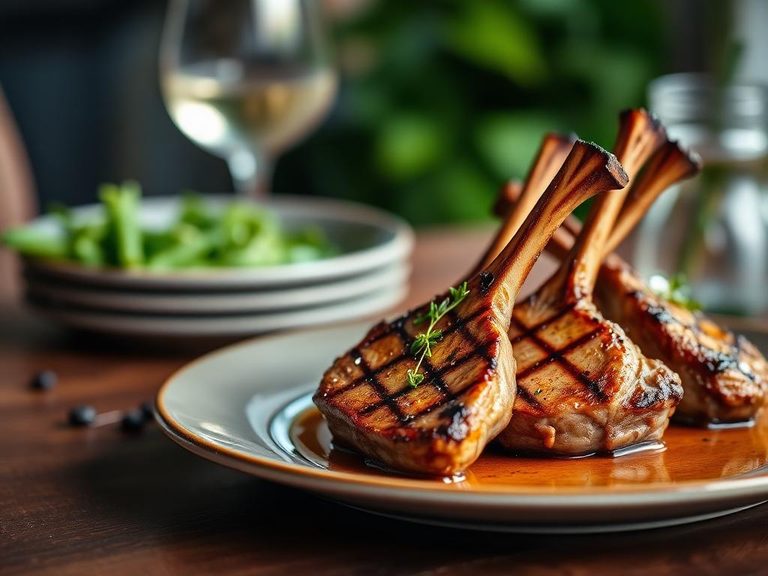
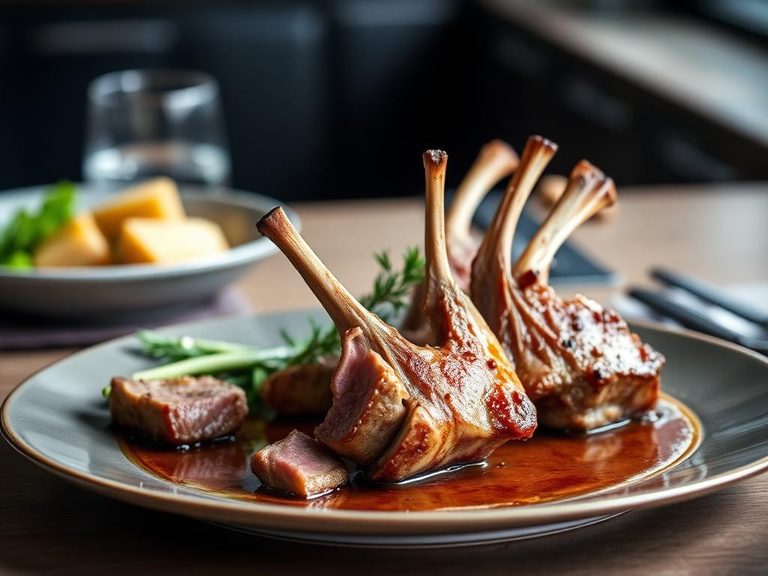
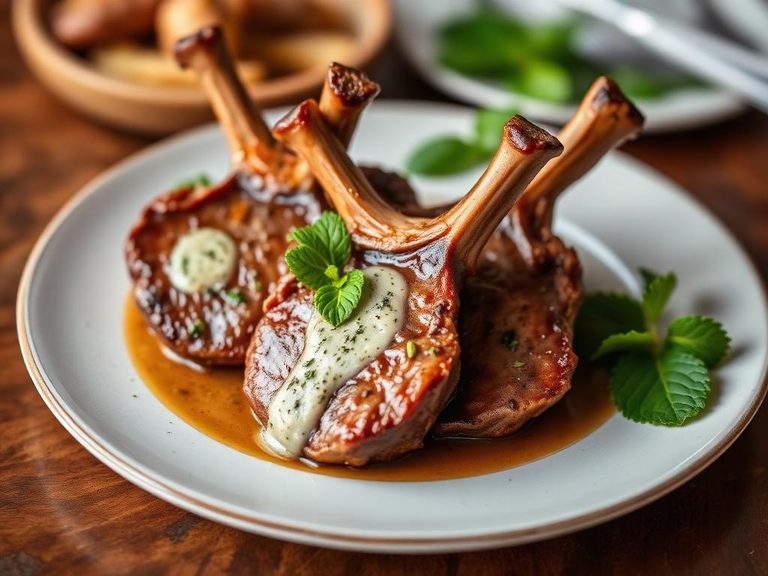
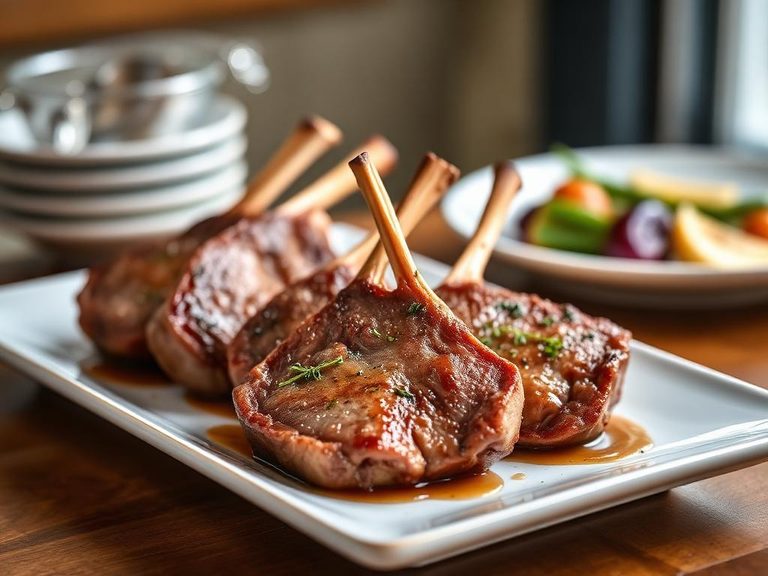
This is a premium cut of Australian lamb rib chop, frenched for elegant presentation and grilled to a perfect medium-rare. The meat offers a rich, buttery flavor with a tender, juicy texture, while the thin, crispy fat cap provides a satisfying contrast. Nutritionally, it's a dense source of high-quality protein and healthy fats, with zero carbohydrates.
Calorie split: 37% protein · 0% carbs · 63% fat
↓ Full nutrition💚 Why it's loved
People adore the luxurious, clean taste of grilled lamb, which is both robust and subtly sweet. The frenched bone makes it a visually stunning centerpiece for special meals, from elegant dinners to festive barbecues.
⚠️ Watch-outs & how to enjoy it better
As a red meat with a notable fat content, it is high in saturated fat and calories, requiring mindful portion control for those monitoring heart health or calorie intake. To counteract this, pair a smaller portion with large servings of non-starchy vegetables like roasted asparagus or a fresh salad to add fiber and volume, enhancing satiety without excess calories.
Key benefits
- Excellent source of complete protein for muscle maintenance and repair.
- Rich in bioavailable iron and zinc, essential for immune function and energy metabolism.
- Provides B vitamins, particularly B12, crucial for nerve health and red blood cell formation.
- Contains conjugated linoleic acid (CLA), a naturally occurring fatty acid studied for its potential health benefits.
- A nutrient-dense, low-carb option suitable for ketogenic and carnivore dietary patterns.
🍽️ Popular dishes
🌍 Where it's eaten
💡 Did you know?
The 'frenched' technique, where meat is scraped clean from the end of the rib bone, is named after the French culinary tradition of preparing racks of lamb for a more refined presentation.
Full nutrition (USDA data · scales with serving)
| Water | 49.6 g |
| Energy | 305 kcal |
| Energy | 1275 kj |
| Protein | 28.5 g |
| Total lipid (fat) | 21.2 g |
| Ash | 1.1 g |
| Carbohydrate, by difference | 0.00 g |
| Fiber, total dietary | 0.00 g |
| Total Sugars | 0.00 g |
| Calcium, Ca | 11.0 mg |
| Iron, Fe | 2.2 mg |
| Magnesium, Mg | 24.0 mg |
| Phosphorus, P | 199 mg |
| Potassium, K | 292 mg |
| Sodium, Na | 79.0 mg |
| Zinc, Zn | 3.0 mg |
| Copper, Cu | 0.12 mg |
| Manganese, Mn | 0.01 mg |
| Selenium, Se | 12.9 ug |
| Vitamin C, total ascorbic acid | 0.00 mg |
| Thiamin | 0.14 mg |
| Riboflavin | 0.34 mg |
| Niacin | 7.8 mg |
| Pantothenic acid | 0.63 mg |
| Vitamin B-6 | 0.54 mg |
| Vitamin B-12 | 1.3 ug |
| Vitamin B-12, added | 0.00 ug |
| Vitamin A, RAE | 3.0 ug |
| Retinol | 3.0 ug |
| Carotene, beta | 0.00 ug |
| Carotene, alpha | 0.00 ug |
| Cryptoxanthin, beta | 0.00 ug |
| Vitamin A, IU | 11.0 iu |
| Lycopene | 0.00 ug |
| Lutein + zeaxanthin | 0.00 ug |
| Vitamin E (alpha-tocopherol) | 0.31 mg |
| Vitamin E, added | 0.00 mg |
| Vitamin D (D2 + D3), International Units | 0.00 iu |
| Vitamin D (D2 + D3) | 0.00 ug |
| Vitamin D2 (ergocalciferol) | 0.00 ug |
| Vitamin D3 (cholecalciferol) | 0.00 ug |
| Alcohol, ethyl | 0.00 g |
| Caffeine | 0.00 mg |
| Theobromine | 0.00 mg |
Fat & fatty acid profile (per 100g)
| Fatty acids, total saturated | 10.7 g |
| SFA 4:0 | 0.00 g |
| SFA 6:0 | 0.00 g |
| SFA 8:0 | 0.00 g |
| SFA 10:0 | 0.03 g |
| SFA 12:0 | 0.05 g |
| SFA 14:0 | 0.73 g |
| SFA 15:0 | 0.14 g |
| SFA 16:0 | 4.9 g |
| SFA 17:0 | 0.32 g |
| SFA 18:0 | 4.5 g |
| SFA 20:0 | 0.04 g |
| SFA 22:0 | 0.01 g |
| SFA 24:0 | 0.00 g |
| Fatty acids, total monounsaturated | 8.4 g |
| MUFA 14:1 | 0.02 g |
| MUFA 15:1 | 0.00 g |
| MUFA 16:1 | 0.26 g |
| MUFA 17:1 | 0.00 g |
| MUFA 18:1 | 8.1 g |
| MUFA 18:1 c | 7.0 g |
| MUFA 20:1 | 0.01 g |
| MUFA 22:1 | 0.00 g |
| MUFA 22:1 c | 0.00 g |
| Fatty acids, total polyunsaturated | 1.2 g |
| PUFA 18:2 | 0.89 g |
| PUFA 18:2 n-6 c,c | 0.39 g |
| PUFA 18:2 CLAs | 0.18 g |
| PUFA 18:3 | 0.21 g |
| PUFA 18:3 n-3 c,c,c (ALA) | 0.21 g |
| PUFA 18:3 n-6 c,c,c | 0.00 g |
| PUFA 18:4 | 0.00 g |
| PUFA 20:2 n-6 c,c | 0.00 g |
| PUFA 20:3 | 0.00 g |
| PUFA 20:4 | 0.05 g |
| PUFA 20:5 n-3 (EPA) | 0.02 g |
| PUFA 22:5 n-3 (DPA) | 0.05 g |
| PUFA 22:6 n-3 (DHA) | 0.01 g |
| Fatty acids, total trans | 1.4 g |
| Fatty acids, total trans-monoenoic | 1.1 g |
| TFA 18:1 t | 1.1 g |
| TFA 18:2 t not further defined | 0.32 g |
| Fatty acids, total trans-polyenoic | 0.32 g |
| Cholesterol | 91.0 mg |
Amino acid profile (per 100g)
| Tryptophan | 0.30 g |
| Threonine | 1.2 g |
| Isoleucine | 1.2 g |
| Leucine | 2.0 g |
| Lysine | 2.2 g |
| Methionine | 0.69 g |
| Cystine | 0.29 g |
| Phenylalanine | 1.1 g |
| Tyrosine | 0.89 g |
| Valine | 1.3 g |
| Arginine | 1.7 g |
| Histidine | 0.74 g |
| Alanine | 1.6 g |
| Aspartic acid | 2.3 g |
| Glutamic acid | 3.8 g |
| Glycine | 1.5 g |
| Proline | 1.2 g |
| Serine | 1.0 g |
FAQ
What does 'frenched' mean for a lamb chop?
Frenched refers to the butchery technique where the meat and fat are trimmed away from the end of the rib bone, leaving it clean and exposed for a more elegant presentation.
How should I cook a frenched lamb rib chop?
Grilling or pan-searing over high heat is ideal to develop a flavorful crust while keeping the interior juicy. Aim for medium-rare (135°F / 57°C internal temperature) for the best texture and flavor.
What is the difference between a rib chop and a loin chop?
A rib chop comes from the rib section and has a long, curved bone with a central eye of meat. A loin chop is from the back and often resembles a small T-bone steak, containing meat from both the loin and tenderloin.
Is Australian lamb grass-fed?
The majority of Australian lamb is grass-fed, as the country's climate and vast pastures are ideal for this raising method. This often results in a distinct, slightly gamier flavor compared to grain-fed lamb.
Nutrient density (calculated · NRF9.3)
Nutrient Rich Foods index: beneficial nutrients (protein, fiber, vitamins, minerals) minus saturated fat, added sugar & sodium, per 100 kcal.
NRF9.3 index — Fulgoni, Keast & Drewnowski, 2009. Computed from USDA nutrients.
Weight-loss friendliness (composite index)
Energy density 3.05 kcal/g · 37% calories from protein · 0.0 g fiber · 0.0 g sugar per 100 g.
Composite of energy density (Rolls et al., 1999), protein & fiber satiety, minus sugar. A calculated heuristic — ranks satiety-per-calorie, not a clinical measure.
Dietary load (calculated from USDA values)
Potential renal acid load. Positive = acid-forming, negative = alkaline-forming.
Sodium-to-potassium ratio: 0.27 (lower is better — aim for ≤ 1)
Sodium:potassium per WHO potassium guidance. Computed from USDA nutrients.