

Beef, chuck eye Country-Style ribs, boneless, separable lean only, trimmed to 0" fat, select, raw
Whole food · Beef Products

Photo: Wikipedia
This is a lean, boneless cut from the chuck shoulder, prized for its deep beefy flavor and tender, fine-grained texture when cooked properly. With an impressive 21.1g of protein and virtually no fat or carbs per 100g, it's a powerhouse of pure nutrition. Its raw, marbled appearance promises rich taste that transforms beautifully with slow, moist heat.
Calorie split: 61% protein · 0% carbs · 39% fat
↓ Full nutrition💚 Why it's loved
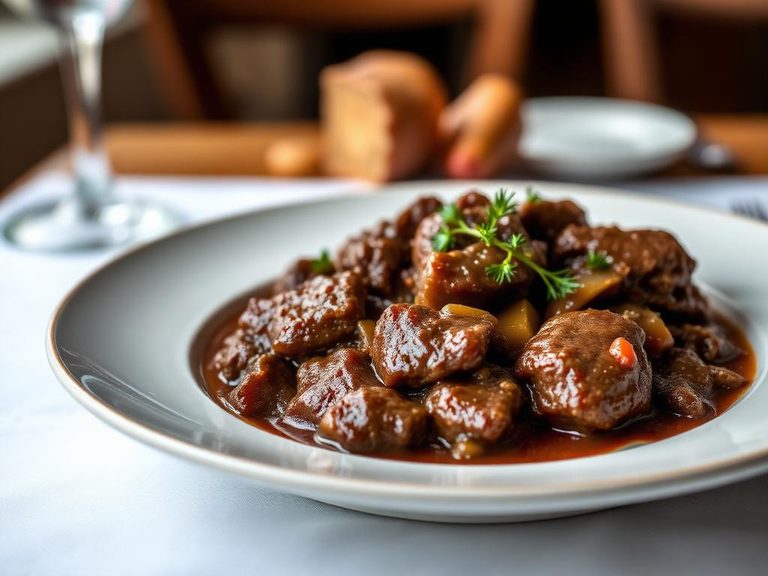
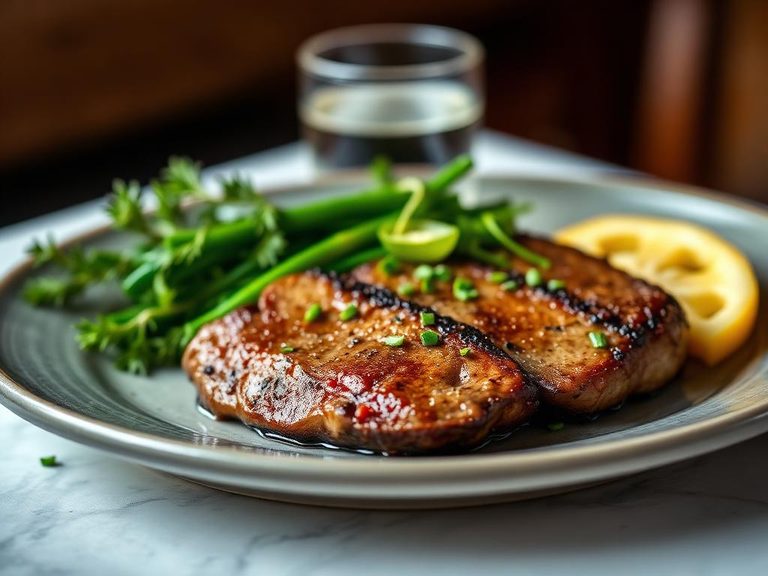
People love it for its robust, meaty flavor that stands up to bold seasonings and long braises, becoming fork-tender without falling apart. Its versatility makes it a staple for everything from hearty stews to simple grilled steaks, connecting it to comfort food traditions worldwide.
⚠️ Watch-outs & how to enjoy it better
Being a very lean cut, it can become tough and chewy if overcooked or prepared with high-heat, dry methods like grilling without proper technique. To counteract this, use moist-heat cooking (braising, stewing) or marinate it to add moisture and tenderize before a quick sear. For those monitoring iron intake, be aware of its high heme iron content.
Key benefits
- Excellent source of complete, high-quality protein.
- Very low in fat and carbohydrates, ideal for lean diets.
- Rich in essential minerals like zinc and iron.
- Versatile for both quick-searing and slow-cooking methods.
- Provides a strong, savory umami base for dishes.
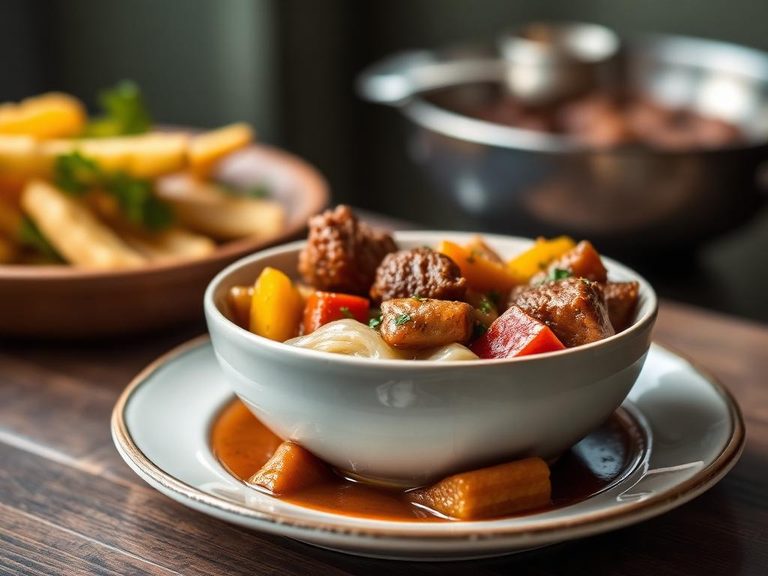
🍽️ Popular dishes
🌍 Where it's eaten
💡 Did you know?
The 'chuck eye' is sometimes called the 'poor man's ribeye' because it comes from the shoulder adjacent to the rib primal, offering similar marbling and flavor at a lower cost.
Full nutrition (USDA data · scales with serving)
| Water | 72.1 g |
| Energy | 137 kcal |
| Energy | 575 kj |
| Protein | 21.1 g |
| Total lipid (fat) | 5.9 g |
| Ash | 0.99 g |
| Carbohydrate, by difference | 0.00 g |
| Fiber, total dietary | 0.00 g |
| Total Sugars | 0.00 g |
| Calcium, Ca | 15.0 mg |
| Iron, Fe | 2.1 mg |
| Magnesium, Mg | 18.0 mg |
| Phosphorus, P | 189 mg |
| Potassium, K | 293 mg |
| Sodium, Na | 82.0 mg |
| Zinc, Zn | 6.5 mg |
| Copper, Cu | 0.09 mg |
| Manganese, Mn | 0.01 mg |
| Selenium, Se | 20.8 ug |
| Vitamin C, total ascorbic acid | 0.00 mg |
| Thiamin | 0.07 mg |
| Riboflavin | 0.18 mg |
| Niacin | 4.3 mg |
| Pantothenic acid | 0.74 mg |
| Vitamin B-6 | 0.36 mg |
| Folate, total | 3.0 ug |
| Folic acid | 0.00 ug |
| Folate, food | 3.0 ug |
| Folate, DFE | 3.0 ug |
| Choline, total | 72.8 mg |
| Betaine | 26.8 mg |
| Vitamin B-12 | 3.1 ug |
| Vitamin B-12, added | 0.00 ug |
| Vitamin A, RAE | 2.0 ug |
| Retinol | 2.0 ug |
| Carotene, beta | 0.00 ug |
| Carotene, alpha | 0.00 ug |
| Cryptoxanthin, beta | 0.00 ug |
| Vitamin A, IU | 7.0 iu |
| Lycopene | 0.00 ug |
| Lutein + zeaxanthin | 0.00 ug |
| Vitamin E (alpha-tocopherol) | 0.12 mg |
| Vitamin E, added | 0.00 mg |
| Vitamin D (D2 + D3), International Units | 3.0 iu |
| Vitamin D (D2 + D3) | 0.10 ug |
| Vitamin D3 (cholecalciferol) | 0.10 ug |
| Vitamin K (phylloquinone) | 1.5 ug |
| Alcohol, ethyl | 0.00 g |
| Caffeine | 0.00 mg |
| Theobromine | 0.00 mg |
Fat & fatty acid profile (per 100g)
| Fatty acids, total saturated | 2.6 g |
| SFA 4:0 | 0.00 g |
| SFA 6:0 | 0.00 g |
| SFA 8:0 | 0.00 g |
| SFA 10:0 | 0.00 g |
| SFA 12:0 | 0.00 g |
| SFA 14:0 | 0.16 g |
| SFA 16:0 | 1.4 g |
| SFA 17:0 | 0.09 g |
| SFA 18:0 | 0.91 g |
| SFA 20:0 | 0.00 g |
| SFA 24:0 | 0.01 g |
| Fatty acids, total monounsaturated | 3.0 g |
| MUFA 14:1 | 0.03 g |
| MUFA 16:1 | 0.18 g |
| MUFA 17:1 | 0.06 g |
| MUFA 18:1 | 2.7 g |
| MUFA 18:1 c | 2.3 g |
| MUFA 18:1-11 t (18:1t n-7) | 0.27 g |
| MUFA 20:1 | 0.01 g |
| MUFA 22:1 | 0.00 g |
| Fatty acids, total polyunsaturated | 0.32 g |
| PUFA 18:2 | 0.28 g |
| PUFA 18:2 n-6 c,c | 0.25 g |
| PUFA 18:2 CLAs | 0.03 g |
| PUFA 18:3 | 0.01 g |
| PUFA 18:3 n-3 c,c,c (ALA) | 0.01 g |
| PUFA 18:4 | 0.00 g |
| PUFA 20:2 n-6 c,c | 0.00 g |
| PUFA 20:4 | 0.03 g |
| PUFA 20:5 n-3 (EPA) | 0.00 g |
| PUFA 22:5 n-3 (DPA) | 0.00 g |
| PUFA 22:6 n-3 (DHA) | 0.00 g |
| Fatty acids, total trans | 0.37 g |
| Fatty acids, total trans-monoenoic | 0.37 g |
| TFA 18:1 t | 0.37 g |
| Cholesterol | 71.0 mg |
Amino acid profile (per 100g)
| Tryptophan | 0.24 g |
| Threonine | 0.95 g |
| Isoleucine | 0.92 g |
| Leucine | 1.7 g |
| Lysine | 1.9 g |
| Methionine | 0.61 g |
| Cystine | 0.23 g |
| Phenylalanine | 0.82 g |
| Tyrosine | 0.75 g |
| Valine | 0.98 g |
| Arginine | 1.4 g |
| Histidine | 0.70 g |
| Alanine | 1.2 g |
| Aspartic acid | 1.9 g |
| Glutamic acid | 3.4 g |
| Glycine | 0.94 g |
| Proline | 0.87 g |
| Serine | 0.83 g |
| Hydroxyproline | 0.11 g |
FAQ
How is 'Country-Style' different from regular chuck roast?
Country-Style ribs are cut from the chuck shoulder blade area, often with more marbling and connective tissue than a standard chuck roast, making them ideal for slow cooking to break down that collagen into gelatin.
What does 'trimmed to 0" fat, select' mean?
It means all external fat has been removed, and the meat is graded 'Select' by the USDA, indicating it's leaner with less marbling than 'Choice' or 'Prime' grades, hence the very low fat content.
Can I grill this cut like a steak?
It's challenging due to its leanness. If grilling, use a quick, high-heat sear to medium-rare, slice thinly against the grain, and consider a marinade to add moisture and prevent toughness.
Nutrient density (calculated · NRF9.3)
Nutrient Rich Foods index: beneficial nutrients (protein, fiber, vitamins, minerals) minus saturated fat, added sugar & sodium, per 100 kcal.
NRF9.3 index — Fulgoni, Keast & Drewnowski, 2009. Computed from USDA nutrients.
Weight-loss friendliness (composite index)
Energy density 1.37 kcal/g · 62% calories from protein · 0.0 g fiber · 0.0 g sugar per 100 g.
Composite of energy density (Rolls et al., 1999), protein & fiber satiety, minus sugar. A calculated heuristic — ranks satiety-per-calorie, not a clinical measure.
Dietary load (calculated from USDA values)
Potential renal acid load. Positive = acid-forming, negative = alkaline-forming.
Sodium-to-potassium ratio: 0.28 (lower is better — aim for ≤ 1)
Sodium:potassium per WHO potassium guidance. Computed from USDA nutrients.