

Wheat flour, white (industrial), 10% protein, unbleached, enriched
Whole food · Cereal Grains and Pasta
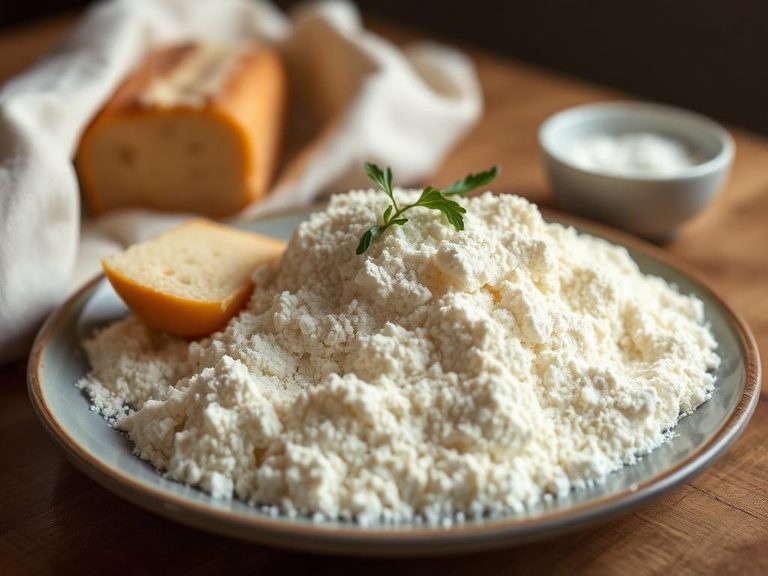
This is the workhorse of commercial baking: a finely milled, unbleached white flour enriched with vitamins and minerals, boasting a mild, slightly sweet flavor and a soft, powdery texture. Its 10% protein content strikes a balance, providing enough structure for tender breads and pastries without the chewiness of high-protein bread flour. Nutritionally, it's a dense source of energy, delivering over 76 grams of carbohydrates per 100 grams, making it a potent fuel source for active bodies.
Calorie split: 11% protein · 85% carbs · 4% fat
↓ Full nutrition💚 Why it's loved
People love it for its incredible versatility and reliability—it's the blank canvas for everything from fluffy pancakes to crusty baguettes. Its mild, neutral flavor allows other ingredients to shine, making it a foundational staple in countless global cuisines.
⚠️ Watch-outs & how to enjoy it better
As a refined carbohydrate, it can cause rapid blood sugar spikes, especially when consumed without protein or fat, and is a common allergen for those with celiac disease or wheat sensitivity. To counteract this, pair it with healthy fats (like nuts or avocado) or protein (like eggs or legumes) to slow digestion, and opt for whole-grain alternatives when possible to increase fiber intake.
Key benefits
- Enriched with iron, B vitamins (thiamin, riboflavin, niacin, folic acid) to replace nutrients lost in milling.
- Provides a quick, accessible source of energy from complex carbohydrates.
- Versatile base for a vast array of baked goods, from breads to cakes.
- Long shelf life when stored properly in a cool, dry place.
- Cost-effective staple for large-scale food production and home kitchens.
🍽️ Popular dishes





🌍 Where it's eaten
💡 Did you know?
The '10% protein' designation is a precise target for industrial milling, ensuring consistent dough behavior—too high and the bread is tough, too low and it collapses.
Full nutrition (USDA data · scales with serving)
| Water | 12.0 g |
| Energy | 366 kcal |
| Energy | 1530 kj |
| Protein | 9.7 g |
| Total lipid (fat) | 1.5 g |
| Ash | 0.58 g |
| Carbohydrate, by difference | 76.2 g |
| Fiber, total dietary | 2.4 g |
| Total Sugars | 0.49 g |
| Sucrose | 0.20 g |
| Glucose | 0.03 g |
| Fructose | 0.03 g |
| Lactose | 0.00 g |
| Maltose | 0.23 g |
| Galactose | 0.00 g |
| Starch | 64.5 g |
| Calcium, Ca | 20.0 mg |
| Iron, Fe | 5.1 mg |
| Magnesium, Mg | 25.0 mg |
| Phosphorus, P | 107 mg |
| Potassium, K | 149 mg |
| Sodium, Na | 2.0 mg |
| Zinc, Zn | 1.0 mg |
| Copper, Cu | 0.19 mg |
| Manganese, Mn | 0.82 mg |
| Selenium, Se | 14.6 ug |
| Vitamin C, total ascorbic acid | 0.00 mg |
| Thiamin | 0.74 mg |
| Riboflavin | 0.45 mg |
| Niacin | 6.0 mg |
| Pantothenic acid | 0.25 mg |
| Vitamin B-6 | 0.04 mg |
| Folate, total | 170 ug |
| Folic acid | 140 ug |
| Folate, food | 31.0 ug |
| Folate, DFE | 268 ug |
| Choline, total | 10.4 mg |
| Vitamin A, RAE | 0.00 ug |
| Carotene, beta | 0.00 ug |
| Carotene, alpha | 0.00 ug |
| Cryptoxanthin, beta | 0.00 ug |
| Vitamin A, IU | 0.00 iu |
| Lycopene | 0.00 ug |
| Lutein + zeaxanthin | 18.0 ug |
| Vitamin E (alpha-tocopherol) | 0.38 mg |
| Tocopherol, beta | 0.13 mg |
| Tocopherol, gamma | 1.5 mg |
| Tocopherol, delta | 0.00 mg |
| Tocotrienol, alpha | 0.14 mg |
| Tocotrienol, beta | 0.00 mg |
| Tocotrienol, gamma | 0.00 mg |
| Tocotrienol, delta | 0.00 mg |
| Vitamin D (D2 + D3), International Units | 0.00 iu |
| Vitamin D (D2 + D3) | 0.00 ug |
| Vitamin K (phylloquinone) | 0.30 ug |
Fat & fatty acid profile (per 100g)
| Fatty acids, total saturated | 0.30 g |
| SFA 4:0 | 0.00 g |
| SFA 6:0 | 0.00 g |
| SFA 8:0 | 0.00 g |
| SFA 10:0 | 0.00 g |
| SFA 12:0 | 0.00 g |
| SFA 14:0 | 0.00 g |
| SFA 15:0 | 0.00 g |
| SFA 16:0 | 0.30 g |
| SFA 17:0 | 0.00 g |
| SFA 18:0 | 0.00 g |
| SFA 20:0 | 0.00 g |
| SFA 22:0 | 0.00 g |
| SFA 24:0 | 0.00 g |
| Fatty acids, total monounsaturated | 0.19 g |
| MUFA 14:1 | 0.00 g |
| MUFA 16:1 | 0.00 g |
| MUFA 18:1 | 0.19 g |
| MUFA 20:1 | 0.00 g |
| MUFA 22:1 | 0.00 g |
| Fatty acids, total polyunsaturated | 0.84 g |
| PUFA 18:2 | 0.83 g |
| PUFA 18:3 | 0.02 g |
| PUFA 18:4 | 0.00 g |
| PUFA 20:4 | 0.00 g |
| PUFA 20:5 n-3 (EPA) | 0.00 g |
| PUFA 22:5 n-3 (DPA) | 0.00 g |
| PUFA 22:6 n-3 (DHA) | 0.00 g |
Amino acid profile (per 100g)
| Tryptophan | 0.11 g |
| Threonine | 0.26 g |
| Isoleucine | 0.33 g |
| Leucine | 0.63 g |
| Lysine | 0.26 g |
| Methionine | 0.15 g |
| Cystine | 0.24 g |
| Phenylalanine | 0.40 g |
| Tyrosine | 0.13 g |
| Valine | 0.39 g |
| Arginine | 0.37 g |
| Histidine | 0.20 g |
| Alanine | 0.29 g |
| Aspartic acid | 0.40 g |
| Glutamic acid | 3.0 g |
| Glycine | 0.33 g |
| Proline | 1.0 g |
| Serine | 0.41 g |
FAQ
What is the difference between unbleached and bleached flour?
Unbleached flour is milled and used as-is, retaining a slightly off-white color and natural flavor, while bleached flour is treated with chemicals to whiten it and soften its texture.
Is this flour suitable for making bread?
Yes, with 10% protein it can make soft breads, but for chewier, more structured loaves, a higher-protein bread flour (12-14%) is often preferred.
How does enrichment affect the flour?
Enrichment adds back nutrients like iron, B vitamins, and folic acid that are lost during the milling process, making it more nutritionally complete than unenriched flour.
Can I substitute this for whole wheat flour?
It can be used in place of whole wheat for lighter textures, but whole wheat flour has more fiber and nutrients, so adjustments to liquid and leavening may be needed.
Nutrient density (calculated · NRF9.3)
Nutrient Rich Foods index: beneficial nutrients (protein, fiber, vitamins, minerals) minus saturated fat, added sugar & sodium, per 100 kcal.
NRF9.3 index — Fulgoni, Keast & Drewnowski, 2009. Computed from USDA nutrients.
Weight-loss friendliness (composite index)
Energy density 3.66 kcal/g · 11% calories from protein · 2.4 g fiber · 0.5 g sugar per 100 g.
Composite of energy density (Rolls et al., 1999), protein & fiber satiety, minus sugar. A calculated heuristic — ranks satiety-per-calorie, not a clinical measure.
Dietary load (calculated from USDA values)
Potential renal acid load. Positive = acid-forming, negative = alkaline-forming.
Sodium-to-potassium ratio: 0.01 (lower is better — aim for ≤ 1)
Sodium:potassium per WHO potassium guidance. Computed from USDA nutrients.