Milk, whole, 3.25% milkfat, with added vitamin D
Whole food · Dairy and Egg Products
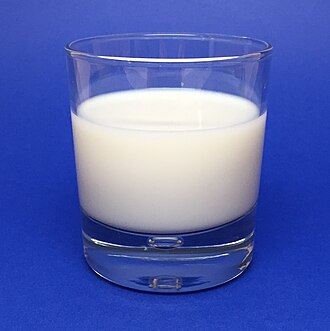
Photo: Wikipedia
Whole milk is a creamy, opaque white liquid with a rich, slightly sweet flavor and a smooth, velvety mouthfeel. Its 3.25% milkfat content provides a satisfying richness that coats the palate, while the naturally occurring lactose offers a subtle sweetness. Nutritionally, it's a standout source of high-quality protein and a key vehicle for calcium and vitamin D fortification.
💚 Why it's loved
People love whole milk for its classic, comforting flavor and creamy texture that elevates everything from coffee to cereal. It's a cultural staple, deeply embedded in traditions from a warm glass at bedtime to being the foundation of countless desserts and sauces.
⚠️ Watch-outs & how to enjoy it better
Its lactose content can cause digestive discomfort for those with lactose intolerance, and its saturated fat and calorie density may be a concern for some diets. To manage this, those sensitive can opt for lactose-free versions or pair it with fiber-rich foods; for calorie control, mindful portioning or using it as an ingredient in cooking rather than a standalone drink can be effective.
Key benefits
- Excellent source of complete protein for muscle maintenance.
- Naturally rich in calcium for bone and dental health.
- Fortified with vitamin D to aid calcium absorption.
- Provides essential nutrients like potassium, vitamin B12, and phosphorus.
- The milkfat contains conjugated linoleic acid (CLA) and butyrate.
🍽️ Popular dishes


🌍 Where it's eaten
💡 Did you know?
The white color of milk comes from casein micelles, which scatter all wavelengths of light equally, while the yellowish tint of cream (and thus whole milk) comes from carotenoid pigments in the cow's diet.
Full nutrition (scales with serving)
| Water | 88.1 g |
| Energy | 61.0 kcal |
| Energy | 254 kj |
| Protein | 3.1 g |
| Total lipid (fat) | 3.3 g |
| Ash | 0.67 g |
| Carbohydrate, by difference | 4.8 g |
| Fiber, total dietary | 0.00 g |
| Total Sugars | 5.0 g |
| Sucrose | 0.00 g |
| Glucose | 0.00 g |
| Fructose | 0.00 g |
| Lactose | 5.0 g |
| Maltose | 0.00 g |
| Galactose | 0.00 g |
| Calcium, Ca | 113 mg |
| Iron, Fe | 0.03 mg |
| Magnesium, Mg | 10.0 mg |
| Phosphorus, P | 84.0 mg |
| Potassium, K | 132 mg |
| Sodium, Na | 43.0 mg |
| Zinc, Zn | 0.37 mg |
| Copper, Cu | 0.03 mg |
| Manganese, Mn | 0.00 mg |
| Selenium, Se | 3.7 ug |
| Vitamin C, total ascorbic acid | 0.00 mg |
| Thiamin | 0.05 mg |
| Riboflavin | 0.17 mg |
| Niacin | 0.09 mg |
| Pantothenic acid | 0.37 mg |
| Vitamin B-6 | 0.04 mg |
| Folate, total | 5.0 ug |
| Folic acid | 0.00 ug |
| Folate, food | 5.0 ug |
| Folate, DFE | 5.0 ug |
| Choline, total | 14.3 mg |
| Betaine | 0.60 mg |
| Vitamin B-12 | 0.45 ug |
| Vitamin B-12, added | 0.00 ug |
| Vitamin A, RAE | 46.0 ug |
| Retinol | 45.0 ug |
| Carotene, beta | 7.0 ug |
| Carotene, alpha | 0.00 ug |
| Cryptoxanthin, beta | 0.00 ug |
| Vitamin A, IU | 162 iu |
| Lycopene | 0.00 ug |
| Lutein + zeaxanthin | 0.00 ug |
| Vitamin E (alpha-tocopherol) | 0.07 mg |
| Vitamin E, added | 0.00 mg |
| Tocopherol, beta | 0.00 mg |
| Tocopherol, gamma | 0.00 mg |
| Tocopherol, delta | 0.00 mg |
| Tocotrienol, alpha | 0.00 mg |
| Tocotrienol, beta | 0.00 mg |
| Tocotrienol, gamma | 0.00 mg |
| Tocotrienol, delta | 0.00 mg |
| Vitamin D (D2 + D3), International Units | 51.0 iu |
| Vitamin D (D2 + D3) | 1.3 ug |
| Vitamin D3 (cholecalciferol) | 1.3 ug |
| Vitamin K (phylloquinone) | 0.30 ug |
| Vitamin K (Dihydrophylloquinone) | 0.00 ug |
| Vitamin K (Menaquinone-4) | 1.0 ug |
| Fatty acids, total saturated | 1.9 g |
| SFA 4:0 | 0.07 g |
| SFA 6:0 | 0.07 g |
| SFA 8:0 | 0.07 g |
| SFA 10:0 | 0.07 g |
| SFA 12:0 | 0.08 g |
| SFA 13:0 | 0.00 g |
| SFA 14:0 | 0.30 g |
| SFA 15:0 | 0.00 g |
| SFA 16:0 | 0.83 g |
| SFA 17:0 | 0.00 g |
| SFA 18:0 | 0.36 g |
| SFA 20:0 | 0.00 g |
| SFA 22:0 | 0.00 g |
| SFA 24:0 | 0.00 g |
| Fatty acids, total monounsaturated | 0.81 g |
| MUFA 14:1 | 0.00 g |
| MUFA 16:1 | 0.00 g |
| MUFA 18:1 | 0.81 g |
| MUFA 20:1 | 0.00 g |
| MUFA 22:1 | 0.00 g |
| Fatty acids, total polyunsaturated | 0.20 g |
| PUFA 18:2 | 0.12 g |
| PUFA 18:3 | 0.07 g |
| PUFA 18:4 | 0.00 g |
| PUFA 20:4 | 0.00 g |
| PUFA 20:5 n-3 (EPA) | 0.00 g |
| PUFA 22:5 n-3 (DPA) | 0.00 g |
| PUFA 22:6 n-3 (DHA) | 0.00 g |
| Cholesterol | 10.0 mg |
| Tryptophan | 0.04 g |
| Threonine | 0.13 g |
| Isoleucine | 0.16 g |
| Leucine | 0.30 g |
| Lysine | 0.26 g |
| Methionine | 0.08 g |
| Cystine | 0.02 g |
| Phenylalanine | 0.16 g |
| Tyrosine | 0.16 g |
| Valine | 0.21 g |
| Arginine | 0.09 g |
| Histidine | 0.10 g |
| Alanine | 0.11 g |
| Aspartic acid | 0.27 g |
| Glutamic acid | 0.71 g |
| Glycine | 0.06 g |
| Proline | 0.31 g |
| Serine | 0.19 g |
| Alcohol, ethyl | 0.00 g |
| Caffeine | 0.00 mg |
| Theobromine | 0.00 mg |
FAQ
What's the difference between whole milk and other milk fat percentages?
Whole milk has 3.25% milkfat by law in the US. Lower fat percentages (2%, 1%, skim) have had some or all of the cream (milkfat) removed, which also reduces calories and fat-soluble vitamins.
Is the vitamin D in milk natural or added?
Vitamin D is not naturally present in significant amounts in milk. It is added during fortification to help the body absorb calcium, making it a crucial public health measure.
Why does whole milk sometimes have a yellowish tint?
The slight yellow hue comes from carotenoids (like beta-carotene) that are fat-soluble and present in the cow's feed. The color is more pronounced in milk from grass-fed cows.