

Lamb, Australian, imported, fresh, leg, hindshank, heel on, bone-in, separable lean only, trimmed to 1/8" fat, cooked, braised
Whole food · Lamb, Veal, and Game Products

Photo: Wikipedia
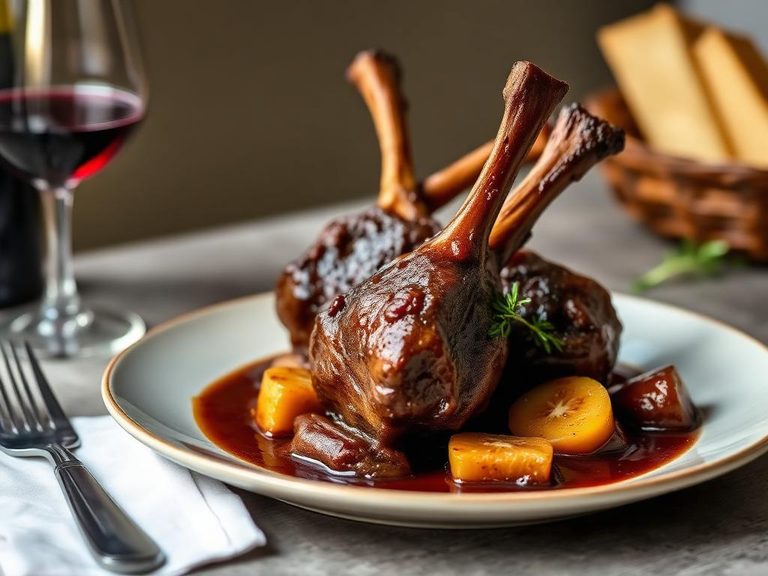
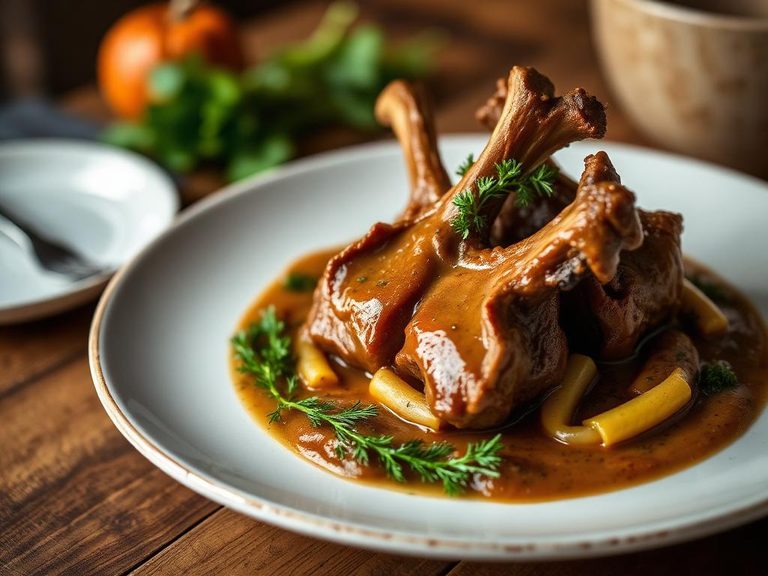
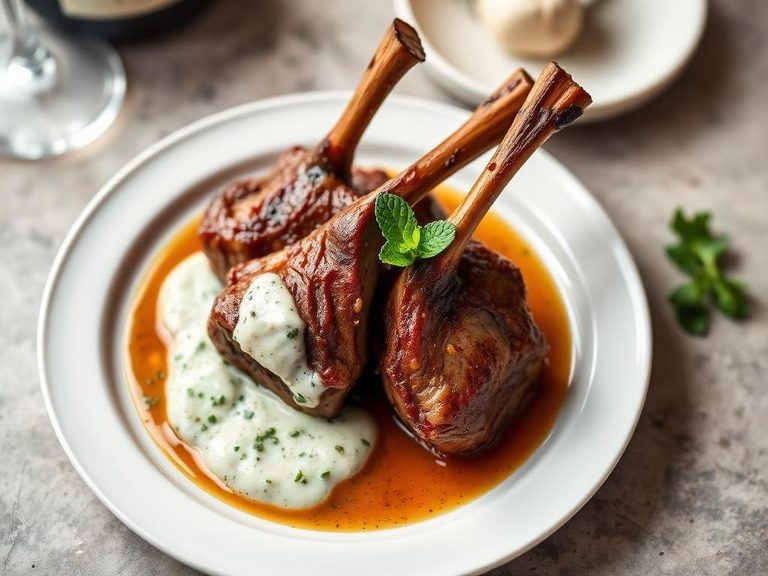
This is a premium cut of Australian lamb, specifically the lower part of the hind leg (the shank), cooked low and slow until the meat is fall-off-the-bone tender. The braising process renders the connective tissue into rich gelatin, creating a succulent, deeply savory flavor with a melt-in-your-mouth texture. Nutritionally, it's a powerhouse of high-quality protein with very little fat and zero carbohydrates.
Calorie split: 71% protein · 0% carbs · 29% fat
↓ Full nutrition💚 Why it's loved
People adore braised lamb shanks for their profound, meaty flavor and the luxurious, silky texture that comes from slow-cooking. It's a centerpiece dish that feels both rustic and elegant, often associated with comforting family meals or special occasion dining.
⚠️ Watch-outs & how to enjoy it better
As a red meat, it is higher in saturated fat and purines than poultry or fish, which may be a concern for some. The braising process often involves added sodium from stocks or seasonings. To counteract this, choose low-sodium broth for braising and pair the shank with a large portion of potassium-rich vegetables like roasted carrots or steamed greens to help balance sodium intake.
Key benefits
- Excellent source of complete protein for muscle maintenance.
- Rich in essential minerals like zinc and iron.
- Provides B vitamins, especially B12, for energy metabolism.
- Low in carbohydrates, suitable for low-carb diets.
- Contains collagen/gelatin from braising, beneficial for gut and joint health.
🍽️ Popular dishes
🌍 Where it's eaten
💡 Did you know?
The 'heel on' specification means the muscular heel of the shank is left attached, which adds extra collagen and flavor to the braising liquid, making for an even richer sauce.
Full nutrition (USDA data · scales with serving)
| Water | 64.9 g |
| Energy | 174 kcal |
| Energy | 726 kj |
| Protein | 30.7 g |
| Total lipid (fat) | 5.6 g |
| Ash | 0.90 g |
| Carbohydrate, by difference | 0.00 g |
| Fiber, total dietary | 0.00 g |
| Total Sugars | 0.00 g |
| Calcium, Ca | 5.0 mg |
| Iron, Fe | 2.0 mg |
| Magnesium, Mg | 19.0 mg |
| Phosphorus, P | 151 mg |
| Potassium, K | 192 mg |
| Sodium, Na | 86.0 mg |
| Zinc, Zn | 4.3 mg |
| Copper, Cu | 0.12 mg |
| Manganese, Mn | 0.01 mg |
| Selenium, Se | 15.6 ug |
| Vitamin C, total ascorbic acid | 0.00 mg |
| Thiamin | 0.10 mg |
| Riboflavin | 0.49 mg |
| Niacin | 5.3 mg |
| Pantothenic acid | 0.73 mg |
| Vitamin B-6 | 0.40 mg |
| Vitamin B-12 | 1.5 ug |
| Vitamin B-12, added | 0.00 ug |
| Vitamin A, RAE | 2.0 ug |
| Retinol | 2.0 ug |
| Carotene, beta | 0.00 ug |
| Carotene, alpha | 0.00 ug |
| Cryptoxanthin, beta | 0.00 ug |
| Vitamin A, IU | 7.0 iu |
| Lycopene | 0.00 ug |
| Lutein + zeaxanthin | 0.00 ug |
| Vitamin E (alpha-tocopherol) | 0.40 mg |
| Vitamin E, added | 0.00 mg |
| Vitamin D (D2 + D3), International Units | 0.00 iu |
| Vitamin D (D2 + D3) | 0.00 ug |
| Vitamin D2 (ergocalciferol) | 0.00 ug |
| Vitamin D3 (cholecalciferol) | 0.00 ug |
| Alcohol, ethyl | 0.00 g |
| Caffeine | 0.00 mg |
| Theobromine | 0.00 mg |
Fat & fatty acid profile (per 100g)
| Fatty acids, total saturated | 2.2 g |
| SFA 4:0 | 0.00 g |
| SFA 6:0 | 0.00 g |
| SFA 8:0 | 0.00 g |
| SFA 10:0 | 0.00 g |
| SFA 12:0 | 0.01 g |
| SFA 14:0 | 0.18 g |
| SFA 15:0 | 0.02 g |
| SFA 16:0 | 1.2 g |
| SFA 17:0 | 0.06 g |
| SFA 18:0 | 0.79 g |
| SFA 20:0 | 0.00 g |
| SFA 22:0 | 0.00 g |
| SFA 24:0 | 0.00 g |
| Fatty acids, total monounsaturated | 2.3 g |
| MUFA 14:1 | 0.00 g |
| MUFA 15:1 | 0.00 g |
| MUFA 16:1 | 0.08 g |
| MUFA 17:1 | 0.00 g |
| MUFA 18:1 | 2.2 g |
| MUFA 18:1 c | 1.9 g |
| MUFA 20:1 | 0.00 g |
| MUFA 22:1 | 0.00 g |
| MUFA 22:1 c | 0.00 g |
| Fatty acids, total polyunsaturated | 0.64 g |
| PUFA 18:2 | 0.40 g |
| PUFA 18:2 n-6 c,c | 0.20 g |
| PUFA 18:2 CLAs | 0.10 g |
| PUFA 18:3 | 0.11 g |
| PUFA 18:3 n-3 c,c,c (ALA) | 0.11 g |
| PUFA 18:3 n-6 c,c,c | 0.00 g |
| PUFA 18:4 | 0.00 g |
| PUFA 20:2 n-6 c,c | 0.00 g |
| PUFA 20:3 | 0.00 g |
| PUFA 20:4 | 0.04 g |
| PUFA 20:5 n-3 (EPA) | 0.03 g |
| PUFA 22:5 n-3 (DPA) | 0.04 g |
| PUFA 22:6 n-3 (DHA) | 0.01 g |
| Fatty acids, total trans | 0.37 g |
| Fatty acids, total trans-monoenoic | 0.26 g |
| TFA 18:1 t | 0.26 g |
| TFA 18:2 t not further defined | 0.10 g |
| Fatty acids, total trans-polyenoic | 0.10 g |
| Cholesterol | 111 mg |
Amino acid profile (per 100g)
| Tryptophan | 0.32 g |
| Threonine | 1.3 g |
| Isoleucine | 1.3 g |
| Leucine | 2.2 g |
| Lysine | 2.3 g |
| Methionine | 0.74 g |
| Cystine | 0.31 g |
| Phenylalanine | 1.1 g |
| Tyrosine | 0.96 g |
| Valine | 1.4 g |
| Arginine | 1.8 g |
| Histidine | 0.80 g |
| Alanine | 1.7 g |
| Aspartic acid | 2.5 g |
| Glutamic acid | 4.1 g |
| Glycine | 1.6 g |
| Proline | 1.3 g |
| Serine | 1.1 g |
FAQ
What does 'separable lean only, trimmed to 1/8" fat' mean?
This is a USDA trimming specification. It means all external fat has been trimmed down to a very thin 1/8-inch layer, and the nutritional data reflects only the lean meat that can be easily separated from any connective tissue or bone after cooking.
Is this cut tough if not cooked properly?
Yes. Lamb shank is a hard-working muscle full of connective tissue. It requires slow, moist cooking methods like braising or stewing to break down the collagen into tender gelatin. Quick, high-heat methods like grilling will result in very tough, chewy meat.
Why is the protein so high and fat relatively low for a braised meat?
The 'separable lean only' designation excludes most of the rendered fat that might be in the cooking liquid. The braising process itself also allows some intramuscular fat to melt away, leaving behind a very protein-dense portion of meat.
Nutrient density (calculated · NRF9.3)
Nutrient Rich Foods index: beneficial nutrients (protein, fiber, vitamins, minerals) minus saturated fat, added sugar & sodium, per 100 kcal.
NRF9.3 index — Fulgoni, Keast & Drewnowski, 2009. Computed from USDA nutrients.
Weight-loss friendliness (composite index)
Energy density 1.74 kcal/g · 71% calories from protein · 0.0 g fiber · 0.0 g sugar per 100 g.
Composite of energy density (Rolls et al., 1999), protein & fiber satiety, minus sugar. A calculated heuristic — ranks satiety-per-calorie, not a clinical measure.
Dietary load (calculated from USDA values)
Potential renal acid load. Positive = acid-forming, negative = alkaline-forming.
Sodium-to-potassium ratio: 0.45 (lower is better — aim for ≤ 1)
Sodium:potassium per WHO potassium guidance. Computed from USDA nutrients.