

Lamb, Australian, imported, fresh, leg, hindshank, heel on, bone-in, separable lean and fat, trimmed to 1/8" fat, cooked, braised
Whole food · Lamb, Veal, and Game Products

Photo: Wikipedia
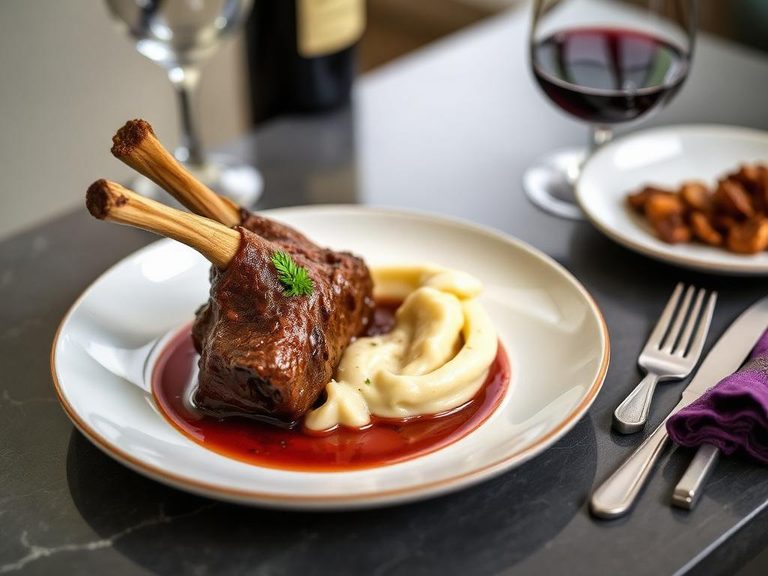
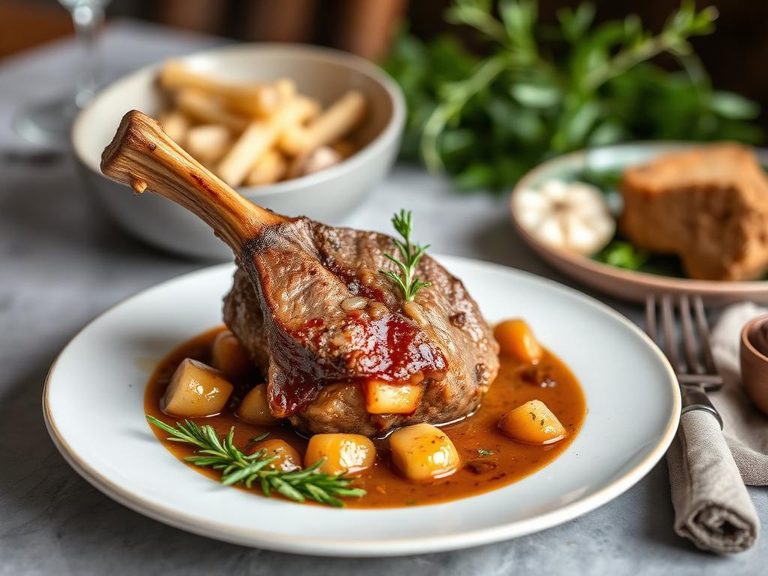
This is a braised hindshank from a bone-in lamb leg—Australia's answer to slow-cooked luxury, where connective tissue melts into silk and the fat coats every fiber with deep, savory richness. At 29.5g of protein per 100g with only 9.5g of fat, it delivers a remarkably lean yet succulent result that lean cuts rarely match, all thanks to the long, low-heat braise that transforms tough collagen into gelatin. Expect a deep crimson-to-brown color, fork-tender pull-apart texture, and a flavor that's earthy, slightly gamey, and unmistakably lamb.
Calorie split: 58% protein · 0% carbs · 42% fat
↓ Full nutrition💚 Why it's loved
People love braised lamb shanks for the way the meat practically falls off the bone after hours of gentle cooking, yielding a melt-in-your-mouth tenderness that's rare in everyday home meals. The flavor is deeply savory and slightly gamey—rich enough to satisfy, yet versatile enough to pair with everything from red wine reduction to minty yogurt sauce.
⚠️ Watch-outs & how to enjoy it better
Despite being a braised cut, the 9.5g fat per 100g and 204 kcal can add up with larger portions, so those watching total caloric intake should practice portion control and stick to around 120g per serving. The bone-in, slow-cooked nature also means the braising liquid can be high in sodium if stock and seasoning are heavy-handed—balance by using low-sodium broth and adding acidity (lemon juice or vinegar) to the final sauce to cut richness.
Key benefits
- Exceptionally high protein at ~30g per 100g, supporting muscle repair and satiety
- Naturally carb-free, making it ideal for low-carb and ketogenic meal plans
- Slow braising converts collagen to gelatin, supporting joint and gut lining health
- Rich source of zinc, iron, and B12 — critical for energy metabolism and immune function
- Bone-in cut releases minerals like calcium and phosphorus into the cooking liquid (stock gold)
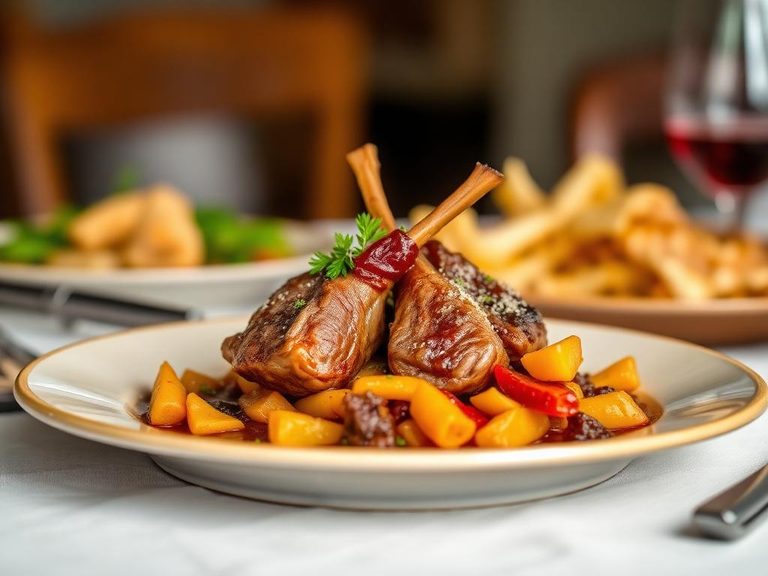
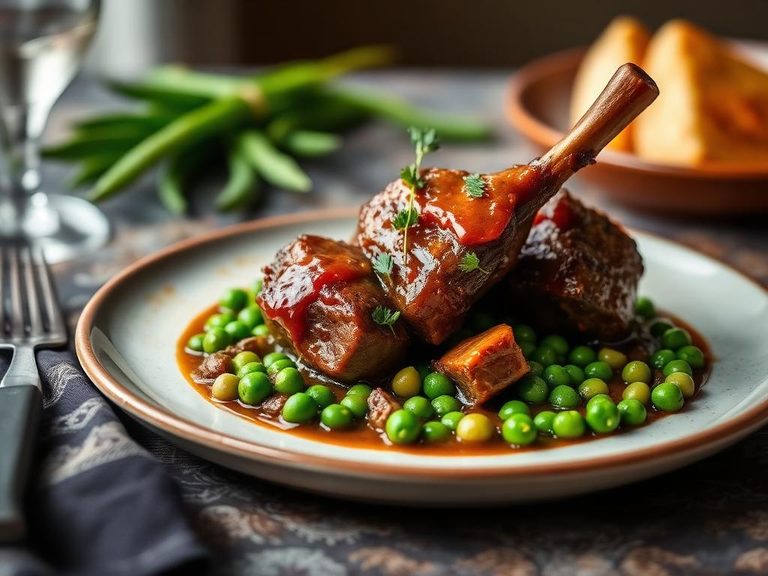
🍽️ Popular dishes
🌍 Where it's eaten
💡 Did you know?
Australia was historically called 'The Land of the Golden Fleece' — lamb and sheep farming shaped the nation's entire 19th-century economy, and today Australians eat more lamb per capita than almost any other country, with hindshanks being a prized cut often reserved for slow Sunday roasts.
Full nutrition (USDA data · scales with serving)
| Water | 61.9 g |
| Energy | 204 kcal |
| Energy | 855 kj |
| Protein | 29.5 g |
| Total lipid (fat) | 9.5 g |
| Ash | 0.89 g |
| Carbohydrate, by difference | 0.00 g |
| Fiber, total dietary | 0.00 g |
| Total Sugars | 0.00 g |
| Calcium, Ca | 6.0 mg |
| Iron, Fe | 2.0 mg |
| Magnesium, Mg | 19.0 mg |
| Phosphorus, P | 150 mg |
| Potassium, K | 192 mg |
| Sodium, Na | 84.0 mg |
| Zinc, Zn | 4.1 mg |
| Copper, Cu | 0.11 mg |
| Manganese, Mn | 0.01 mg |
| Selenium, Se | 14.8 ug |
| Vitamin C, total ascorbic acid | 0.00 mg |
| Thiamin | 0.10 mg |
| Riboflavin | 0.47 mg |
| Niacin | 5.2 mg |
| Pantothenic acid | 0.71 mg |
| Vitamin B-6 | 0.39 mg |
| Vitamin B-12 | 1.4 ug |
| Vitamin B-12, added | 0.00 ug |
| Vitamin A, RAE | 2.0 ug |
| Retinol | 2.0 ug |
| Carotene, beta | 0.00 ug |
| Carotene, alpha | 0.00 ug |
| Cryptoxanthin, beta | 0.00 ug |
| Vitamin A, IU | 7.0 iu |
| Lycopene | 0.00 ug |
| Lutein + zeaxanthin | 0.00 ug |
| Vitamin E (alpha-tocopherol) | 0.36 mg |
| Vitamin E, added | 0.00 mg |
| Vitamin D (D2 + D3), International Units | 0.00 iu |
| Vitamin D (D2 + D3) | 0.00 ug |
| Vitamin D2 (ergocalciferol) | 0.00 ug |
| Vitamin D3 (cholecalciferol) | 0.00 ug |
| Alcohol, ethyl | 0.00 g |
| Caffeine | 0.00 mg |
| Theobromine | 0.00 mg |
Fat & fatty acid profile (per 100g)
| Fatty acids, total saturated | 4.3 g |
| SFA 4:0 | 0.00 g |
| SFA 6:0 | 0.00 g |
| SFA 8:0 | 0.00 g |
| SFA 10:0 | 0.01 g |
| SFA 12:0 | 0.02 g |
| SFA 14:0 | 0.32 g |
| SFA 15:0 | 0.05 g |
| SFA 16:0 | 2.0 g |
| SFA 17:0 | 0.13 g |
| SFA 18:0 | 1.7 g |
| SFA 20:0 | 0.01 g |
| SFA 22:0 | 0.00 g |
| SFA 24:0 | 0.00 g |
| Fatty acids, total monounsaturated | 3.8 g |
| MUFA 14:1 | 0.00 g |
| MUFA 15:1 | 0.00 g |
| MUFA 16:1 | 0.12 g |
| MUFA 17:1 | 0.00 g |
| MUFA 18:1 | 3.7 g |
| MUFA 18:1 c | 3.1 g |
| MUFA 20:1 | 0.00 g |
| MUFA 22:1 | 0.00 g |
| MUFA 22:1 c | 0.00 g |
| Fatty acids, total polyunsaturated | 0.84 g |
| PUFA 18:2 | 0.57 g |
| PUFA 18:2 n-6 c,c | 0.25 g |
| PUFA 18:2 CLAs | 0.15 g |
| PUFA 18:3 | 0.15 g |
| PUFA 18:3 n-3 c,c,c (ALA) | 0.15 g |
| PUFA 18:3 n-6 c,c,c | 0.00 g |
| PUFA 18:4 | 0.00 g |
| PUFA 20:2 n-6 c,c | 0.00 g |
| PUFA 20:3 | 0.00 g |
| PUFA 20:4 | 0.04 g |
| PUFA 20:5 n-3 (EPA) | 0.03 g |
| PUFA 22:5 n-3 (DPA) | 0.04 g |
| PUFA 22:6 n-3 (DHA) | 0.01 g |
| Fatty acids, total trans | 0.68 g |
| Fatty acids, total trans-monoenoic | 0.51 g |
| TFA 18:1 t | 0.51 g |
| TFA 18:2 t not further defined | 0.17 g |
| Fatty acids, total trans-polyenoic | 0.17 g |
| Cholesterol | 110 mg |
Amino acid profile (per 100g)
| Tryptophan | 0.31 g |
| Threonine | 1.2 g |
| Isoleucine | 1.2 g |
| Leucine | 2.1 g |
| Lysine | 2.3 g |
| Methionine | 0.71 g |
| Cystine | 0.30 g |
| Phenylalanine | 1.1 g |
| Tyrosine | 0.92 g |
| Valine | 1.3 g |
| Arginine | 1.8 g |
| Histidine | 0.77 g |
| Alanine | 1.7 g |
| Aspartic acid | 2.4 g |
| Glutamic acid | 3.9 g |
| Glycine | 1.6 g |
| Proline | 1.3 g |
| Serine | 1.0 g |
FAQ
How is hindshank different from fore-shank in flavor and texture?
Hindshank comes from the rear leg, is meatier and slightly more tender than the leaner, sinewy fore-shank, and has a richer, more deep-tasting composition ideal for braising or roasting.
Can I eat this on a keto or carnivore diet?
Absolutely — with zero carbs, zero sugar, and high protein, this braised lamb hindshank is a staple-friendly option for both keto and carnivore approaches, assuming you use low-carb braise liquids and avoid sugary glazes.
Is braising truly healthier than frying lamb?
Braising uses no added fat for searing (or minimal), cooks the meat slowly in liquid (often broth or wine), and reduces the need for oil, so it generally results in a leaner final dish than frying while preserving moisture.
What makes the braising liquid so nutritious?
The long cooking time extracts collagen, minerals, and flavor from the bone and connective tissue into the liquid, creating a natural gelatin-rich broth that's packed with amino acids and minerals like calcium — essentially homemade bone broth.
How do I keep the final dish from being too fatty?
After braising, refrigerate the liquid and skim off the solidified fat on top before reheating the meat in the sauce. This significantly reduces total fat while retaining the delicious flavor of the braised lamb.
Nutrient density (calculated · NRF9.3)
Nutrient Rich Foods index: beneficial nutrients (protein, fiber, vitamins, minerals) minus saturated fat, added sugar & sodium, per 100 kcal.
NRF9.3 index — Fulgoni, Keast & Drewnowski, 2009. Computed from USDA nutrients.
Weight-loss friendliness (composite index)
Energy density 2.04 kcal/g · 58% calories from protein · 0.0 g fiber · 0.0 g sugar per 100 g.
Composite of energy density (Rolls et al., 1999), protein & fiber satiety, minus sugar. A calculated heuristic — ranks satiety-per-calorie, not a clinical measure.
Dietary load (calculated from USDA values)
Potential renal acid load. Positive = acid-forming, negative = alkaline-forming.
Sodium-to-potassium ratio: 0.44 (lower is better — aim for ≤ 1)
Sodium:potassium per WHO potassium guidance. Computed from USDA nutrients.