

Egg rolls, chicken, refrigerated, heated
Whole food · Meals, Entrees, and Side Dishes

Photo: Wikipedia
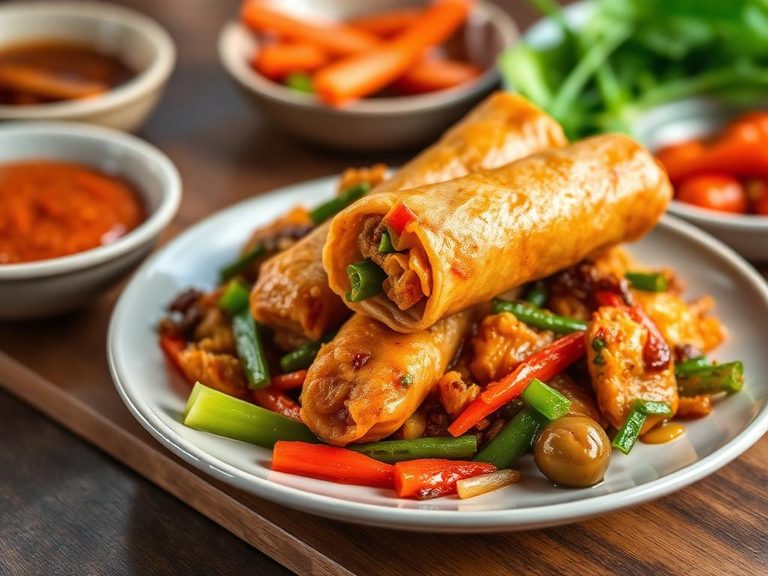
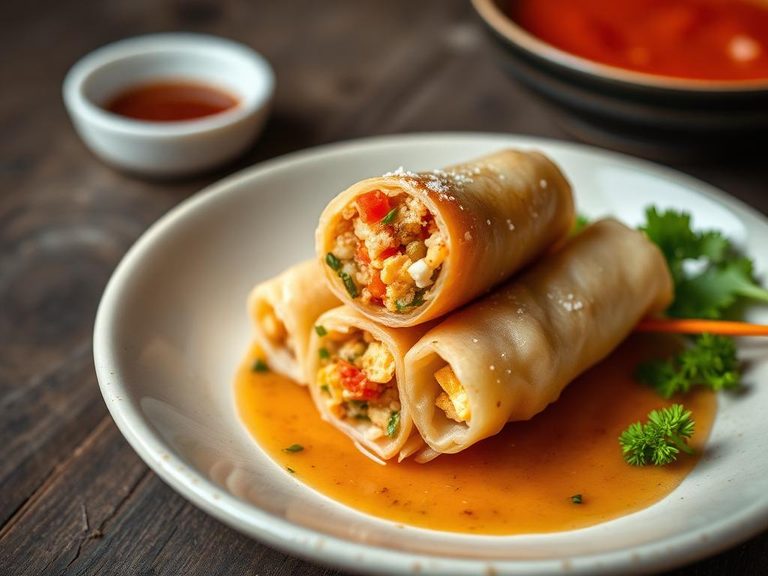
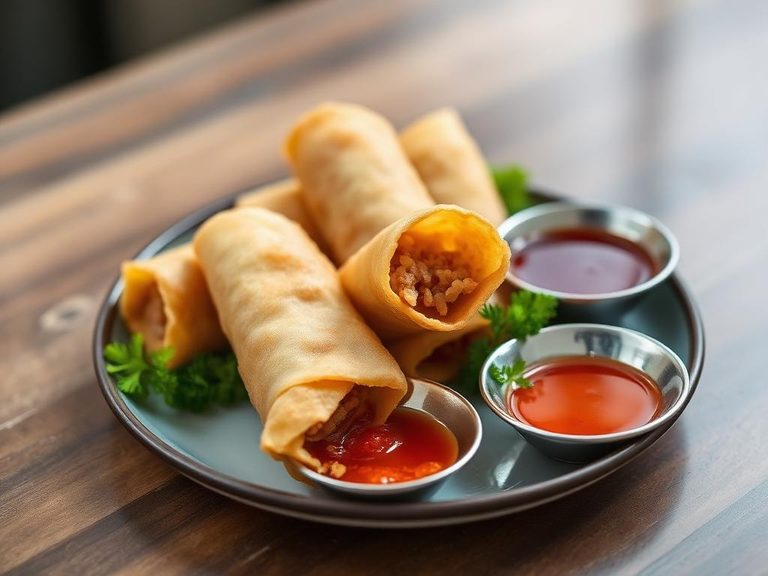
A golden, crispy wrapper encases a savory, tender filling of seasoned chicken and vegetables, offering a satisfying crunch followed by a juicy, umami-rich bite. With nearly 200 calories per 100g, these are a substantial, energy-dense snack or appetizer, balancing protein and carbohydrates for quick fuel. The reheated texture retains a delightful crispness, making them a popular choice for on-the-go eating or party platters.
Calorie split: 21% protein · 58% carbs · 21% fat
↓ Full nutrition💚 Why it's loved
People love them for the irresistible contrast of a shatteringly crisp exterior and a savory, steaming-hot filling, often enhanced by sweet chili or soy-based dipping sauces. They are a cultural staple in many Asian-American and Chinese-American settings, symbolizing comfort and celebration.
⚠️ Watch-outs & how to enjoy it better
The high carbohydrate and moderate fat content can cause blood-sugar spikes if eaten in large quantities, and they may be high in sodium or contain common allergens like wheat and soy. To counteract, pair with a protein-rich side (like a small salad or tofu), practice portion control (limit to 2-3 rolls), and choose lower-sodium dipping sauces or add fresh vegetables to the meal.
Key benefits
- Good source of protein (10.44g per 100g) for muscle maintenance
- Provides quick energy from carbohydrates (28.54g per 100g)
- Contains dietary fiber (2.4g per 100g) for digestive support
- Convenient, pre-cooked meal or snack option
- Versatile for pairing with various sauces and sides
🍽️ Popular dishes
🌍 Where it's eaten
💡 Did you know?
The modern American egg roll is believed to have been invented in New York City in the 1930s, possibly by a chef at a Chinese restaurant who added cabbage and pork to a spring roll wrapper to appeal to local tastes.
Full nutrition (USDA data · scales with serving)
| Water | 54.2 g |
| Energy | 197 kcal |
| Energy | 822 kj |
| Protein | 10.4 g |
| Total lipid (fat) | 4.5 g |
| Ash | 2.3 g |
| Carbohydrate, by difference | 28.5 g |
| Fiber, total dietary | 2.4 g |
| Total Sugars | 5.6 g |
| Sucrose | 2.5 g |
| Glucose | 1.1 g |
| Fructose | 0.82 g |
| Lactose | 0.00 g |
| Maltose | 1.2 g |
| Galactose | 0.00 g |
| Starch | 19.1 g |
| Calcium, Ca | 47.0 mg |
| Iron, Fe | 1.7 mg |
| Magnesium, Mg | 30.0 mg |
| Phosphorus, P | 118 mg |
| Potassium, K | 281 mg |
| Sodium, Na | 478 mg |
| Zinc, Zn | 0.52 mg |
| Copper, Cu | 0.10 mg |
| Manganese, Mn | 0.40 mg |
| Selenium, Se | 17.3 ug |
| Vitamin C, total ascorbic acid | 11.2 mg |
| Thiamin | 0.24 mg |
| Riboflavin | 0.17 mg |
| Niacin | 3.6 mg |
| Pantothenic acid | 0.66 mg |
| Vitamin B-6 | 0.29 mg |
| Folate, total | 63.0 ug |
| Folic acid | 42.0 ug |
| Folate, food | 20.0 ug |
| Folate, DFE | 93.0 ug |
| Choline, total | 31.2 mg |
| Vitamin B-12 | 0.10 ug |
| Vitamin B-12, added | 0.00 ug |
| Vitamin A, RAE | 55.0 ug |
| Retinol | 2.0 ug |
| Carotene, beta | 524 ug |
| Carotene, alpha | 223 ug |
| Cryptoxanthin, beta | 0.00 ug |
| Vitamin A, IU | 1066 iu |
| Lycopene | 0.00 ug |
| Lutein + zeaxanthin | 73.0 ug |
| Vitamin E (alpha-tocopherol) | 0.37 mg |
| Vitamin E, added | 0.00 mg |
| Tocopherol, beta | 0.54 mg |
| Tocopherol, gamma | 0.98 mg |
| Tocopherol, delta | 0.25 mg |
| Tocotrienol, alpha | 0.20 mg |
| Tocotrienol, beta | 0.00 mg |
| Tocotrienol, gamma | 0.00 mg |
| Tocotrienol, delta | 0.00 mg |
| Vitamin D (D2 + D3), International Units | 1.0 iu |
| Vitamin D (D2 + D3) | 0.00 ug |
| Vitamin K (phylloquinone) | 23.8 ug |
| Alcohol, ethyl | 0.00 g |
| Caffeine | 0.00 mg |
| Theobromine | 0.00 mg |
Fat & fatty acid profile (per 100g)
| Fatty acids, total saturated | 0.96 g |
| SFA 4:0 | 0.00 g |
| SFA 6:0 | 0.00 g |
| SFA 8:0 | 0.00 g |
| SFA 10:0 | 0.00 g |
| SFA 12:0 | 0.00 g |
| SFA 14:0 | 0.01 g |
| SFA 15:0 | 0.00 g |
| SFA 16:0 | 0.74 g |
| SFA 17:0 | 0.00 g |
| SFA 18:0 | 0.18 g |
| SFA 20:0 | 0.01 g |
| SFA 22:0 | 0.01 g |
| SFA 24:0 | 0.00 g |
| Fatty acids, total monounsaturated | 1.3 g |
| MUFA 14:1 | 0.00 g |
| MUFA 15:1 | 0.00 g |
| MUFA 16:1 | 0.09 g |
| MUFA 17:1 | 0.00 g |
| MUFA 18:1 | 1.2 g |
| MUFA 20:1 | 0.01 g |
| MUFA 22:1 | 0.00 g |
| Fatty acids, total polyunsaturated | 1.8 g |
| PUFA 18:2 | 1.7 g |
| PUFA 18:3 | 0.12 g |
| PUFA 18:4 | 0.00 g |
| PUFA 20:2 n-6 c,c | 0.00 g |
| PUFA 20:3 | 0.00 g |
| PUFA 20:4 | 0.01 g |
| PUFA 20:5 n-3 (EPA) | 0.00 g |
| PUFA 22:4 | 0.00 g |
| PUFA 22:5 n-3 (DPA) | 0.00 g |
| PUFA 22:6 n-3 (DHA) | 0.00 g |
| Cholesterol | 14.0 mg |
Amino acid profile (per 100g)
| Tryptophan | 0.14 g |
| Threonine | 0.34 g |
| Isoleucine | 0.35 g |
| Leucine | 0.68 g |
| Lysine | 0.48 g |
| Methionine | 0.19 g |
| Cystine | 0.14 g |
| Phenylalanine | 0.43 g |
| Tyrosine | 0.21 g |
| Valine | 0.39 g |
| Arginine | 0.48 g |
| Histidine | 0.25 g |
| Alanine | 0.42 g |
| Aspartic acid | 0.74 g |
| Glutamic acid | 2.3 g |
| Glycine | 0.40 g |
| Proline | 0.72 g |
| Serine | 0.43 g |
FAQ
Are egg rolls healthy?
Egg rolls can be part of a balanced diet when eaten in moderation, as they provide protein and fiber, but they are also high in calories, carbohydrates, and potentially sodium. Pairing them with vegetables and lean protein can make them a more nutritious meal.
How do I reheat refrigerated egg rolls to keep them crispy?
For best results, reheat in an air fryer at 350°F (175°C) for 5-7 minutes or in a preheated oven at 400°F (200°C) for 10-12 minutes, flipping halfway. Avoid microwaving, as it can make the wrapper soggy.
What are common allergens in chicken egg rolls?
Common allergens include wheat (in the wrapper), soy (in sauces or fillings), and sometimes sesame or peanuts. Always check the ingredient list if you have allergies.
Nutrient density (calculated · NRF9.3)
Nutrient Rich Foods index: beneficial nutrients (protein, fiber, vitamins, minerals) minus saturated fat, added sugar & sodium, per 100 kcal.
NRF9.3 index — Fulgoni, Keast & Drewnowski, 2009. Computed from USDA nutrients.
Weight-loss friendliness (composite index)
Energy density 1.97 kcal/g · 21% calories from protein · 2.4 g fiber · 5.6 g sugar per 100 g.
Composite of energy density (Rolls et al., 1999), protein & fiber satiety, minus sugar. A calculated heuristic — ranks satiety-per-calorie, not a clinical measure.
Dietary load (calculated from USDA values)
Potential renal acid load. Positive = acid-forming, negative = alkaline-forming.
Sodium-to-potassium ratio: 1.70 (lower is better — aim for ≤ 1)
Sodium:potassium per WHO potassium guidance. Computed from USDA nutrients.