

Bologna, chicken, pork
Whole food · Sausages and Luncheon Meats

Photo: Wikipedia
Bologna, chicken, pork is a finely ground, emulsified sausage with a smooth, springy texture and a mild, savory, slightly smoky flavor. It's a processed meat product made from a blend of chicken and pork, typically seasoned with salt, spices, and curing agents. Nutritionally, it's a dense source of calories and fat, providing a quick energy boost but minimal fiber or sugar.
Calorie split: 12% protein · 5% carbs · 83% fat
↓ Full nutrition💚 Why it's loved
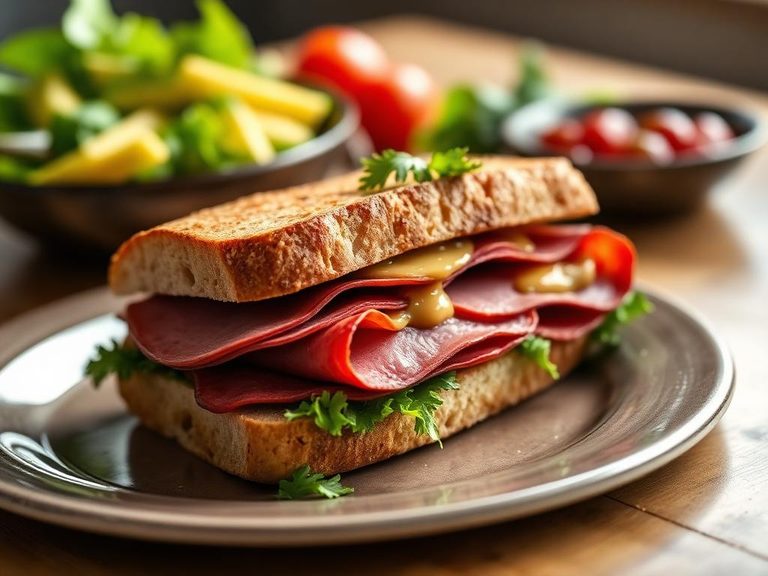
People love bologna for its familiar, comforting taste and its ultimate convenience as a no-cook protein for sandwiches, especially for children's lunches. Its mild flavor and soft texture make it a versatile canvas for condiments like mustard or mayonnaise.
⚠️ Watch-outs & how to enjoy it better
As a processed meat, it is typically high in sodium and saturated fat, which can be a concern for heart health. It also contains nitrates/nitrites as preservatives. To counteract this, pair it with high-fiber foods like whole-grain bread, fresh lettuce, and tomato to slow digestion, and practice strict portion control, treating it as an occasional food rather than a daily staple.
Key benefits
- High in protein for muscle maintenance
- Provides quick energy from fats
- Long shelf life when refrigerated or canned
- Convenient, ready-to-eat protein source
- Versatile for sandwiches and quick meals
🍽️ Popular dishes

🌍 Where it's eaten
💡 Did you know?
The city of Bologna, Italy, has a protected culinary tradition, and its famous 'Mortadella' is the authentic ancestor of the American-style bologna sausage, though the two products are quite different in texture and ingredients.
Full nutrition (USDA data · scales with serving)
| Water | 50.9 g |
| Energy | 336 kcal |
| Energy | 1407 kj |
| Protein | 10.3 g |
| Total lipid (fat) | 30.6 g |
| Ash | 4.0 g |
| Carbohydrate, by difference | 4.2 g |
| Fiber, total dietary | 0.00 g |
| Total Sugars | 0.00 g |
| Calcium, Ca | 196 mg |
| Iron, Fe | 1.1 mg |
| Magnesium, Mg | 16.0 mg |
| Phosphorus, P | 223 mg |
| Potassium, K | 162 mg |
| Sodium, Na | 1240 mg |
| Zinc, Zn | 1.0 mg |
| Copper, Cu | 0.04 mg |
| Manganese, Mn | 0.04 mg |
| Selenium, Se | 0.00 ug |
| Fluoride, F | 36.0 ug |
| Vitamin C, total ascorbic acid | 13.2 mg |
| Thiamin | 0.06 mg |
| Riboflavin | 0.13 mg |
| Niacin | 3.7 mg |
| Pantothenic acid | 0.78 mg |
| Vitamin B-6 | 0.19 mg |
| Folate, total | 13.0 ug |
| Folic acid | 0.00 ug |
| Folate, food | 13.0 ug |
| Folate, DFE | 13.0 ug |
| Vitamin B-12 | 0.50 ug |
| Vitamin A, RAE | 13.0 ug |
| Retinol | 11.0 ug |
| Carotene, beta | 11.0 ug |
| Carotene, alpha | 11.0 ug |
| Cryptoxanthin, beta | 11.0 ug |
| Vitamin A, IU | 75.0 iu |
| Lycopene | 11.0 ug |
| Lutein + zeaxanthin | 0.00 ug |
| Vitamin E (alpha-tocopherol) | 0.64 mg |
| Tocopherol, beta | 0.00 mg |
| Tocopherol, gamma | 0.29 mg |
| Tocopherol, delta | 0.00 mg |
| Tocotrienol, alpha | 0.10 mg |
| Tocotrienol, beta | 0.00 mg |
| Tocotrienol, gamma | 0.00 mg |
| Tocotrienol, delta | 0.00 mg |
| Vitamin K (phylloquinone) | 0.60 ug |
| Alcohol, ethyl | 0.00 g |
| Caffeine | 0.00 mg |
| Theobromine | 0.00 mg |
Fat & fatty acid profile (per 100g)
| Fatty acids, total saturated | 9.9 g |
| SFA 4:0 | 0.00 g |
| SFA 6:0 | 0.00 g |
| SFA 8:0 | 0.00 g |
| SFA 10:0 | 0.00 g |
| SFA 12:0 | 0.00 g |
| SFA 14:0 | 0.32 g |
| SFA 15:0 | 0.00 g |
| SFA 16:0 | 6.6 g |
| SFA 17:0 | 0.08 g |
| SFA 18:0 | 2.8 g |
| SFA 20:0 | 0.05 g |
| SFA 22:0 | 0.00 g |
| Fatty acids, total monounsaturated | 13.2 g |
| MUFA 14:1 | 0.00 g |
| MUFA 15:1 | 0.00 g |
| MUFA 16:1 | 1.1 g |
| MUFA 18:1 | 11.8 g |
| MUFA 20:1 | 0.23 g |
| MUFA 22:1 | 0.00 g |
| Fatty acids, total polyunsaturated | 4.3 g |
| PUFA 18:2 | 3.9 g |
| PUFA 18:3 | 0.24 g |
| PUFA 18:3 n-3 c,c,c (ALA) | 0.20 g |
| PUFA 18:3 n-6 c,c,c | 0.03 g |
| PUFA 18:4 | 0.00 g |
| PUFA 20:2 n-6 c,c | 0.13 g |
| PUFA 20:3 | 0.00 g |
| PUFA 20:4 | 0.11 g |
| PUFA 20:5 n-3 (EPA) | 0.00 g |
| PUFA 22:5 n-3 (DPA) | 0.00 g |
| PUFA 22:6 n-3 (DHA) | 0.00 g |
| Fatty acids, total trans | 0.28 g |
| Cholesterol | 87.0 mg |
Amino acid profile (per 100g)
| Tryptophan | 0.08 g |
| Threonine | 0.40 g |
| Isoleucine | 0.47 g |
| Leucine | 0.78 g |
| Lysine | 0.82 g |
| Methionine | 0.22 g |
| Cystine | 0.11 g |
| Phenylalanine | 0.41 g |
| Tyrosine | 0.32 g |
| Valine | 0.53 g |
| Arginine | 0.67 g |
| Histidine | 0.32 g |
| Alanine | 0.66 g |
| Aspartic acid | 0.92 g |
| Glutamic acid | 1.5 g |
| Glycine | 0.70 g |
| Proline | 0.51 g |
| Serine | 0.40 g |
| Hydroxyproline | 0.13 g |
FAQ
What's the difference between bologna and mortadella?
Mortadella is the Italian original, a whole-muscle sausage from Bologna with visible cubes of fat and often pistachios. American bologna is a finely emulsified, pre-sliced product with a more uniform texture and milder flavor.
Is bologna a good source of protein?
Yes, per 100g it provides about 10.3g of protein, making it a decent source. However, it comes with a high fat and sodium content, so it's best viewed as a protein source within a balanced diet.
How should I store opened bologna?
Once opened, keep bologna in its original packaging or an airtight container in the refrigerator. It should be consumed within 3-5 days for optimal freshness and safety. It can also be frozen for up to 2 months.
Nutrient density (calculated · NRF9.3)
Nutrient Rich Foods index: beneficial nutrients (protein, fiber, vitamins, minerals) minus saturated fat, added sugar & sodium, per 100 kcal.
NRF9.3 index — Fulgoni, Keast & Drewnowski, 2009. Computed from USDA nutrients.
Weight-loss friendliness (composite index)
Energy density 3.36 kcal/g · 12% calories from protein · 0.0 g fiber · 0.0 g sugar per 100 g.
Composite of energy density (Rolls et al., 1999), protein & fiber satiety, minus sugar. A calculated heuristic — ranks satiety-per-calorie, not a clinical measure.
Dietary load (calculated from USDA values)
Potential renal acid load. Positive = acid-forming, negative = alkaline-forming.
Sodium-to-potassium ratio: 7.65 (lower is better — aim for ≤ 1)
Sodium:potassium per WHO potassium guidance. Computed from USDA nutrients.