

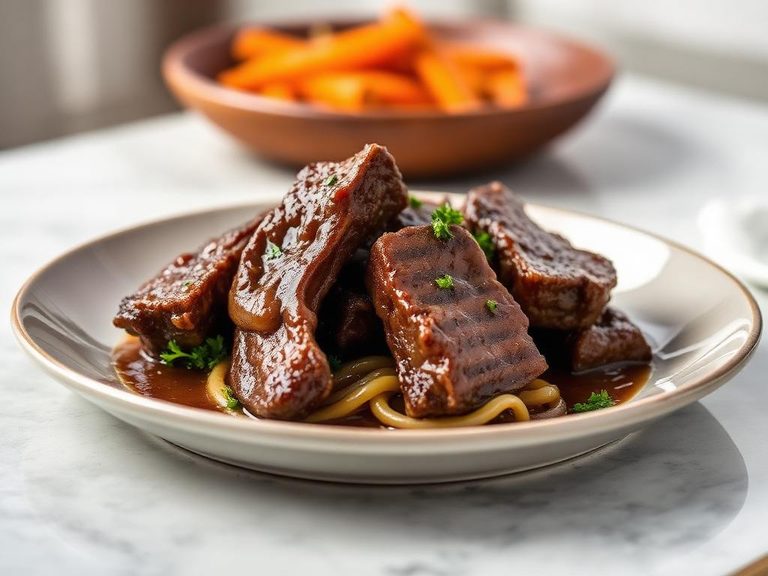
Beef, chuck, under blade steak, boneless, separable lean only, trimmed to 0" fat, select, cooked, braised
Whole food · Beef Products

Photo: Wikipedia
This is a deeply savory, lean cut from the shoulder area, specifically the under blade, which becomes incredibly tender and flavorful through slow braising. With virtually no fat, its nutrition profile is dominated by high-quality protein, making it a powerhouse for muscle repair and satiety. The texture, when cooked properly, is succulent and falls apart easily, offering a rich, beefy taste without the greasiness of fattier cuts.
Calorie split: 60% protein · 0% carbs · 40% fat
↓ Full nutrition💚 Why it's loved
People love it for its profound, concentrated beef flavor and melt-in-your-mouth texture after braising, which makes it the star of hearty, comforting stews. It's also valued for its versatility, absorbing sauces and seasonings beautifully while remaining a lean, satisfying centerpiece in many cuisines.
⚠️ Watch-outs & how to enjoy it better
As a lean cut, it can become tough and dry if not cooked with moist heat like braising, so it's not ideal for quick grilling. For those managing iron intake, its high heme iron content may be a concern, and it's a common allergen for individuals with red meat sensitivities. To counteract dryness, always braise it low and slow in liquid, and pair it with a source of healthy fat like olive oil in the sauce to enhance flavor and nutrient absorption.
Key benefits
- Exceptionally high in protein for muscle maintenance and satiety.
- Very low in fat and contains zero carbohydrates or sugars.
- Rich in essential minerals like iron, zinc, and B vitamins, especially B12.
- A nutrient-dense choice for low-fat, high-protein dietary goals.
🍽️ Popular dishes
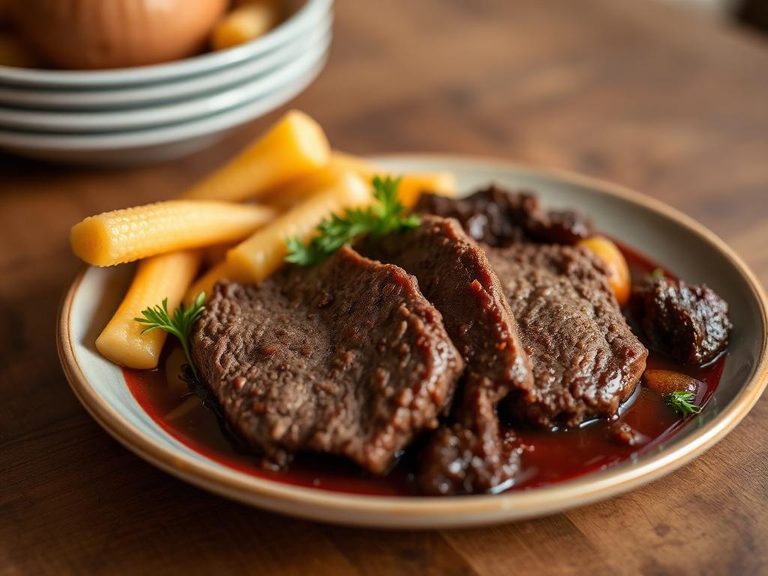
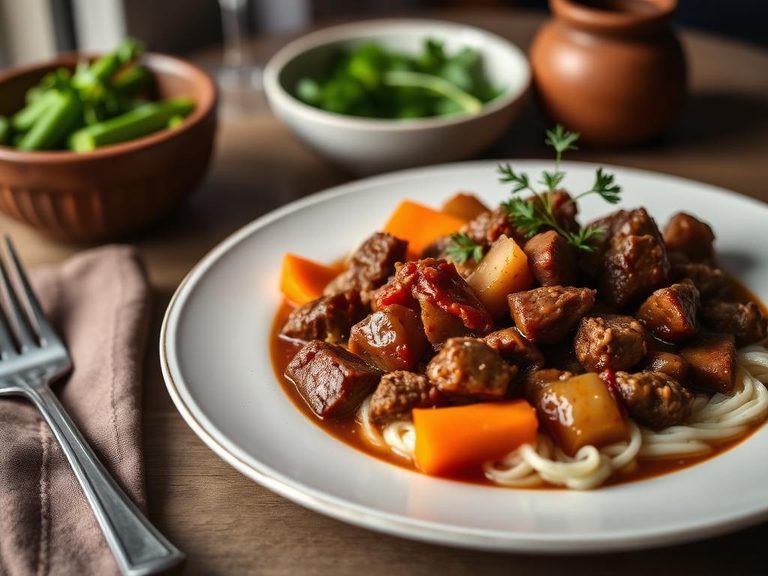
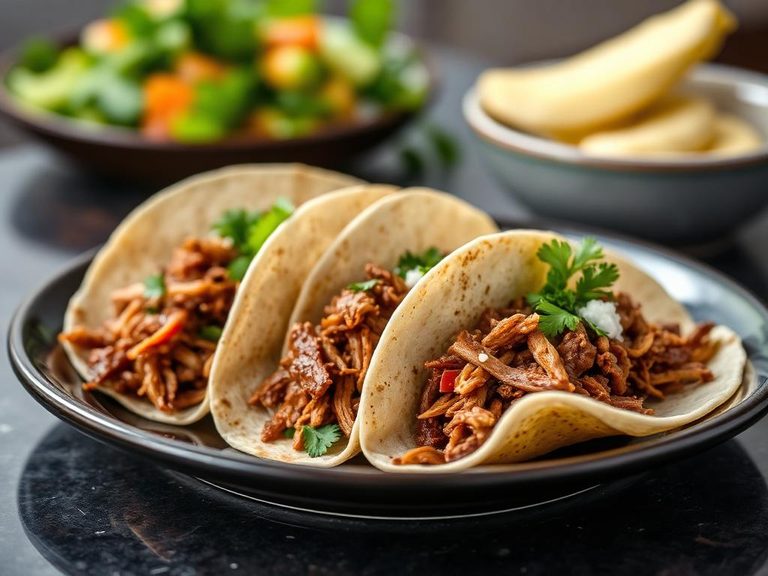
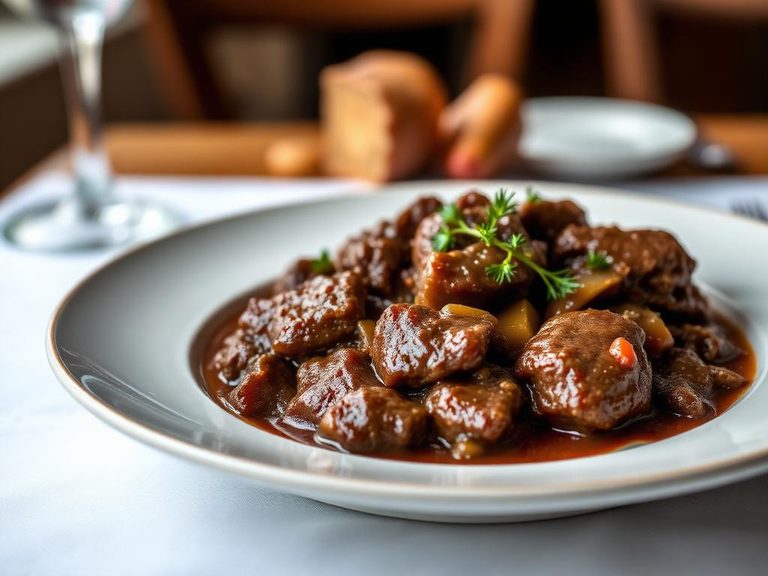
🌍 Where it's eaten
💡 Did you know?
The 'under blade' is also known as the 'chuck tender' or 'mock tender' because it resembles the more expensive tenderloin in shape but requires slow cooking to achieve its tenderness.
Full nutrition (USDA data · scales with serving)
| Water | 58.9 g |
| Energy | 215 kcal |
| Energy | 899 kj |
| Protein | 32.0 g |
| Total lipid (fat) | 9.7 g |
| Ash | 1.2 g |
| Carbohydrate, by difference | 0.00 g |
| Fiber, total dietary | 0.00 g |
| Total Sugars | 0.00 g |
| Calcium, Ca | 14.0 mg |
| Iron, Fe | 3.1 mg |
| Magnesium, Mg | 22.0 mg |
| Phosphorus, P | 202 mg |
| Potassium, K | 303 mg |
| Sodium, Na | 66.0 mg |
| Zinc, Zn | 11.4 mg |
| Copper, Cu | 0.11 mg |
| Manganese, Mn | 0.01 mg |
| Selenium, Se | 36.1 ug |
| Vitamin C, total ascorbic acid | 0.00 mg |
| Thiamin | 0.07 mg |
| Riboflavin | 0.26 mg |
| Niacin | 3.9 mg |
| Pantothenic acid | 0.78 mg |
| Vitamin B-6 | 0.33 mg |
| Folate, total | 8.0 ug |
| Folic acid | 0.00 ug |
| Folate, food | 8.0 ug |
| Folate, DFE | 8.0 ug |
| Choline, total | 104 mg |
| Betaine | 11.1 mg |
| Vitamin B-12 | 3.4 ug |
| Vitamin B-12, added | 0.00 ug |
| Vitamin A, RAE | 2.0 ug |
| Retinol | 2.0 ug |
| Carotene, beta | 0.00 ug |
| Carotene, alpha | 0.00 ug |
| Cryptoxanthin, beta | 0.00 ug |
| Vitamin A, IU | 8.0 iu |
| Lycopene | 0.00 ug |
| Lutein + zeaxanthin | 0.00 ug |
| Vitamin E (alpha-tocopherol) | 0.06 mg |
| Vitamin E, added | 0.00 mg |
| Vitamin D (D2 + D3), International Units | 4.0 iu |
| Vitamin D (D2 + D3) | 0.10 ug |
| Vitamin D3 (cholecalciferol) | 0.10 ug |
| Vitamin K (phylloquinone) | 1.6 ug |
| Alcohol, ethyl | 0.00 g |
| Caffeine | 0.00 mg |
| Theobromine | 0.00 mg |
Fat & fatty acid profile (per 100g)
| Fatty acids, total saturated | 3.6 g |
| SFA 4:0 | 0.00 g |
| SFA 6:0 | 0.00 g |
| SFA 8:0 | 0.00 g |
| SFA 10:0 | 0.00 g |
| SFA 12:0 | 0.00 g |
| SFA 14:0 | 0.23 g |
| SFA 16:0 | 2.0 g |
| SFA 17:0 | 0.10 g |
| SFA 18:0 | 1.2 g |
| SFA 20:0 | 0.01 g |
| SFA 24:0 | 0.01 g |
| Fatty acids, total monounsaturated | 4.3 g |
| MUFA 14:1 | 0.04 g |
| MUFA 16:1 | 0.30 g |
| MUFA 17:1 | 0.08 g |
| MUFA 18:1 | 3.8 g |
| MUFA 18:1 c | 3.4 g |
| MUFA 18:1-11 t (18:1t n-7) | 0.31 g |
| MUFA 20:1 | 0.02 g |
| MUFA 22:1 | 0.00 g |
| Fatty acids, total polyunsaturated | 0.53 g |
| PUFA 18:2 | 0.44 g |
| PUFA 18:2 n-6 c,c | 0.41 g |
| PUFA 18:2 CLAs | 0.03 g |
| PUFA 18:3 | 0.02 g |
| PUFA 18:3 n-3 c,c,c (ALA) | 0.02 g |
| PUFA 18:4 | 0.00 g |
| PUFA 20:2 n-6 c,c | 0.00 g |
| PUFA 20:4 | 0.06 g |
| PUFA 20:5 n-3 (EPA) | 0.00 g |
| PUFA 22:5 n-3 (DPA) | 0.00 g |
| PUFA 22:6 n-3 (DHA) | 0.00 g |
| Fatty acids, total trans | 0.43 g |
| Fatty acids, total trans-monoenoic | 0.43 g |
| TFA 18:1 t | 0.43 g |
| Cholesterol | 108 mg |
Amino acid profile (per 100g)
| Tryptophan | 0.37 g |
| Threonine | 1.4 g |
| Isoleucine | 1.4 g |
| Leucine | 2.6 g |
| Lysine | 2.9 g |
| Methionine | 0.93 g |
| Cystine | 0.34 g |
| Phenylalanine | 1.2 g |
| Tyrosine | 1.1 g |
| Valine | 1.5 g |
| Arginine | 2.2 g |
| Histidine | 1.1 g |
| Alanine | 1.9 g |
| Aspartic acid | 2.9 g |
| Glutamic acid | 5.2 g |
| Glycine | 1.4 g |
| Proline | 1.3 g |
| Serine | 1.3 g |
| Hydroxyproline | 0.16 g |
FAQ
What is the best cooking method for this cut?
Braising is ideal, as slow, moist heat breaks down the connective tissue and makes the lean meat tender and flavorful.
How does it differ from other chuck cuts?
The under blade is leaner and has a more uniform shape, making it suitable for braising or slow roasting, but it can be tougher than other chuck cuts if not cooked properly.
Is this a good cut for a low-fat diet?
Yes, with only 9.66g of fat per 100g and zero carbs, it's an excellent high-protein, low-fat option for weight management.
Nutrient density (calculated · NRF9.3)
Nutrient Rich Foods index: beneficial nutrients (protein, fiber, vitamins, minerals) minus saturated fat, added sugar & sodium, per 100 kcal.
NRF9.3 index — Fulgoni, Keast & Drewnowski, 2009. Computed from USDA nutrients.
Weight-loss friendliness (composite index)
Energy density 2.15 kcal/g · 60% calories from protein · 0.0 g fiber · 0.0 g sugar per 100 g.
Composite of energy density (Rolls et al., 1999), protein & fiber satiety, minus sugar. A calculated heuristic — ranks satiety-per-calorie, not a clinical measure.
Dietary load (calculated from USDA values)
Potential renal acid load. Positive = acid-forming, negative = alkaline-forming.
Sodium-to-potassium ratio: 0.22 (lower is better — aim for ≤ 1)
Sodium:potassium per WHO potassium guidance. Computed from USDA nutrients.