

Babyfood, cereal, rice, with bananas, prepared with whole milk
Whole food · Baby Foods

Photo: Wikipedia
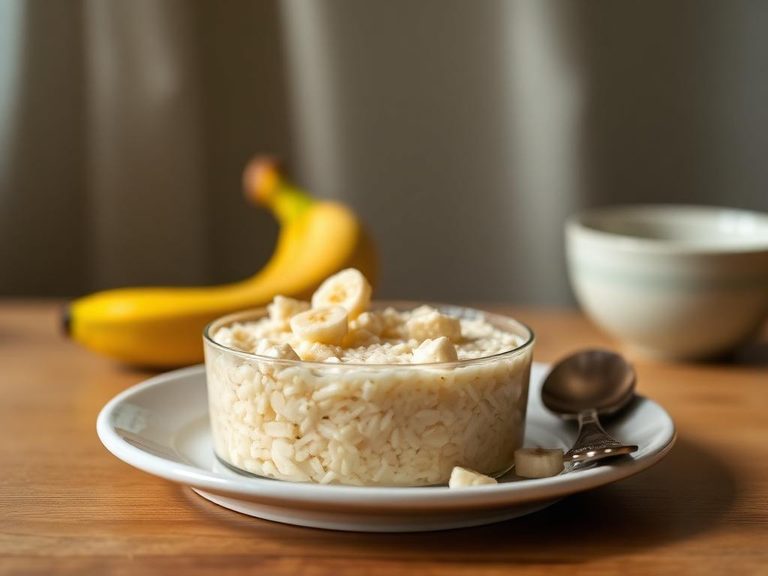
This is a smooth, creamy, and mildly sweet infant cereal made from rice flour and banana, prepared with whole milk for a richer texture and flavor. It offers a gentle introduction to solids with a balanced profile of quick energy from carbs and sustaining nutrients from milk and banana. The 86 kcal per 100g provides a calorie-dense yet easily digestible meal for growing babies.
Calorie split: 17% protein · 49% carbs · 35% fat
↓ Full nutrition💚 Why it's loved
Parents love it for its convenience, reliable nutritional profile, and the fact that its mild, familiar flavors are often accepted by babies new to solids. It's a trusted staple in many cultures for its gentle impact on developing digestive systems.
⚠️ Watch-outs & how to enjoy it better
The high carbohydrate content, particularly from refined rice and fruit sugar, can cause rapid blood sugar spikes if not balanced. It is also a common first allergen exposure (milk) and may lack sufficient fiber for older toddlers. To counteract, pair it with a side of mashed avocado or a sprinkle of nut butter powder (if age-appropriate) to add healthy fats and slow digestion.
Key benefits
- Excellent first food for infants due to its smooth, lump-free texture.
- Provides quick energy from easily digestible rice carbohydrates.
- Whole milk preparation adds essential fats and calcium for bone development.
- Naturally sweetened with banana, avoiding added sugars.
- Fortified with iron in many commercial versions to prevent deficiency.
🍽️ Popular dishes
🌍 Where it's eaten
💡 Did you know?
The combination of rice cereal and banana is one of the most widely recommended first foods globally, not just for nutrition, but because its neutral taste profile helps infants adapt to non-milk flavors without strong aversions.
Full nutrition (USDA data · scales with serving)
| Water | 81.8 g |
| Energy | 86.0 kcal |
| Energy | 360 kj |
| Protein | 3.6 g |
| Total lipid (fat) | 3.3 g |
| Ash | 0.81 g |
| Carbohydrate, by difference | 10.5 g |
| Fiber, total dietary | 0.10 g |
| Total Sugars | 6.1 g |
| Sucrose | 0.00 g |
| Glucose | 0.00 g |
| Fructose | 0.00 g |
| Lactose | 4.7 g |
| Maltose | 0.00 g |
| Galactose | 0.00 g |
| Calcium, Ca | 156 mg |
| Iron, Fe | 3.6 mg |
| Magnesium, Mg | 20.0 mg |
| Phosphorus, P | 109 mg |
| Potassium, K | 180 mg |
| Sodium, Na | 47.0 mg |
| Zinc, Zn | 0.46 mg |
| Copper, Cu | 0.04 mg |
| Manganese, Mn | 0.00 mg |
| Selenium, Se | 4.3 ug |
| Vitamin C, total ascorbic acid | 0.20 mg |
| Thiamin | 0.68 mg |
| Riboflavin | 0.44 mg |
| Niacin | 1.8 mg |
| Pantothenic acid | 0.34 mg |
| Vitamin B-6 | 0.09 mg |
| Folate, total | 6.0 ug |
| Folic acid | 0.00 ug |
| Folate, food | 6.0 ug |
| Folate, DFE | 6.0 ug |
| Choline, total | 15.2 mg |
| Betaine | 0.60 mg |
| Vitamin B-12 | 0.43 ug |
| Vitamin B-12, added | 0.00 ug |
| Vitamin A, RAE | 43.0 ug |
| Retinol | 42.0 ug |
| Carotene, beta | 7.0 ug |
| Carotene, alpha | 1.0 ug |
| Cryptoxanthin, beta | 0.00 ug |
| Vitamin A, IU | 152 iu |
| Lycopene | 0.00 ug |
| Lutein + zeaxanthin | 3.0 ug |
| Vitamin E (alpha-tocopherol) | 0.09 mg |
| Vitamin E, added | 0.00 mg |
| Tocopherol, beta | 0.00 mg |
| Tocopherol, gamma | 0.00 mg |
| Tocopherol, delta | 0.00 mg |
| Tocotrienol, alpha | 0.00 mg |
| Tocotrienol, beta | 0.00 mg |
| Tocotrienol, gamma | 0.00 mg |
| Tocotrienol, delta | 0.00 mg |
| Vitamin D (D2 + D3), International Units | 47.0 iu |
| Vitamin D (D2 + D3) | 1.2 ug |
| Vitamin D3 (cholecalciferol) | 1.2 ug |
| Vitamin K (phylloquinone) | 0.50 ug |
| Vitamin K (Dihydrophylloquinone) | 0.00 ug |
| Vitamin K (Menaquinone-4) | 0.90 ug |
| Alcohol, ethyl | 0.00 g |
| Caffeine | 0.00 mg |
| Theobromine | 0.00 mg |
Fat & fatty acid profile (per 100g)
| Fatty acids, total saturated | 1.8 g |
| SFA 4:0 | 0.07 g |
| SFA 6:0 | 0.07 g |
| SFA 8:0 | 0.07 g |
| SFA 10:0 | 0.07 g |
| SFA 12:0 | 0.07 g |
| SFA 13:0 | 0.00 g |
| SFA 14:0 | 0.28 g |
| SFA 15:0 | 0.00 g |
| SFA 16:0 | 0.83 g |
| SFA 17:0 | 0.00 g |
| SFA 18:0 | 0.34 g |
| SFA 20:0 | 0.00 g |
| SFA 22:0 | 0.00 g |
| SFA 24:0 | 0.00 g |
| Fatty acids, total monounsaturated | 0.83 g |
| MUFA 14:1 | 0.00 g |
| MUFA 16:1 | 0.00 g |
| MUFA 18:1 | 0.82 g |
| MUFA 20:1 | 0.00 g |
| MUFA 22:1 | 0.00 g |
| Fatty acids, total polyunsaturated | 0.29 g |
| PUFA 18:2 | 0.21 g |
| PUFA 18:3 | 0.09 g |
| PUFA 18:4 | 0.00 g |
| PUFA 20:4 | 0.00 g |
| PUFA 20:5 n-3 (EPA) | 0.00 g |
| PUFA 22:5 n-3 (DPA) | 0.00 g |
| PUFA 22:6 n-3 (DHA) | 0.00 g |
| Cholesterol | 10.0 mg |
Amino acid profile (per 100g)
| Tryptophan | 0.08 g |
| Threonine | 0.16 g |
| Isoleucine | 0.18 g |
| Leucine | 0.30 g |
| Lysine | 0.16 g |
| Methionine | 0.09 g |
| Cystine | 0.03 g |
| Phenylalanine | 0.16 g |
| Tyrosine | 0.17 g |
| Valine | 0.21 g |
| Arginine | 0.11 g |
| Histidine | 0.09 g |
| Alanine | 0.13 g |
| Aspartic acid | 0.28 g |
| Glutamic acid | 0.70 g |
| Glycine | 0.10 g |
| Proline | 0.34 g |
| Serine | 0.13 g |
FAQ
Is this cereal gluten-free?
Yes, rice-based baby cereals are naturally gluten-free, making them suitable for infants with celiac disease or gluten sensitivity, provided they are processed in a dedicated facility.
Can I mix it with formula instead of whole milk?
Absolutely. Many parents use breast milk, formula, or water to prepare the cereal, adjusting the consistency to their baby's preference and stage of development.
At what age can babies start eating this?
Most pediatricians recommend introducing single-grain cereals like this around 4 to 6 months, when the baby shows signs of readiness like good head control and interest in food.
Nutrient density (calculated · NRF9.3)
Nutrient Rich Foods index: beneficial nutrients (protein, fiber, vitamins, minerals) minus saturated fat, added sugar & sodium, per 100 kcal.
NRF9.3 index — Fulgoni, Keast & Drewnowski, 2009. Computed from USDA nutrients.
Weight-loss friendliness (composite index)
Energy density 0.86 kcal/g · 17% calories from protein · 0.1 g fiber · 6.1 g sugar per 100 g.
Composite of energy density (Rolls et al., 1999), protein & fiber satiety, minus sugar. A calculated heuristic — ranks satiety-per-calorie, not a clinical measure.
Dietary load (calculated from USDA values)
Potential renal acid load. Positive = acid-forming, negative = alkaline-forming.
Sodium-to-potassium ratio: 0.26 (lower is better — aim for ≤ 1)
Sodium:potassium per WHO potassium guidance. Computed from USDA nutrients.