

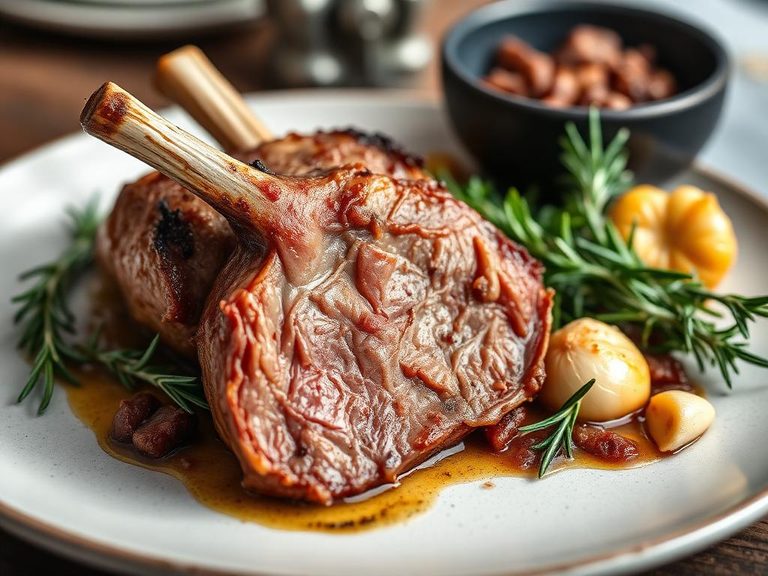
Lamb, Australian, imported, fresh, rack, roast, frenched, bone-in, separable lean only, trimmed to 1/8" fat, cooked, roasted
Whole food · Lamb, Veal, and Game Products

Photo: Wikipedia
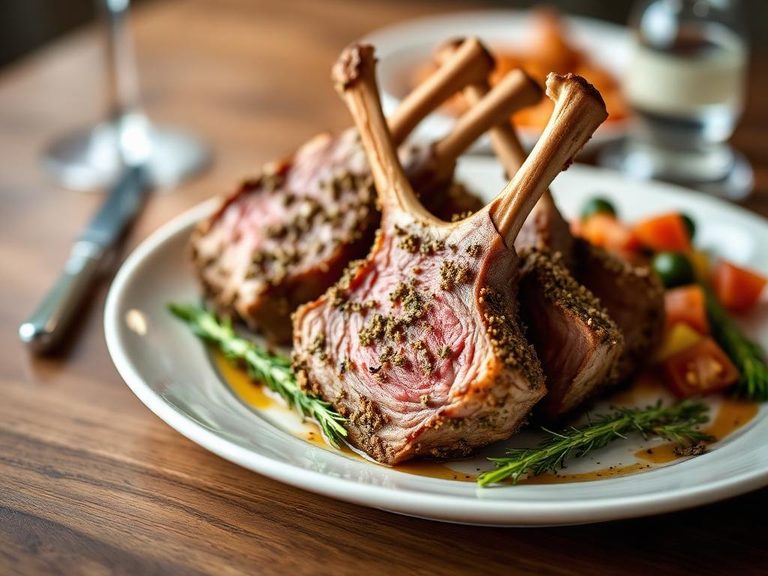
This is a premium cut of Australian lamb, frenched for a dramatic presentation and roasted to a perfect medium-rare. The lean meat is incredibly tender with a rich, slightly sweet, and distinctly savory flavor that's less gamey than some other lamb cuts. It's a high-protein, low-carb centerpiece, delivering over 28 grams of protein per 100g with zero carbohydrates.
Calorie split: 46% protein · 0% carbs · 54% fat
↓ Full nutrition💚 Why it's loved
People adore the rack for its elegant presentation and the perfect balance of tender, juicy meat and flavorful fat. It's a showstopper that's surprisingly simple to prepare, making it a favorite for special occasions and Sunday roasts.
⚠️ Watch-outs & how to enjoy it better
The primary caution is its high saturated fat and calorie density, which requires mindful portion control for those managing heart health or calorie intake. To counteract this, pair a smaller portion (like 3-4 ribs) with large servings of fiber-rich vegetables like roasted broccoli or a tangy salad to add volume and nutrients without excessive calories.
Key benefits
- Excellent source of high-quality complete protein
- Naturally zero carbohydrates and sugar
- Rich in essential minerals like iron and zinc
- Provides B vitamins, especially B12
- A flavorful centerpiece for celebratory meals
🍽️ Popular dishes
🌍 Where it's eaten
💡 Did you know?
The 'frenched' preparation, where the rib bones are scraped clean of meat and fat, is named after the French culinary technique of 'fresing' and is purely for elegant presentation—it doesn't affect the cooking or flavor of the meat itself.
Full nutrition (USDA data · scales with serving)
| Water | 57.9 g |
| Energy | 244 kcal |
| Energy | 1020 kj |
| Protein | 28.0 g |
| Total lipid (fat) | 14.6 g |
| Ash | 1.0 g |
| Carbohydrate, by difference | 0.00 g |
| Fiber, total dietary | 0.00 g |
| Total Sugars | 0.00 g |
| Calcium, Ca | 6.0 mg |
| Iron, Fe | 2.6 mg |
| Magnesium, Mg | 22.0 mg |
| Phosphorus, P | 174 mg |
| Potassium, K | 237 mg |
| Sodium, Na | 67.0 mg |
| Zinc, Zn | 3.0 mg |
| Copper, Cu | 0.11 mg |
| Manganese, Mn | 0.00 mg |
| Selenium, Se | 16.5 ug |
| Vitamin C, total ascorbic acid | 0.00 mg |
| Thiamin | 0.12 mg |
| Riboflavin | 0.42 mg |
| Niacin | 6.6 mg |
| Pantothenic acid | 0.54 mg |
| Vitamin B-6 | 0.56 mg |
| Vitamin B-12 | 1.5 ug |
| Vitamin B-12, added | 0.00 ug |
| Vitamin A, RAE | 4.0 ug |
| Retinol | 4.0 ug |
| Carotene, beta | 0.00 ug |
| Carotene, alpha | 0.00 ug |
| Cryptoxanthin, beta | 0.00 ug |
| Vitamin A, IU | 14.0 iu |
| Lycopene | 0.00 ug |
| Lutein + zeaxanthin | 0.00 ug |
| Vitamin E (alpha-tocopherol) | 0.51 mg |
| Vitamin E, added | 0.00 mg |
| Vitamin D (D2 + D3), International Units | 0.00 iu |
| Vitamin D (D2 + D3) | 0.00 ug |
| Vitamin D2 (ergocalciferol) | 0.00 ug |
| Vitamin D3 (cholecalciferol) | 0.00 ug |
| Alcohol, ethyl | 0.00 g |
| Caffeine | 0.00 mg |
| Theobromine | 0.00 mg |
Fat & fatty acid profile (per 100g)
| Fatty acids, total saturated | 6.8 g |
| SFA 4:0 | 0.00 g |
| SFA 6:0 | 0.00 g |
| SFA 8:0 | 0.00 g |
| SFA 10:0 | 0.01 g |
| SFA 12:0 | 0.01 g |
| SFA 14:0 | 0.35 g |
| SFA 15:0 | 0.08 g |
| SFA 16:0 | 3.6 g |
| SFA 17:0 | 0.18 g |
| SFA 18:0 | 2.6 g |
| SFA 20:0 | 0.02 g |
| SFA 22:0 | 0.01 g |
| SFA 24:0 | 0.00 g |
| Fatty acids, total monounsaturated | 6.1 g |
| MUFA 14:1 | 0.01 g |
| MUFA 15:1 | 0.00 g |
| MUFA 16:1 | 0.18 g |
| MUFA 17:1 | 0.00 g |
| MUFA 18:1 | 5.9 g |
| MUFA 18:1 c | 5.2 g |
| MUFA 20:1 | 0.01 g |
| MUFA 22:1 | 0.00 g |
| MUFA 22:1 c | 0.00 g |
| Fatty acids, total polyunsaturated | 1.0 g |
| PUFA 18:2 | 0.72 g |
| PUFA 18:2 n-6 c,c | 0.35 g |
| PUFA 18:2 CLAs | 0.18 g |
| PUFA 18:3 | 0.18 g |
| PUFA 18:3 n-3 c,c,c (ALA) | 0.18 g |
| PUFA 18:3 n-6 c,c,c | 0.00 g |
| PUFA 18:4 | 0.00 g |
| PUFA 20:2 n-6 c,c | 0.00 g |
| PUFA 20:3 | 0.00 g |
| PUFA 20:4 | 0.05 g |
| PUFA 20:5 n-3 (EPA) | 0.03 g |
| PUFA 22:5 n-3 (DPA) | 0.04 g |
| PUFA 22:6 n-3 (DHA) | 0.01 g |
| Fatty acids, total trans | 0.90 g |
| Fatty acids, total trans-monoenoic | 0.72 g |
| TFA 18:1 t | 0.72 g |
| TFA 18:2 t not further defined | 0.18 g |
| Fatty acids, total trans-polyenoic | 0.18 g |
| Cholesterol | 96.0 mg |
Amino acid profile (per 100g)
| Tryptophan | 0.29 g |
| Threonine | 1.1 g |
| Isoleucine | 1.2 g |
| Leucine | 2.0 g |
| Lysine | 2.1 g |
| Methionine | 0.68 g |
| Cystine | 0.29 g |
| Phenylalanine | 1.0 g |
| Tyrosine | 0.88 g |
| Valine | 1.3 g |
| Arginine | 1.7 g |
| Histidine | 0.73 g |
| Alanine | 1.6 g |
| Aspartic acid | 2.3 g |
| Glutamic acid | 3.7 g |
| Glycine | 1.5 g |
| Proline | 1.2 g |
| Serine | 0.99 g |
FAQ
What does 'frenched' mean?
It's a butchery technique where the meat and fat are scraped away from the top inch of the rib bones, creating a clean, elegant 'handle' for presentation and eating.
How is Australian lamb different?
Australian lamb is often grass-fed, which can give it a leaner, more distinct 'lamb' flavor compared to grain-fed lamb. The country's strict quality standards also ensure a consistent product.
What's the best way to cook it for a home cook?
A simple high-heat sear followed by a moderate oven roast is foolproof. Sear the meaty side in a hot pan for color, then transfer to a 400°F (200°C) oven for 12-15 minutes for a perfect medium-rare (135°F internal temp).
Nutrient density (calculated · NRF9.3)
Nutrient Rich Foods index: beneficial nutrients (protein, fiber, vitamins, minerals) minus saturated fat, added sugar & sodium, per 100 kcal.
NRF9.3 index — Fulgoni, Keast & Drewnowski, 2009. Computed from USDA nutrients.
Weight-loss friendliness (composite index)
Energy density 2.44 kcal/g · 46% calories from protein · 0.0 g fiber · 0.0 g sugar per 100 g.
Composite of energy density (Rolls et al., 1999), protein & fiber satiety, minus sugar. A calculated heuristic — ranks satiety-per-calorie, not a clinical measure.
Dietary load (calculated from USDA values)
Potential renal acid load. Positive = acid-forming, negative = alkaline-forming.
Sodium-to-potassium ratio: 0.28 (lower is better — aim for ≤ 1)
Sodium:potassium per WHO potassium guidance. Computed from USDA nutrients.