

Fast foods, biscuit, with sausage
Whole food · Fast Foods
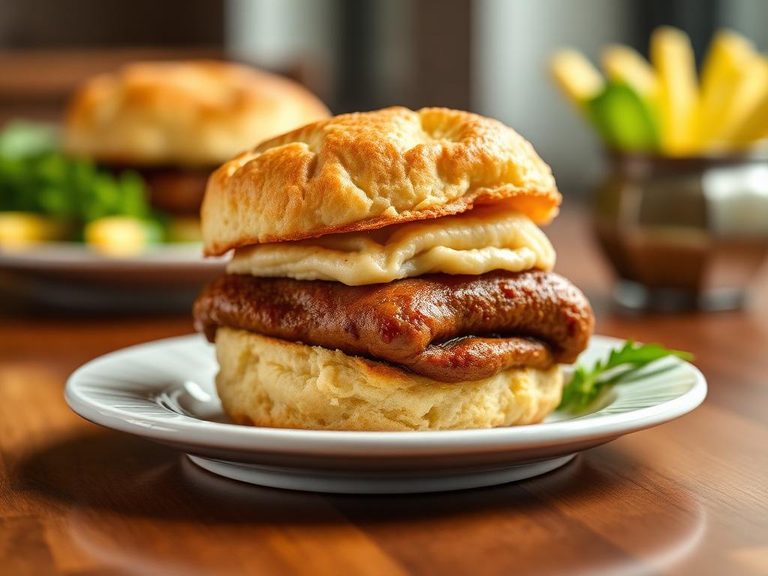
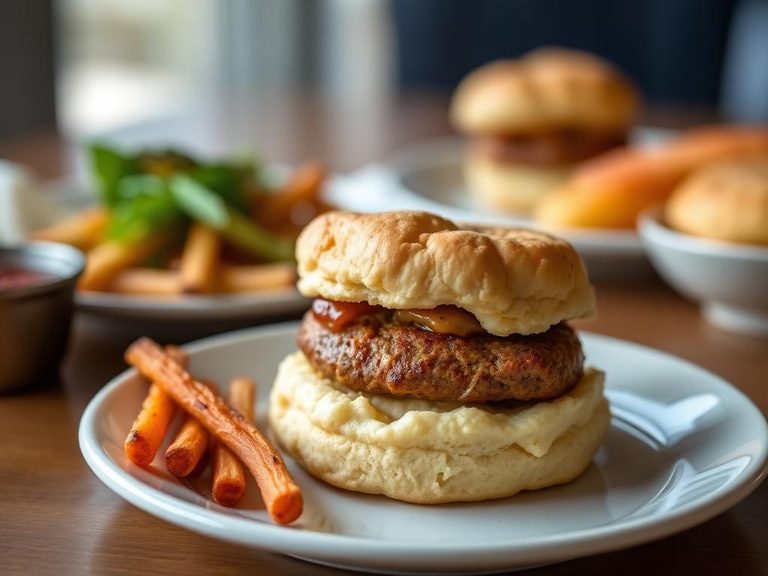
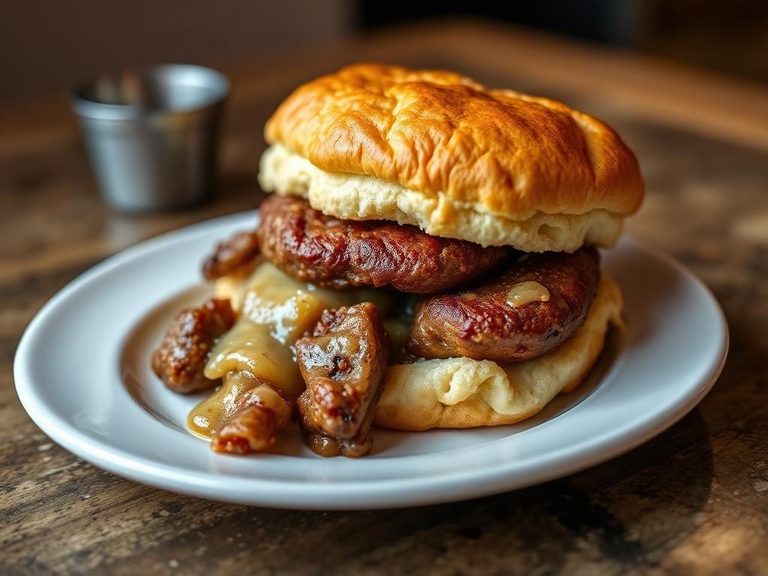
A savory handheld breakfast staple, this is a flaky, buttery biscuit split open to cradle a juicy, seasoned pork sausage patty. The contrast between the tender, crumbly bread and the salty, meaty sausage creates a satisfyingly rich and comforting bite. Nutritionally, it's a calorie-dense option, packing significant fat and refined carbohydrates into a small package.
Calorie split: 10% protein · 32% carbs · 58% fat
↓ Full nutrition💚 Why it's loved
People adore this classic for its perfect marriage of textures—the soft, yielding biscuit and the firm, savory sausage. It's a beloved, no-fuss comfort food deeply embedded in American breakfast culture, offering a hearty start to the day.
⚠️ Watch-outs & how to enjoy it better
The high saturated fat and refined carb content can lead to sluggishness and may not suit those managing blood sugar or heart health. The sodium level is also typically high. To counteract, consider pairing it with a side of fresh fruit or a simple green salad to add fiber and nutrients, and practice portion control by enjoying it as an occasional treat rather than a daily habit.
Key benefits
- Provides a quick and substantial source of energy from fats and carbs.
- Offers a notable protein boost from the sausage patty.
- Convenient, portable, and widely available for a fast meal.
- Satisfies savory and salty cravings effectively.
🍽️ Popular dishes


🌍 Where it's eaten
💡 Did you know?
The modern American breakfast biscuit is believed to have evolved from British scones, with the addition of chemical leavening agents like baking powder in the 19th century making them lighter and quicker to prepare.
Full nutrition (USDA data · scales with serving)
| Water | 32.8 g |
| Energy | 371 kcal |
| Energy | 1552 kj |
| Protein | 9.7 g |
| Total lipid (fat) | 24.4 g |
| Ash | 3.1 g |
| Carbohydrate, by difference | 30.0 g |
| Fiber, total dietary | 0.40 g |
| Total Sugars | 1.6 g |
| Sucrose | 0.42 g |
| Glucose | 0.21 g |
| Fructose | 0.11 g |
| Lactose | 0.66 g |
| Maltose | 0.19 g |
| Galactose | 0.00 g |
| Starch | 24.2 g |
| Calcium, Ca | 47.0 mg |
| Iron, Fe | 1.9 mg |
| Magnesium, Mg | 13.0 mg |
| Phosphorus, P | 341 mg |
| Potassium, K | 153 mg |
| Sodium, Na | 814 mg |
| Zinc, Zn | 0.71 mg |
| Copper, Cu | 0.26 mg |
| Manganese, Mn | 0.18 mg |
| Selenium, Se | 15.0 ug |
| Vitamin C, total ascorbic acid | 0.00 mg |
| Thiamin | 0.39 mg |
| Riboflavin | 0.22 mg |
| Niacin | 3.4 mg |
| Pantothenic acid | 0.47 mg |
| Vitamin B-6 | 0.06 mg |
| Folate, total | 49.0 ug |
| Folic acid | 38.0 ug |
| Folate, food | 11.0 ug |
| Folate, DFE | 75.0 ug |
| Choline, total | 26.7 mg |
| Betaine | 9.1 mg |
| Vitamin B-12 | 0.60 ug |
| Vitamin B-12, added | 0.00 ug |
| Vitamin A, RAE | 1.0 ug |
| Retinol | 0.00 ug |
| Carotene, beta | 8.0 ug |
| Carotene, alpha | 0.00 ug |
| Cryptoxanthin, beta | 0.00 ug |
| Vitamin A, IU | 13.0 iu |
| Lycopene | 0.00 ug |
| Lutein + zeaxanthin | 6.0 ug |
| Vitamin E (alpha-tocopherol) | 0.84 mg |
| Vitamin E, added | 0.00 mg |
| Tocopherol, beta | 0.04 mg |
| Tocopherol, gamma | 4.6 mg |
| Tocopherol, delta | 2.1 mg |
| Tocotrienol, alpha | 0.00 mg |
| Tocotrienol, beta | 0.00 mg |
| Tocotrienol, gamma | 0.00 mg |
| Tocotrienol, delta | 0.00 mg |
| Vitamin D (D2 + D3), International Units | 14.0 iu |
| Vitamin D (D2 + D3) | 0.30 ug |
| Vitamin K (phylloquinone) | 5.5 ug |
| Vitamin K (Dihydrophylloquinone) | 28.9 ug |
| Alcohol, ethyl | 0.00 g |
| Caffeine | 0.00 mg |
| Theobromine | 0.00 mg |
Fat & fatty acid profile (per 100g)
| Fatty acids, total saturated | 7.4 g |
| SFA 4:0 | 0.00 g |
| SFA 6:0 | 0.00 g |
| SFA 8:0 | 0.00 g |
| SFA 10:0 | 0.01 g |
| SFA 12:0 | 0.01 g |
| SFA 14:0 | 0.20 g |
| SFA 15:0 | 0.00 g |
| SFA 16:0 | 4.3 g |
| SFA 17:0 | 0.06 g |
| SFA 18:0 | 2.7 g |
| SFA 20:0 | 0.13 g |
| SFA 22:0 | 0.03 g |
| SFA 24:0 | 0.00 g |
| Fatty acids, total monounsaturated | 12.2 g |
| MUFA 14:1 | 0.00 g |
| MUFA 15:1 | 0.00 g |
| MUFA 16:1 | 0.38 g |
| MUFA 17:1 | 0.00 g |
| MUFA 18:1 | 11.7 g |
| MUFA 20:1 | 0.13 g |
| MUFA 22:1 | 0.00 g |
| Fatty acids, total polyunsaturated | 3.1 g |
| PUFA 18:2 | 2.6 g |
| PUFA 18:3 | 0.14 g |
| PUFA 18:4 | 0.03 g |
| PUFA 20:2 n-6 c,c | 0.28 g |
| PUFA 20:3 | 0.00 g |
| PUFA 20:4 | 0.04 g |
| PUFA 20:5 n-3 (EPA) | 0.00 g |
| PUFA 22:5 n-3 (DPA) | 0.00 g |
| PUFA 22:6 n-3 (DHA) | 0.00 g |
| Cholesterol | 28.0 mg |
Amino acid profile (per 100g)
| Tryptophan | 0.10 g |
| Threonine | 0.35 g |
| Isoleucine | 0.36 g |
| Leucine | 0.66 g |
| Lysine | 0.52 g |
| Methionine | 0.16 g |
| Cystine | 0.15 g |
| Tyrosine | 0.25 g |
| Valine | 0.42 g |
| Histidine | 0.25 g |
| Alanine | 0.43 g |
| Glutamic acid | 2.0 g |
| Glycine | 0.49 g |
| Serine | 0.41 g |
FAQ
Is this a good post-workout meal?
While it provides protein and carbs, the high fat and refined flour content may slow digestion. A meal with lean protein and complex carbs would be more optimal for recovery.
How can I make a healthier version at home?
Use a whole-wheat or low-carb biscuit, choose a lean turkey or chicken sausage patty, and consider adding a slice of tomato or avocado for extra nutrients and fiber.
What is the main difference between this and a sausage and egg biscuit?
The primary difference is the addition of a cooked egg, which increases the protein content and adds a different texture and flavor profile to the sandwich.
Nutrient density (calculated · NRF9.3)
Nutrient Rich Foods index: beneficial nutrients (protein, fiber, vitamins, minerals) minus saturated fat, added sugar & sodium, per 100 kcal.
NRF9.3 index — Fulgoni, Keast & Drewnowski, 2009. Computed from USDA nutrients.
Weight-loss friendliness (composite index)
Energy density 3.71 kcal/g · 10% calories from protein · 0.4 g fiber · 1.6 g sugar per 100 g.
Composite of energy density (Rolls et al., 1999), protein & fiber satiety, minus sugar. A calculated heuristic — ranks satiety-per-calorie, not a clinical measure.
Dietary load (calculated from USDA values)
Potential renal acid load. Positive = acid-forming, negative = alkaline-forming.
Sodium-to-potassium ratio: 5.32 (lower is better — aim for ≤ 1)
Sodium:potassium per WHO potassium guidance. Computed from USDA nutrients.