

Beverages, lemonade, frozen concentrate, pink, prepared with water
Whole food · Beverages

Photo: Wikipedia
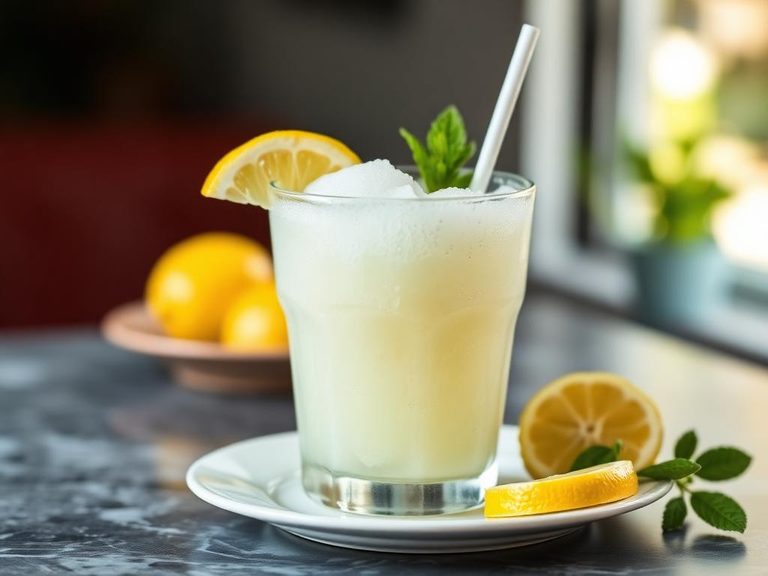
This is a refreshing, sweet-tart beverage made by diluting a frozen pink lemonade concentrate with water. It has a smooth, slightly slushy texture when freshly mixed and a vibrant pink hue, typically from added fruit juices or coloring. Nutritionally, it's a low-calorie, sugar-sweetened drink offering quick energy primarily from carbohydrates.
Calorie split: 0% protein · 97% carbs · 3% fat
↓ Full nutrition💚 Why it's loved
People love it for its nostalgic, classic summertime flavor that balances sweet and tart perfectly. Its versatility makes it a go-to base for cocktails, mocktails, or a simple, cooling non-alcoholic treat on a hot day.
⚠️ Watch-outs & how to enjoy it better
The high sugar content can lead to rapid blood-sugar spikes, making it less ideal for those managing diabetes or seeking sustained energy. To counteract this, pair it with a source of protein or healthy fat (like nuts or yogurt) to slow sugar absorption, or dilute it further with water or sparkling water to reduce the sugar load per serving.
Key benefits
- Quick source of energy from simple sugars
- Low in fat and protein
- Provides hydration
- Convenient and easy to prepare
- Contains small amounts of vitamin C from lemon juice
🍽️ Popular dishes



🌍 Where it's eaten
💡 Did you know?
The pink color in traditional pink lemonade wasn't from fruit—it was often created by adding a bit of red fruit juice, cranberry juice, or even a dash of grenadine or food coloring to the regular yellow lemonade.
Full nutrition (USDA data · scales with serving)
| Water | 88.9 g |
| Energy | 43.0 kcal |
| Energy | 178 kj |
| Protein | 0.05 g |
| Total lipid (fat) | 0.15 g |
| Ash | 0.11 g |
| Carbohydrate, by difference | 10.8 g |
| Fiber, total dietary | 0.10 g |
| Total Sugars | 10.3 g |
| Sucrose | 1.6 g |
| Glucose | 4.1 g |
| Fructose | 4.4 g |
| Lactose | 0.00 g |
| Maltose | 0.10 g |
| Galactose | 0.00 g |
| Starch | 0.00 g |
| Calcium, Ca | 4.0 mg |
| Iron, Fe | 0.02 mg |
| Magnesium, Mg | 2.0 mg |
| Phosphorus, P | 2.0 mg |
| Potassium, K | 17.0 mg |
| Sodium, Na | 4.0 mg |
| Zinc, Zn | 0.01 mg |
| Copper, Cu | 0.01 mg |
| Manganese, Mn | 0.00 mg |
| Selenium, Se | 0.00 ug |
| Fluoride, F | 55.4 ug |
| Vitamin C, total ascorbic acid | 3.1 mg |
| Thiamin | 0.00 mg |
| Riboflavin | 0.00 mg |
| Niacin | 0.03 mg |
| Pantothenic acid | 0.02 mg |
| Vitamin B-6 | 0.00 mg |
| Folate, total | 2.0 ug |
| Folic acid | 0.00 ug |
| Folate, food | 2.0 ug |
| Folate, DFE | 2.0 ug |
| Choline, total | 0.40 mg |
| Betaine | 0.00 mg |
| Vitamin B-12 | 0.00 ug |
| Vitamin B-12, added | 0.00 ug |
| Vitamin A, RAE | 0.00 ug |
| Retinol | 0.00 ug |
| Carotene, beta | 0.00 ug |
| Carotene, alpha | 0.00 ug |
| Cryptoxanthin, beta | 0.00 ug |
| Vitamin A, IU | 0.00 iu |
| Lycopene | 0.00 ug |
| Lutein + zeaxanthin | 0.00 ug |
| Vitamin E (alpha-tocopherol) | 0.02 mg |
| Vitamin E, added | 0.00 mg |
| Tocopherol, beta | 0.00 mg |
| Tocopherol, gamma | 0.00 mg |
| Tocopherol, delta | 0.00 mg |
| Tocotrienol, alpha | 0.00 mg |
| Tocotrienol, beta | 0.00 mg |
| Tocotrienol, gamma | 0.00 mg |
| Tocotrienol, delta | 0.00 mg |
| Vitamin D (D2 + D3), International Units | 0.00 iu |
| Vitamin D (D2 + D3) | 0.00 ug |
| Vitamin K (phylloquinone) | 0.00 ug |
| Vitamin K (Dihydrophylloquinone) | 0.00 ug |
| Alcohol, ethyl | 0.00 g |
| Caffeine | 0.00 mg |
| Theobromine | 0.00 mg |
Fat & fatty acid profile (per 100g)
| Fatty acids, total saturated | 0.01 g |
| SFA 4:0 | 0.00 g |
| SFA 6:0 | 0.00 g |
| SFA 8:0 | 0.00 g |
| SFA 10:0 | 0.00 g |
| SFA 12:0 | 0.00 g |
| SFA 14:0 | 0.00 g |
| SFA 16:0 | 0.01 g |
| SFA 18:0 | 0.00 g |
| Fatty acids, total monounsaturated | 0.00 g |
| MUFA 16:1 | 0.00 g |
| MUFA 18:1 | 0.00 g |
| MUFA 20:1 | 0.00 g |
| MUFA 22:1 | 0.00 g |
| Fatty acids, total polyunsaturated | 0.01 g |
| PUFA 18:2 | 0.01 g |
| PUFA 18:3 | 0.00 g |
| PUFA 18:4 | 0.00 g |
| PUFA 20:4 | 0.00 g |
| PUFA 20:5 n-3 (EPA) | 0.00 g |
| PUFA 22:5 n-3 (DPA) | 0.00 g |
| PUFA 22:6 n-3 (DHA) | 0.00 g |
| Fatty acids, total trans | 0.00 g |
| Cholesterol | 0.00 mg |
Amino acid profile (per 100g)
Estimated from Beverages, carbonated, tonic water — USDA does not publish this profile for Beverages.
| Tryptophan | 0.00 g |
| Threonine | 0.00 g |
| Isoleucine | 0.00 g |
| Leucine | 0.00 g |
| Lysine | 0.00 g |
| Methionine | 0.00 g |
| Cystine | 0.00 g |
| Phenylalanine | 0.00 g |
| Tyrosine | 0.00 g |
| Valine | 0.00 g |
| Arginine | 0.00 g |
| Histidine | 0.00 g |
| Alanine | 0.00 g |
| Aspartic acid | 0.00 g |
| Glutamic acid | 0.00 g |
| Glycine | 0.00 g |
| Proline | 0.00 g |
| Serine | 0.00 g |
FAQ
Is pink lemonade just regular lemonade with red dye?
Not necessarily. While some commercial versions use coloring, authentic pink lemonade often gets its color and a subtle flavor twist from added fruit juices like cranberry, raspberry, or strawberry, or from a splash of grenadine.
How does the nutrition compare to regular lemonade?
The nutrition is very similar. Both are primarily water and sugar with minimal other nutrients. The 'pink' version may have trace amounts of additional fruit juice, but the calorie and sugar content is typically comparable.
Can I use this concentrate for things other than drinks?
Absolutely! It's excellent as a glaze for chicken or fish, a flavoring for yogurt or oatmeal, a base for salad dressings, or as a liquid in cake batters to add a bright, citrusy note.
Nutrient density (calculated · NRF9.3)
Nutrient Rich Foods index: beneficial nutrients (protein, fiber, vitamins, minerals) minus saturated fat, added sugar & sodium, per 100 kcal.
NRF9.3 index — Fulgoni, Keast & Drewnowski, 2009. Computed from USDA nutrients.
Weight-loss friendliness (composite index)
Energy density 0.43 kcal/g · 0% calories from protein · 0.1 g fiber · 10.3 g sugar per 100 g.
Composite of energy density (Rolls et al., 1999), protein & fiber satiety, minus sugar. A calculated heuristic — ranks satiety-per-calorie, not a clinical measure.
Dietary load (calculated from USDA values)
Potential renal acid load. Positive = acid-forming, negative = alkaline-forming.
Sodium-to-potassium ratio: 0.24 (lower is better — aim for ≤ 1)
Sodium:potassium per WHO potassium guidance. Computed from USDA nutrients.