

ON THE BORDER, Mexican rice
Whole food · Restaurant Foods

Photo: Wikipedia
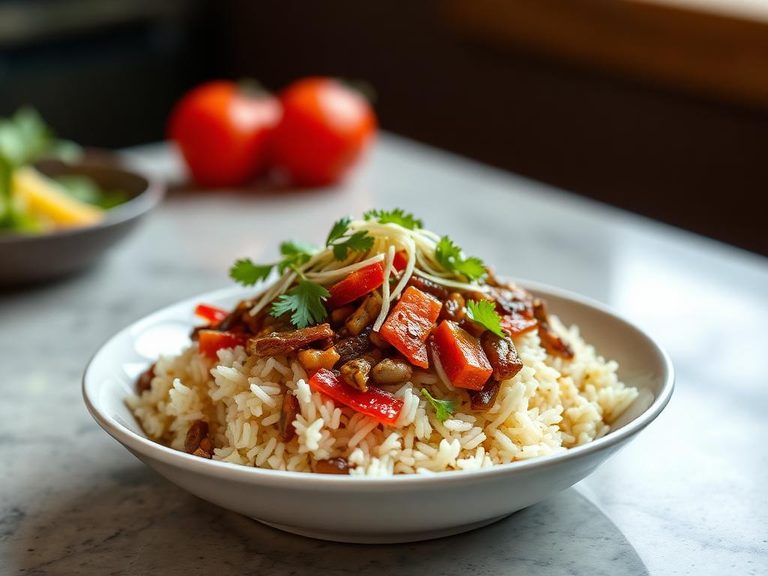
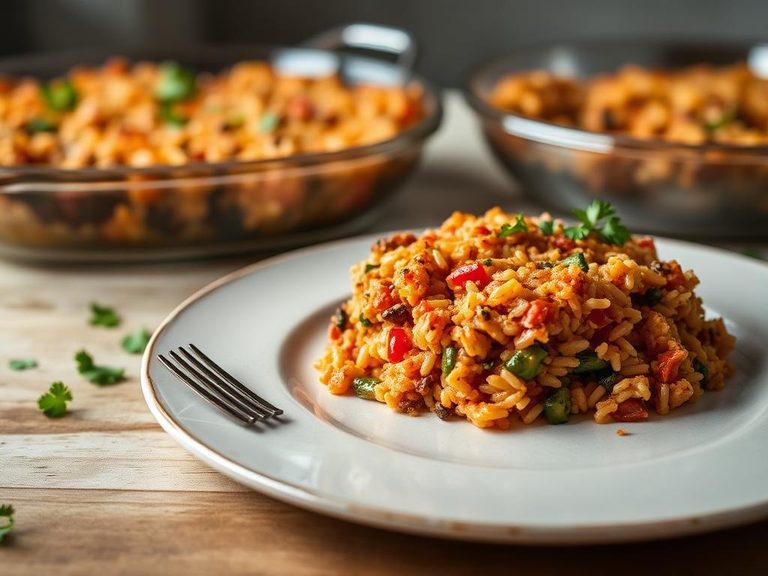
On The Border's Mexican rice is a savory, fluffy side dish of long-grain rice cooked in a tomato-based broth with onions, garlic, and mild spices. It has a slightly soft, tender texture with a subtle, savory flavor profile. Nutritionally, it is primarily a carbohydrate source, providing quick energy with minimal protein and fat.
Calorie split: 7% protein · 70% carbs · 22% fat
↓ Full nutrition💚 Why it's loved
People love it for its comforting, savory flavor that acts as the perfect canvas for richer, spicier main dishes like fajitas or enchiladas. It's a nostalgic staple that brings the familiar, satisfying taste of Tex-Mex restaurant meals to the table.
⚠️ Watch-outs & how to enjoy it better
Its high carbohydrate content and low fiber can lead to blood sugar spikes, especially when eaten alone. To counteract this, pair it with a protein source like grilled chicken or beans, and add non-starchy vegetables to the meal to slow digestion. Be mindful of portion sizes if monitoring carbohydrate intake.
Key benefits
- Provides quick energy from carbohydrates
- Low in fat and contains no cholesterol
- Contains small amounts of essential minerals from spices
- A versatile side that complements many proteins
- Gluten-free by its primary ingredient
🍽️ Popular dishes
🌍 Where it's eaten
💡 Did you know?
The red-orange color of restaurant-style Mexican rice typically comes from tomato sauce or paste, not from the spices themselves, which are often just garlic, onion, and cumin.
Full nutrition (USDA data · scales with serving)
| Water | 55.2 g |
| Energy | 195 kcal |
| Energy | 814 kj |
| Protein | 3.6 g |
| Total lipid (fat) | 4.9 g |
| Ash | 2.2 g |
| Carbohydrate, by difference | 34.1 g |
| Fiber, total dietary | 1.1 g |
| Total Sugars | 1.4 g |
| Sucrose | 0.68 g |
| Glucose | 0.37 g |
| Fructose | 0.33 g |
| Lactose | 0.00 g |
| Maltose | 0.00 g |
| Galactose | 0.00 g |
| Starch | 28.9 g |
| Calcium, Ca | 39.0 mg |
| Iron, Fe | 1.2 mg |
| Magnesium, Mg | 15.0 mg |
| Phosphorus, P | 74.0 mg |
| Potassium, K | 131 mg |
| Sodium, Na | 677 mg |
| Zinc, Zn | 0.38 mg |
| Copper, Cu | 0.07 mg |
| Manganese, Mn | 0.35 mg |
| Selenium, Se | 7.3 ug |
| Vitamin C, total ascorbic acid | 0.30 mg |
| Thiamin | 0.28 mg |
| Riboflavin | 0.09 mg |
| Niacin | 2.8 mg |
| Pantothenic acid | 0.51 mg |
| Folate, total | 52.0 ug |
| Choline, total | 9.1 mg |
| Betaine | 19.9 mg |
| Vitamin B-12 | 0.09 ug |
| Vitamin A, RAE | 3.0 ug |
| Carotene, beta | 37.0 ug |
| Carotene, alpha | 0.00 ug |
| Cryptoxanthin, beta | 0.00 ug |
| Vitamin A, IU | 61.0 iu |
| Lycopene | 208 ug |
| Lutein + zeaxanthin | 100 ug |
| Vitamin E (alpha-tocopherol) | 0.59 mg |
| Tocopherol, beta | 0.05 mg |
| Tocopherol, gamma | 2.8 mg |
| Tocopherol, delta | 0.91 mg |
| Tocotrienol, alpha | 0.14 mg |
| Tocotrienol, beta | 0.00 mg |
| Tocotrienol, gamma | 0.20 mg |
| Tocotrienol, delta | 0.00 mg |
| Vitamin K (phylloquinone) | 12.3 ug |
| Vitamin K (Dihydrophylloquinone) | 0.20 ug |
| Vitamin K (Menaquinone-4) | 0.00 ug |
Fat & fatty acid profile (per 100g)
| Fatty acids, total saturated | 0.89 g |
| SFA 4:0 | 0.00 g |
| SFA 6:0 | 0.00 g |
| SFA 8:0 | 0.00 g |
| SFA 10:0 | 0.00 g |
| SFA 12:0 | 0.00 g |
| SFA 14:0 | 0.01 g |
| SFA 15:0 | 0.00 g |
| SFA 16:0 | 0.55 g |
| SFA 17:0 | 0.00 g |
| SFA 18:0 | 0.29 g |
| SFA 20:0 | 0.01 g |
| SFA 22:0 | 0.01 g |
| SFA 24:0 | 0.01 g |
| Fatty acids, total monounsaturated | 1.2 g |
| MUFA 14:1 | 0.00 g |
| MUFA 15:1 | 0.00 g |
| MUFA 16:1 | 0.00 g |
| MUFA 16:1 c | 0.00 g |
| MUFA 17:1 | 0.00 g |
| MUFA 18:1 | 1.1 g |
| MUFA 18:1 c | 1.1 g |
| MUFA 20:1 | 0.01 g |
| MUFA 22:1 | 0.00 g |
| MUFA 22:1 c | 0.00 g |
| MUFA 24:1 c | 0.00 g |
| Fatty acids, total polyunsaturated | 2.3 g |
| PUFA 18:2 | 2.1 g |
| PUFA 18:2 n-6 c,c | 2.0 g |
| PUFA 18:2 CLAs | 0.00 g |
| PUFA 18:3 | 0.24 g |
| PUFA 18:3 n-3 c,c,c (ALA) | 0.23 g |
| PUFA 18:3 n-6 c,c,c | 0.01 g |
| PUFA 18:3i | 0.00 g |
| PUFA 18:4 | 0.00 g |
| PUFA 20:2 n-6 c,c | 0.00 g |
| PUFA 20:3 | 0.00 g |
| PUFA 20:3 n-3 | 0.00 g |
| PUFA 20:3 n-6 | 0.00 g |
| PUFA 20:4 | 0.00 g |
| PUFA 20:5 n-3 (EPA) | 0.00 g |
| PUFA 22:4 | 0.00 g |
| PUFA 22:5 n-3 (DPA) | 0.00 g |
| PUFA 22:6 n-3 (DHA) | 0.00 g |
| Fatty acids, total trans | 0.03 g |
| Fatty acids, total trans-monoenoic | 0.02 g |
| TFA 16:1 t | 0.00 g |
| TFA 18:1 t | 0.02 g |
| TFA 22:1 t | 0.00 g |
| TFA 18:2 t not further defined | 0.01 g |
| Fatty acids, total trans-polyenoic | 0.01 g |
| Cholesterol | 0.00 mg |
FAQ
Is this rice spicy?
No, On The Border's Mexican rice is generally mild and savory, seasoned with garlic, onion, and tomato rather than hot chilies.
Is it gluten-free?
Yes, the base of the dish is rice, which is naturally gluten-free. However, always check for cross-contamination or added seasonings if you have severe gluten sensitivity.
How does it differ from Spanish rice?
The terms are often used interchangeably in the U.S. In general, 'Mexican rice' (or red rice) is cooked with tomato, while 'Spanish rice' might sometimes refer to a saffron-infused paella-style rice, though restaurant usage varies.
Nutrient density (calculated · NRF9.3)
Nutrient Rich Foods index: beneficial nutrients (protein, fiber, vitamins, minerals) minus saturated fat, added sugar & sodium, per 100 kcal.
NRF9.3 index — Fulgoni, Keast & Drewnowski, 2009. Computed from USDA nutrients.
Weight-loss friendliness (composite index)
Energy density 1.95 kcal/g · 7% calories from protein · 1.1 g fiber · 1.4 g sugar per 100 g.
Composite of energy density (Rolls et al., 1999), protein & fiber satiety, minus sugar. A calculated heuristic — ranks satiety-per-calorie, not a clinical measure.
Dietary load (calculated from USDA values)
Potential renal acid load. Positive = acid-forming, negative = alkaline-forming.
Sodium-to-potassium ratio: 5.17 (lower is better — aim for ≤ 1)
Sodium:potassium per WHO potassium guidance. Computed from USDA nutrients.