

Lamb, Australian, imported, fresh, rib chop, frenched, bone-in, separable lean only, trimmed to 1/8" fat, cooked, grilled
Whole food · Lamb, Veal, and Game Products
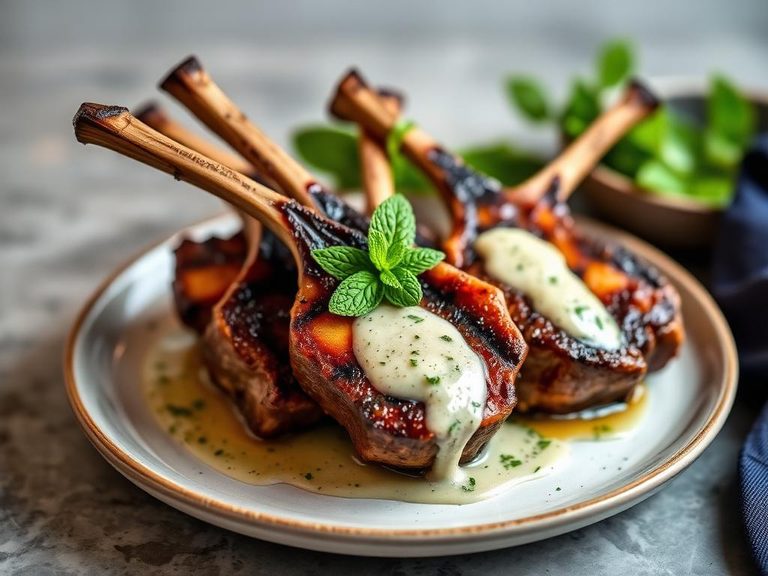
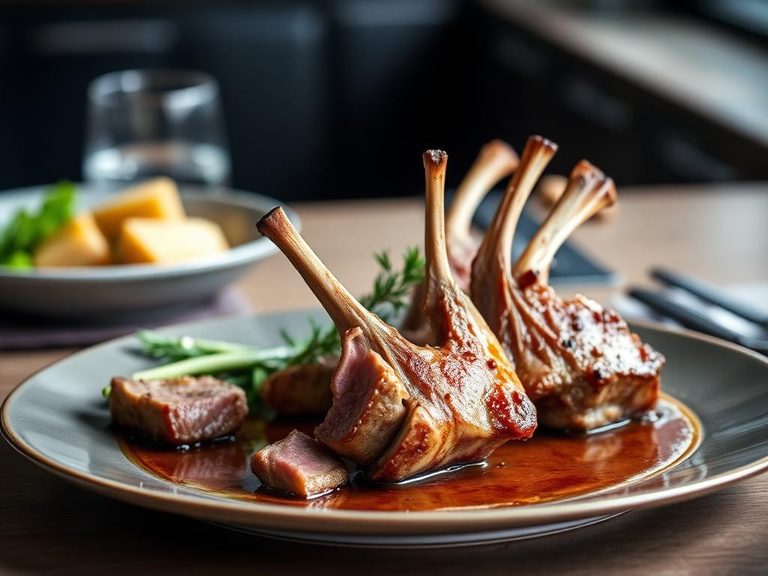
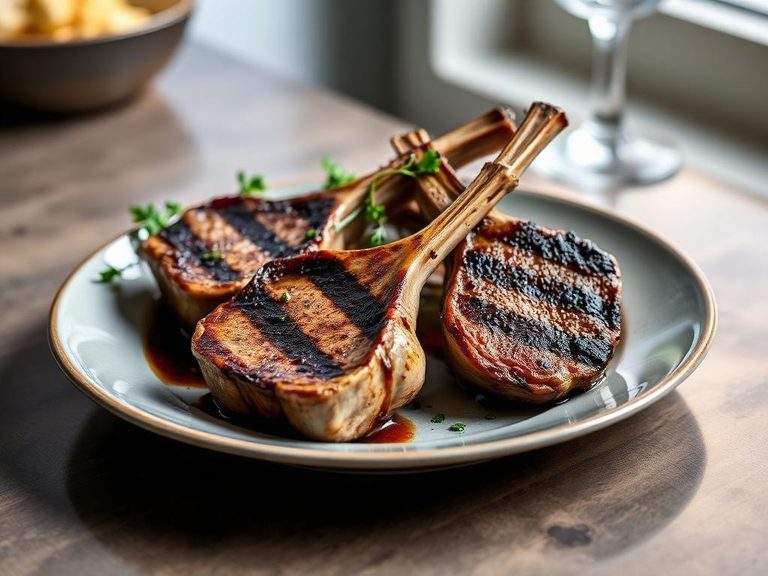
This is a premium cut of Australian lamb, frenched to expose the bone for an elegant presentation, then grilled to perfection. The lean meat offers a rich, slightly gamey yet sweet flavor with a tender, succulent texture that's less fatty than other cuts. It's a protein powerhouse, delivering over 32 grams of high-quality protein per 100g with virtually no carbohydrates.
Calorie split: 55% protein · 0% carbs · 45% fat
↓ Full nutrition💚 Why it's loved
People adore this cut for its perfect balance of robust lamb flavor and elegant tenderness when grilled. The frenched bone makes it a showstopper on the plate, ideal for special occasions, while its relative leanness allows the natural taste of the lamb to shine without excessive greasiness.
⚠️ Watch-outs & how to enjoy it better
The primary downside is its higher saturated fat content compared to poultry or fish, which those managing heart health should consider. The strong, distinct flavor of lamb can also be off-putting to some palates. To mitigate, pair it with a bright, acidic side like a mint-yogurt sauce or a vinegar-based salad to cut through the richness, and practice portion control by serving it alongside generous portions of vegetables.
Key benefits
- Excellent source of complete protein for muscle maintenance and repair
- Rich in essential nutrients like iron, zinc, and B vitamins (especially B12)
- Contains conjugated linoleic acid (CLA), a fatty acid studied for potential health benefits
- Naturally low in carbohydrates, suitable for low-carb and ketogenic diets
- Provides heme iron, which is more easily absorbed than plant-based iron
🍽️ Popular dishes
🌍 Where it's eaten
💡 Did you know?
The 'frenched' preparation, where meat and fat are scraped clean from the end of the rib bone, is believed to have been popularized in the 19th century not just for aesthetics, but also to provide a clean 'handle' for eating the chop by hand at formal banquets.
Full nutrition (USDA data · scales with serving)
| Water | 56.3 g |
| Energy | 234 kcal |
| Energy | 978 kj |
| Protein | 32.2 g |
| Total lipid (fat) | 11.7 g |
| Ash | 1.1 g |
| Carbohydrate, by difference | 0.00 g |
| Fiber, total dietary | 0.00 g |
| Total Sugars | 0.00 g |
| Calcium, Ca | 11.0 mg |
| Iron, Fe | 2.4 mg |
| Magnesium, Mg | 26.0 mg |
| Phosphorus, P | 216 mg |
| Potassium, K | 320 mg |
| Sodium, Na | 85.0 mg |
| Zinc, Zn | 3.3 mg |
| Copper, Cu | 0.13 mg |
| Manganese, Mn | 0.01 mg |
| Selenium, Se | 15.2 ug |
| Vitamin C, total ascorbic acid | 0.00 mg |
| Thiamin | 0.15 mg |
| Riboflavin | 0.37 mg |
| Niacin | 8.9 mg |
| Pantothenic acid | 0.66 mg |
| Vitamin B-6 | 0.60 mg |
| Vitamin B-12 | 1.7 ug |
| Vitamin B-12, added | 0.00 ug |
| Vitamin A, RAE | 4.0 ug |
| Retinol | 4.0 ug |
| Carotene, beta | 0.00 ug |
| Carotene, alpha | 0.00 ug |
| Cryptoxanthin, beta | 0.00 ug |
| Vitamin A, IU | 15.0 iu |
| Lycopene | 0.00 ug |
| Lutein + zeaxanthin | 0.00 ug |
| Vitamin E (alpha-tocopherol) | 0.41 mg |
| Vitamin E, added | 0.00 mg |
| Vitamin D (D2 + D3), International Units | 0.00 iu |
| Vitamin D (D2 + D3) | 0.00 ug |
| Vitamin D2 (ergocalciferol) | 0.00 ug |
| Vitamin D3 (cholecalciferol) | 0.00 ug |
| Alcohol, ethyl | 0.00 g |
| Caffeine | 0.00 mg |
| Theobromine | 0.00 mg |
Fat & fatty acid profile (per 100g)
| Fatty acids, total saturated | 5.7 g |
| SFA 4:0 | 0.00 g |
| SFA 6:0 | 0.00 g |
| SFA 8:0 | 0.00 g |
| SFA 10:0 | 0.01 g |
| SFA 12:0 | 0.03 g |
| SFA 14:0 | 0.39 g |
| SFA 15:0 | 0.06 g |
| SFA 16:0 | 2.8 g |
| SFA 17:0 | 0.15 g |
| SFA 18:0 | 2.2 g |
| SFA 20:0 | 0.02 g |
| SFA 22:0 | 0.00 g |
| SFA 24:0 | 0.00 g |
| Fatty acids, total monounsaturated | 4.8 g |
| MUFA 14:1 | 0.01 g |
| MUFA 15:1 | 0.00 g |
| MUFA 16:1 | 0.16 g |
| MUFA 17:1 | 0.00 g |
| MUFA 18:1 | 4.6 g |
| MUFA 18:1 c | 4.1 g |
| MUFA 20:1 | 0.01 g |
| MUFA 22:1 | 0.00 g |
| MUFA 22:1 c | 0.00 g |
| Fatty acids, total polyunsaturated | 0.65 g |
| PUFA 18:2 | 0.41 g |
| PUFA 18:2 n-6 c,c | 0.26 g |
| PUFA 18:2 CLAs | 0.01 g |
| PUFA 18:3 | 0.11 g |
| PUFA 18:3 n-3 c,c,c (ALA) | 0.11 g |
| PUFA 18:3 n-6 c,c,c | 0.00 g |
| PUFA 18:4 | 0.00 g |
| PUFA 20:2 n-6 c,c | 0.00 g |
| PUFA 20:3 | 0.00 g |
| PUFA 20:4 | 0.05 g |
| PUFA 20:5 n-3 (EPA) | 0.03 g |
| PUFA 22:5 n-3 (DPA) | 0.04 g |
| PUFA 22:6 n-3 (DHA) | 0.01 g |
| Fatty acids, total trans | 0.63 g |
| Fatty acids, total trans-monoenoic | 0.49 g |
| TFA 18:1 t | 0.49 g |
| TFA 18:2 t not further defined | 0.14 g |
| Fatty acids, total trans-polyenoic | 0.14 g |
| Cholesterol | 92.0 mg |
Amino acid profile (per 100g)
| Tryptophan | 0.33 g |
| Threonine | 1.3 g |
| Isoleucine | 1.3 g |
| Leucine | 2.3 g |
| Lysine | 2.5 g |
| Methionine | 0.78 g |
| Cystine | 0.33 g |
| Phenylalanine | 1.2 g |
| Tyrosine | 1.0 g |
| Valine | 1.4 g |
| Arginine | 1.9 g |
| Histidine | 0.84 g |
| Alanine | 1.8 g |
| Aspartic acid | 2.6 g |
| Glutamic acid | 4.3 g |
| Glycine | 1.7 g |
| Proline | 1.4 g |
| Serine | 1.1 g |
FAQ
How do I prevent grilled lamb chops from becoming tough?
The key is to not overcook them. Since this is a lean cut, aim for an internal temperature of 145°F (63°C) for medium-rare, which will leave it juicy and tender. Let the chops rest for 5-10 minutes after grilling before serving.
What's the best way to get a good sear without burning the frenched bone?
Pat the chops completely dry before seasoning. Preheat your grill or pan to high heat. You can wrap the exposed bone ends in a small piece of aluminum foil to prevent them from charring too quickly while the meat sears.
Is there a significant nutritional difference between Australian and other imported lamb?
Nutritionally, they are very similar. The primary differences are often in flavor profile and fat marbling, which can be influenced by the specific breed of sheep and their diet (grass-fed vs. grain-finished). Australian lamb is often noted for its consistent quality and milder flavor.
Nutrient density (calculated · NRF9.3)
Nutrient Rich Foods index: beneficial nutrients (protein, fiber, vitamins, minerals) minus saturated fat, added sugar & sodium, per 100 kcal.
NRF9.3 index — Fulgoni, Keast & Drewnowski, 2009. Computed from USDA nutrients.
Weight-loss friendliness (composite index)
Energy density 2.34 kcal/g · 55% calories from protein · 0.0 g fiber · 0.0 g sugar per 100 g.
Composite of energy density (Rolls et al., 1999), protein & fiber satiety, minus sugar. A calculated heuristic — ranks satiety-per-calorie, not a clinical measure.
Dietary load (calculated from USDA values)
Potential renal acid load. Positive = acid-forming, negative = alkaline-forming.
Sodium-to-potassium ratio: 0.27 (lower is better — aim for ≤ 1)
Sodium:potassium per WHO potassium guidance. Computed from USDA nutrients.