

BURGER KING, Original Chicken Sandwich
Whole food · Fast Foods
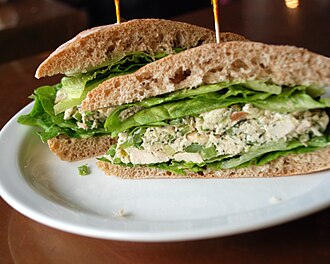
Photo: Wikipedia
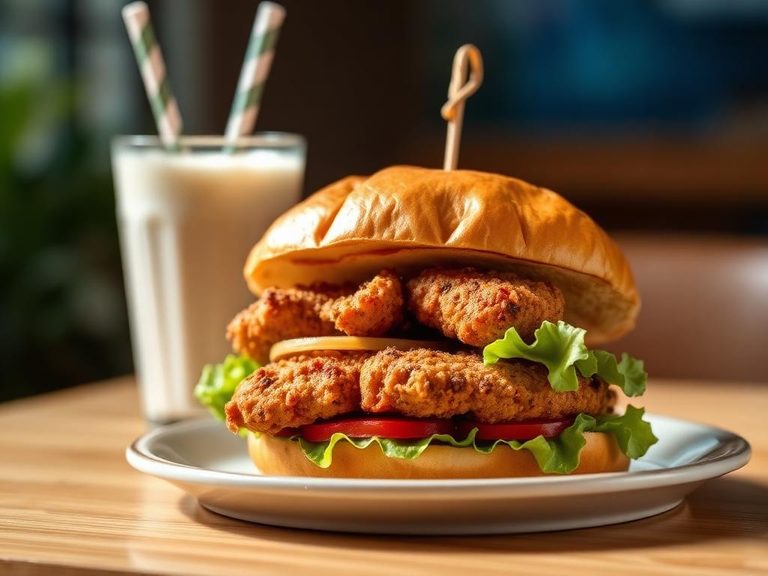
The Burger King Original Chicken Sandwich is a crispy, breaded patty of white-meat chicken served on a sesame seed bun, offering a satisfying crunch and mild, savory flavor. Nutritionally, it provides a solid protein source (12.14g per 100g) but is also relatively high in fat (14.69g) and carbohydrates (26.22g), making it a more indulgent choice. Its balanced macronutrient profile makes it a filling, quick meal option.
Calorie split: 17% protein · 37% carbs · 46% fat
↓ Full nutrition💚 Why it's loved
People love it for its consistent, crispy texture and the satisfying combination of savory chicken with a soft, slightly sweet bun. It's a versatile staple that pairs well with fries and a drink, making it a go-to for a quick, familiar meal.
⚠️ Watch-outs & how to enjoy it better
The sandwich is high in fat and sodium, which can contribute to blood-sugar spikes and may not be ideal for those monitoring their intake. To counteract this, pair it with a side salad or vegetables to increase fiber and nutrient intake, and consider portion control by opting for a smaller meal or sharing. Additionally, the breaded coating and bun are common sources of gluten and allergens, so those with sensitivities should be cautious.
Key benefits
- Good source of protein for muscle maintenance
- Provides quick energy from carbohydrates
- Convenient and widely available fast-food option
- Offers a familiar, comforting taste profile
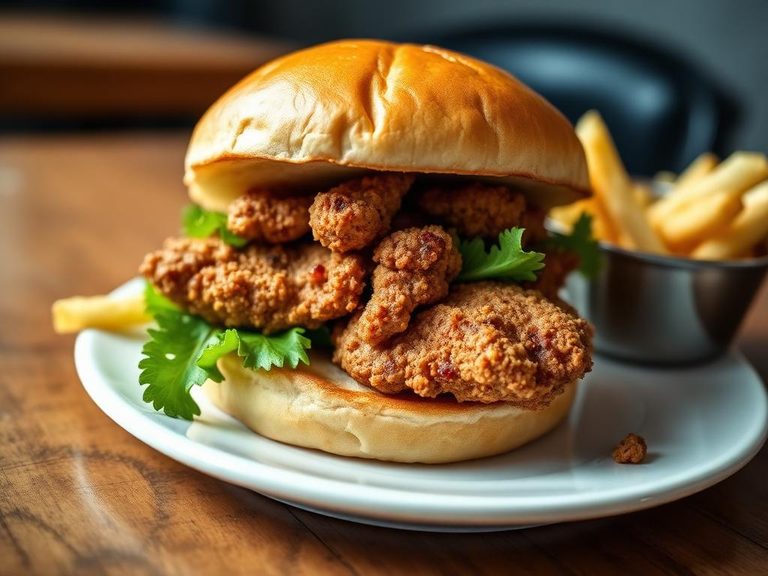
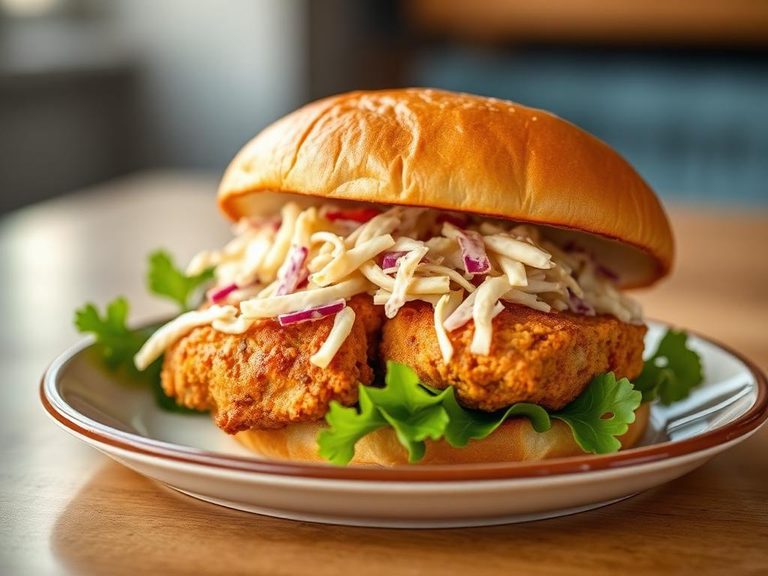
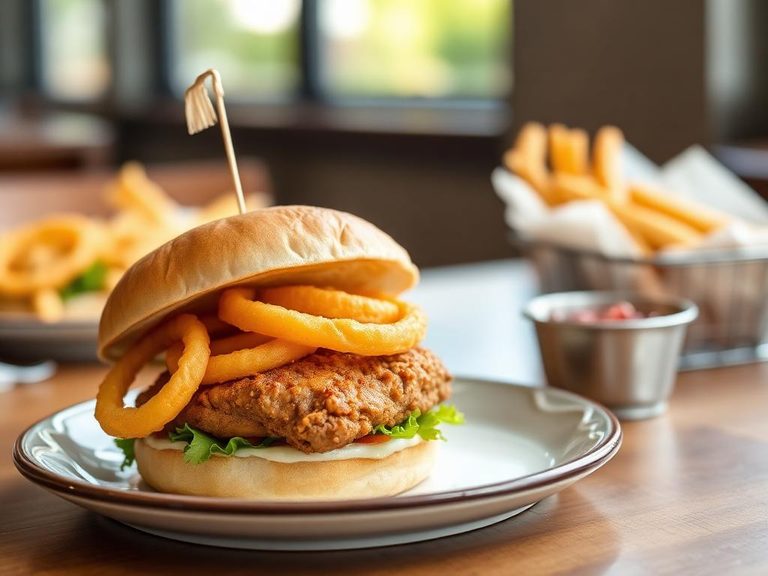
🍽️ Popular dishes

🌍 Where it's eaten
💡 Did you know?
The Original Chicken Sandwich was first introduced by Burger King in 1979, making it one of the chain's longest-standing menu items, predating the popular Whopper's 1957 debut by over two decades.
Full nutrition (USDA data · scales with serving)
| Water | 44.7 g |
| Energy | 286 kcal |
| Energy | 1195 kj |
| Protein | 12.1 g |
| Total lipid (fat) | 14.7 g |
| Ash | 2.3 g |
| Carbohydrate, by difference | 26.2 g |
| Fiber, total dietary | 2.4 g |
| Total Sugars | 3.0 g |
| Sucrose | 0.07 g |
| Glucose | 1.0 g |
| Fructose | 1.4 g |
| Lactose | 0.02 g |
| Maltose | 0.57 g |
| Galactose | 0.00 g |
| Calcium, Ca | 46.0 mg |
| Iron, Fe | 1.8 mg |
| Magnesium, Mg | 23.0 mg |
| Phosphorus, P | 128 mg |
| Potassium, K | 196 mg |
| Sodium, Na | 638 mg |
| Zinc, Zn | 0.62 mg |
| Copper, Cu | 0.09 mg |
| Manganese, Mn | 0.40 mg |
| Selenium, Se | 23.4 ug |
| Vitamin C, total ascorbic acid | 0.20 mg |
| Thiamin | 0.28 mg |
| Riboflavin | 0.16 mg |
| Niacin | 4.7 mg |
| Pantothenic acid | 0.43 mg |
| Vitamin B-6 | 0.15 mg |
| Folate, total | 33.0 ug |
| Folic acid | 21.0 ug |
| Folate, food | 12.0 ug |
| Folate, DFE | 48.0 ug |
| Vitamin K (phylloquinone) | 23.7 ug |
| Vitamin K (Dihydrophylloquinone) | 7.7 ug |
Fat & fatty acid profile (per 100g)
| Fatty acids, total saturated | 2.7 g |
| SFA 4:0 | 0.00 g |
| SFA 6:0 | 0.00 g |
| SFA 8:0 | 0.00 g |
| SFA 10:0 | 0.01 g |
| SFA 12:0 | 0.00 g |
| SFA 14:0 | 0.03 g |
| SFA 15:0 | 0.01 g |
| SFA 16:0 | 1.9 g |
| SFA 17:0 | 0.01 g |
| SFA 18:0 | 0.62 g |
| SFA 20:0 | 0.04 g |
| SFA 22:0 | 0.04 g |
| SFA 24:0 | 0.02 g |
| Fatty acids, total monounsaturated | 3.7 g |
| MUFA 14:1 | 0.00 g |
| MUFA 15:1 | 0.00 g |
| MUFA 16:1 | 0.14 g |
| MUFA 16:1 c | 0.14 g |
| MUFA 17:1 | 0.01 g |
| MUFA 18:1 | 3.5 g |
| MUFA 18:1 c | 3.5 g |
| MUFA 20:1 | 0.07 g |
| MUFA 22:1 | 0.00 g |
| MUFA 22:1 c | 0.00 g |
| MUFA 24:1 c | 0.00 g |
| Fatty acids, total polyunsaturated | 7.2 g |
| PUFA 18:2 | 6.5 g |
| PUFA 18:2 n-6 c,c | 6.4 g |
| PUFA 18:2 CLAs | 0.01 g |
| PUFA 18:3 | 0.67 g |
| PUFA 18:3 n-3 c,c,c (ALA) | 0.65 g |
| PUFA 18:3 n-6 c,c,c | 0.02 g |
| PUFA 18:4 | 0.00 g |
| PUFA 20:2 n-6 c,c | 0.01 g |
| PUFA 20:3 | 0.01 g |
| PUFA 20:3 n-3 | 0.00 g |
| PUFA 20:3 n-6 | 0.01 g |
| PUFA 20:4 | 0.03 g |
| PUFA 20:5 n-3 (EPA) | 0.00 g |
| PUFA 22:4 | 0.01 g |
| PUFA 22:5 n-3 (DPA) | 0.00 g |
| PUFA 22:6 n-3 (DHA) | 0.00 g |
| Fatty acids, total trans | 0.08 g |
| Fatty acids, total trans-monoenoic | 0.02 g |
| TFA 16:1 t | 0.00 g |
| TFA 18:1 t | 0.02 g |
| TFA 22:1 t | 0.00 g |
| TFA 18:2 t not further defined | 0.06 g |
| Fatty acids, total trans-polyenoic | 0.06 g |
| Cholesterol | 31.0 mg |
Amino acid profile (per 100g)
| Tryptophan | 0.14 g |
| Threonine | 0.37 g |
| Isoleucine | 0.55 g |
| Leucine | 0.94 g |
| Lysine | 0.81 g |
| Methionine | 0.27 g |
| Cystine | 0.21 g |
| Phenylalanine | 0.56 g |
| Tyrosine | 0.33 g |
| Valine | 0.61 g |
| Arginine | 0.69 g |
| Histidine | 0.37 g |
| Alanine | 0.52 g |
| Aspartic acid | 0.88 g |
| Glutamic acid | 2.7 g |
| Glycine | 0.64 g |
| Proline | 1.1 g |
| Serine | 0.36 g |
| Hydroxyproline | 0.08 g |
FAQ
What is the main protein source in the Burger King Original Chicken Sandwich?
The main protein source is white-meat chicken, which is breaded and fried, providing a good amount of protein per serving.
Is the Burger King Original Chicken Sandwich suitable for vegetarians or vegans?
No, it contains chicken and is not suitable for vegetarians or vegans. However, Burger King offers plant-based alternatives like the Impossible Whopper for those seeking vegetarian options.
How does the nutritional content compare to other fast-food chicken sandwiches?
The Burger King Original Chicken Sandwich has a moderate protein content but is higher in fat and carbs compared to some grilled chicken options, making it a more indulgent choice.
Nutrient density (calculated · NRF9.3)
Nutrient Rich Foods index: beneficial nutrients (protein, fiber, vitamins, minerals) minus saturated fat, added sugar & sodium, per 100 kcal.
NRF9.3 index — Fulgoni, Keast & Drewnowski, 2009. Computed from USDA nutrients.
Weight-loss friendliness (composite index)
Energy density 2.86 kcal/g · 17% calories from protein · 2.4 g fiber · 3.0 g sugar per 100 g.
Composite of energy density (Rolls et al., 1999), protein & fiber satiety, minus sugar. A calculated heuristic — ranks satiety-per-calorie, not a clinical measure.
Dietary load (calculated from USDA values)
Potential renal acid load. Positive = acid-forming, negative = alkaline-forming.
Sodium-to-potassium ratio: 3.26 (lower is better — aim for ≤ 1)
Sodium:potassium per WHO potassium guidance. Computed from USDA nutrients.