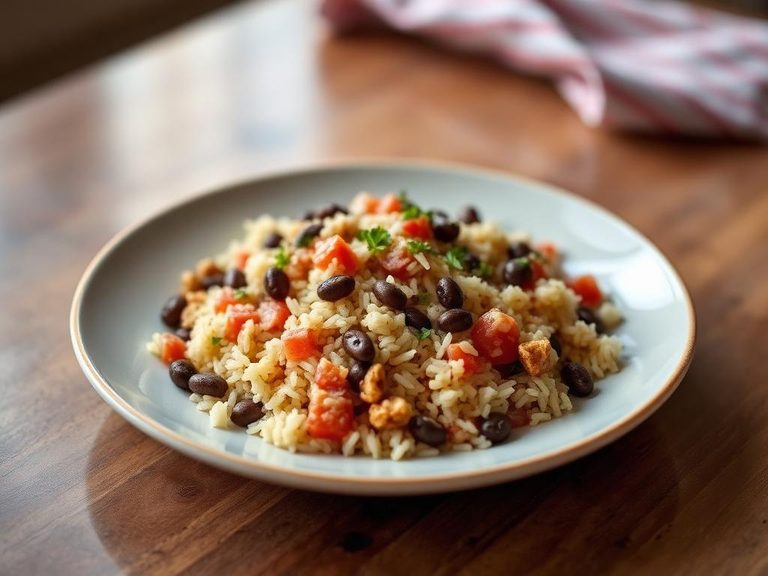
Restaurant, Latino, Arroz con frijoles negros (rice and black beans)
Whole food · Restaurant Foods
Arroz con frijoles negros is a comforting staple of Latin American cuisine, featuring fluffy white rice mingled with earthy, creamy black beans. The dish offers a satisfying, mild flavor with a soft, starchy texture, making it a versatile base for countless meals. Nutritionally, it provides a solid plant-based protein and fiber boost, with a moderate calorie count that supports balanced energy.
💚 Why it's loved
People love it for its deeply comforting, home-cooked flavor and its incredible versatility—it’s the perfect canvas for toppings like salsa, avocado, or grilled chicken. It’s also a beloved cultural staple, representing family, tradition, and hearty, affordable nourishment across Latin America.
⚠️ Watch-outs & how to enjoy it better
The high carbohydrate content can cause blood-sugar spikes, especially for those with insulin resistance, and canned beans often add significant sodium. To counteract this, pair it with a source of protein (like an egg or shredded chicken) and healthy fat (like avocado) to slow digestion, and choose low-sodium beans or rinse them thoroughly.
Key benefits
- Excellent source of plant-based protein and dietary fiber
- Provides complex carbohydrates for sustained energy
- Low in sugar and naturally cholesterol-free
- Contains essential minerals like iron and magnesium from black beans
- Versatile base for adding vegetables, lean proteins, or healthy fats
🍽️ Popular dishes


🌍 Where it's eaten
💡 Did you know?
The name 'Moros y Cristianos' (Moors and Christians) in Cuba poetically refers to the black beans (Moors) and white rice (Christians), reflecting the island's complex colonial history.
Full nutrition (scales with serving)
| Water | 65.5 g |
| Energy | 151 kcal |
| Energy | 631 kj |
| Protein | 4.6 g |
| Total lipid (fat) | 3.9 g |
| Ash | 1.6 g |
| Carbohydrate, by difference | 24.4 g |
| Fiber, total dietary | 3.4 g |
| Total Sugars | 0.86 g |
| Sucrose | 0.00 g |
| Glucose | 0.40 g |
| Fructose | 0.46 g |
| Lactose | 0.00 g |
| Maltose | 0.00 g |
| Galactose | 0.00 g |
| Starch | 18.6 g |
| Calcium, Ca | 37.0 mg |
| Iron, Fe | 1.6 mg |
| Magnesium, Mg | 26.0 mg |
| Phosphorus, P | 87.0 mg |
| Potassium, K | 224 mg |
| Sodium, Na | 420 mg |
| Zinc, Zn | 0.74 mg |
| Copper, Cu | 0.16 mg |
| Manganese, Mn | 0.44 mg |
| Selenium, Se | 4.8 ug |
| Thiamin | 0.12 mg |
| Riboflavin | 0.02 mg |
| Niacin | 1.0 mg |
| Pantothenic acid | 0.26 mg |
| Vitamin B-6 | 0.06 mg |
| Vitamin E (alpha-tocopherol) | 0.47 mg |
| Tocopherol, beta | 0.03 mg |
| Tocopherol, gamma | 2.3 mg |
| Tocopherol, delta | 0.56 mg |
| Tocotrienol, alpha | 0.00 mg |
| Tocotrienol, beta | 0.00 mg |
| Tocotrienol, gamma | 0.00 mg |
| Tocotrienol, delta | 0.00 mg |
| Vitamin K (phylloquinone) | 10.3 ug |
| Vitamin K (Dihydrophylloquinone) | 0.00 ug |
| Vitamin K (Menaquinone-4) | 0.00 ug |
Fat & fatty acid profile (per 100g)
| Fatty acids, total saturated | 0.73 g |
| SFA 6:0 | 0.00 g |
| SFA 8:0 | 0.00 g |
| SFA 10:0 | 0.02 g |
| SFA 12:0 | 0.01 g |
| SFA 14:0 | 0.03 g |
| SFA 15:0 | 0.00 g |
| SFA 16:0 | 0.46 g |
| SFA 17:0 | 0.01 g |
| SFA 18:0 | 0.18 g |
| SFA 20:0 | 0.01 g |
| SFA 22:0 | 0.01 g |
| SFA 24:0 | 0.01 g |
| Fatty acids, total monounsaturated | 0.89 g |
| MUFA 14:1 | 0.00 g |
| MUFA 15:1 | 0.00 g |
| MUFA 16:1 | 0.02 g |
| MUFA 16:1 c | 0.02 g |
| MUFA 17:1 | 0.00 g |
| MUFA 18:1 | 0.85 g |
| MUFA 18:1 c | 0.82 g |
| MUFA 20:1 | 0.01 g |
| MUFA 22:1 | 0.00 g |
| MUFA 22:1 c | 0.00 g |
| MUFA 24:1 c | 0.00 g |
| Fatty acids, total polyunsaturated | 1.6 g |
| PUFA 18:2 | 1.3 g |
| PUFA 18:2 n-6 c,c | 1.3 g |
| PUFA 18:2 CLAs | 0.00 g |
| PUFA 18:3 | 0.24 g |
| PUFA 18:3 n-3 c,c,c (ALA) | 0.24 g |
| PUFA 18:3 n-6 c,c,c | 0.00 g |
| PUFA 18:4 | 0.00 g |
| PUFA 20:2 n-6 c,c | 0.00 g |
| PUFA 20:3 | 0.00 g |
| PUFA 20:3 n-3 | 0.00 g |
| PUFA 20:3 n-6 | 0.00 g |
| PUFA 20:4 | 0.00 g |
| PUFA 20:5 n-3 (EPA) | 0.00 g |
| PUFA 22:4 | 0.00 g |
| PUFA 22:5 n-3 (DPA) | 0.00 g |
| PUFA 22:6 n-3 (DHA) | 0.00 g |
| Fatty acids, total trans | 0.05 g |
| Fatty acids, total trans-monoenoic | 0.03 g |
| TFA 16:1 t | 0.00 g |
| TFA 18:1 t | 0.03 g |
| TFA 22:1 t | 0.00 g |
| TFA 18:2 t not further defined | 0.01 g |
| Fatty acids, total trans-polyenoic | 0.01 g |
Amino acid profile (per 100g)
| Tryptophan | 0.06 g |
| Threonine | 0.19 g |
| Isoleucine | 0.20 g |
| Leucine | 0.37 g |
| Lysine | 0.26 g |
| Methionine | 0.07 g |
| Cystine | 0.05 g |
| Phenylalanine | 0.26 g |
| Tyrosine | 0.15 g |
| Valine | 0.27 g |
| Arginine | 0.32 g |
| Histidine | 0.13 g |
| Alanine | 0.21 g |
| Aspartic acid | 0.52 g |
| Glutamic acid | 0.76 g |
| Glycine | 0.18 g |
| Proline | 0.16 g |
| Serine | 0.26 g |
FAQ
Is arroz con frijoles negros a complete protein?
While black beans are high in protein, rice is low in the amino acid lysine. Together, they form a complementary protein profile, making this combination a complete protein source for vegetarians and vegans.
How can I reduce the sodium content?
Use dried black beans you cook yourself, or choose canned beans with no added salt. If using canned, rinse them thoroughly under cold water before mixing with the rice to remove up to 40% of the added sodium.
Can I make this dish ahead of time?
Yes, it stores and reheats exceptionally well. Keep it in an airtight container in the refrigerator for up to 4 days. Add a splash of water when reheating to restore moisture.