

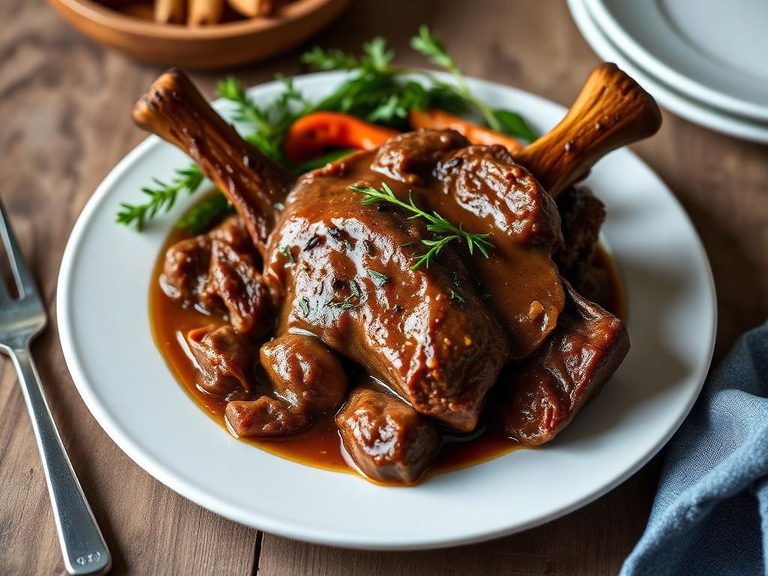
Veal, foreshank, osso buco, separable lean and fat, cooked, braised
Whole food · Lamb, Veal, and Game Products

Photo: Wikipedia
Braised veal osso buco is the cross-cut shank of the calf, prized for its rich, gelatinous marrow and tender, fall-off-the-bone meat. The slow cooking process transforms the tough connective tissue into a luscious, savory sauce, creating a deeply satisfying texture. It's a protein powerhouse with minimal carbohydrates, making it a centerpiece for hearty, low-carb meals.
Calorie split: 61% protein · 0% carbs · 38% fat
↓ Full nutrition💚 Why it's loved
People love it for the luxurious, melt-in-your-mouth texture and the deeply savory, umami-rich flavor that develops during braising. It's a classic comfort food that feels both rustic and elegant, often served as a celebratory centerpiece in family meals.
⚠️ Watch-outs & how to enjoy it better
The dish can be high in saturated fat and calories, and traditional preparations often use significant salt. Those monitoring fat intake or with hypertension should enjoy it in moderation. To counteract, skim fat from the braising liquid before serving and use low-sodium broth or season with herbs and acid (like lemon zest) instead of extra salt.
Key benefits
- Excellent source of complete protein for muscle maintenance.
- Rich in collagen and gelatin, which support joint and gut health.
- High in iron and zinc, essential minerals for immune function.
- Naturally very low in carbohydrates and sugars.
- Provides healthy fats and energy-dense calories.
🍽️ Popular dishes
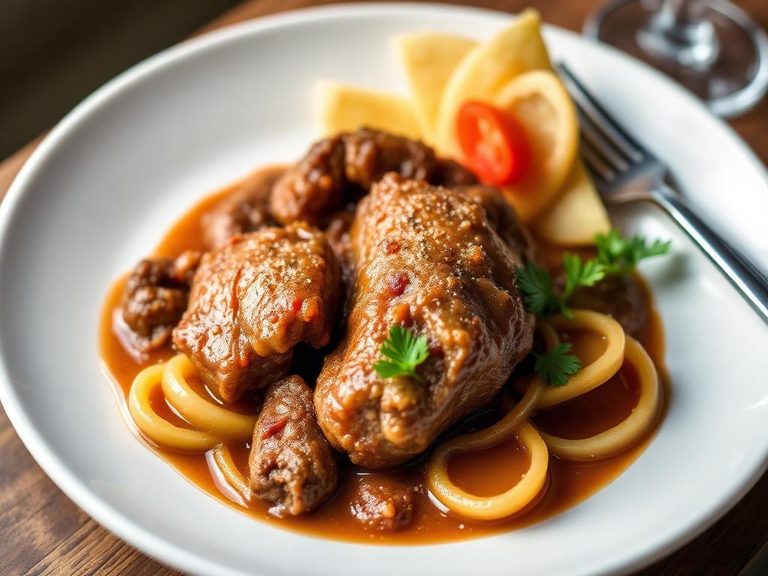
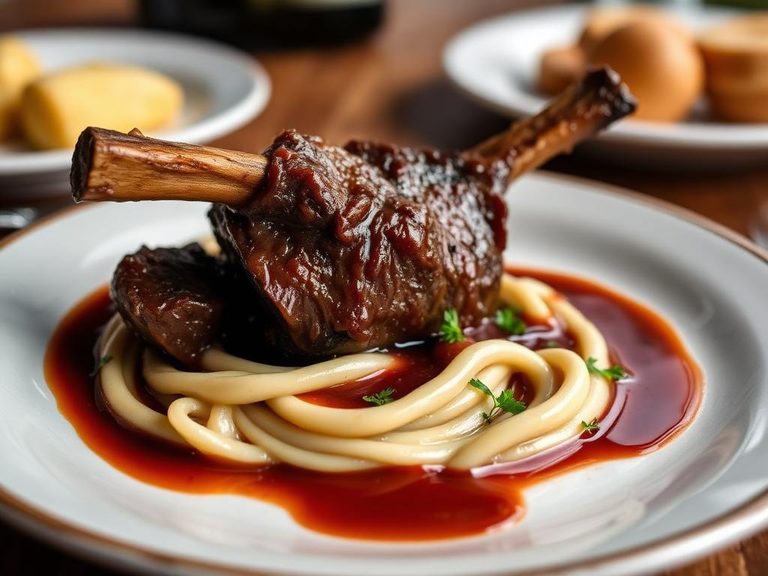
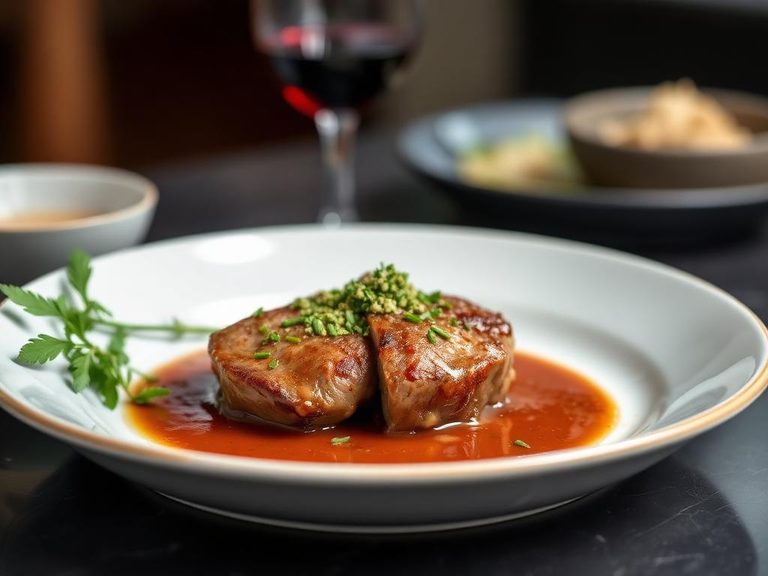
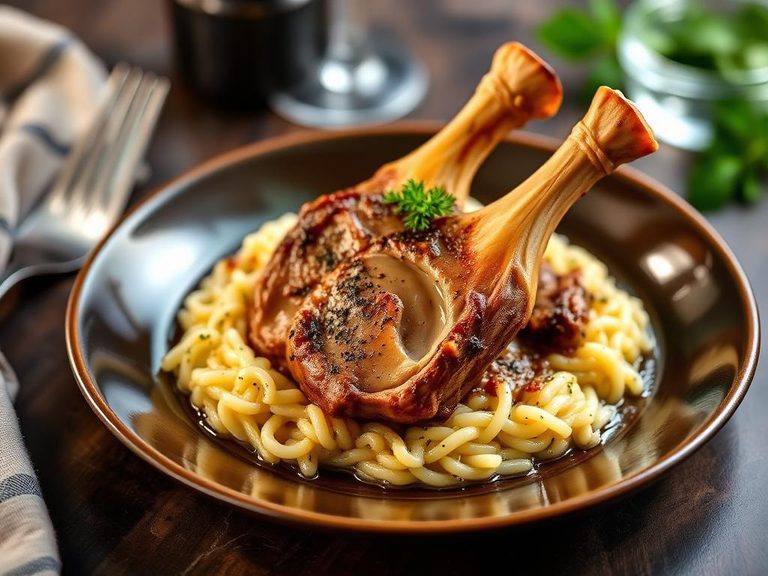
🌍 Where it's eaten
💡 Did you know?
The name 'osso buco' literally translates to 'bone with a hole' in Italian, referring to the prized marrow cavity at the center of the cross-cut shank.
Full nutrition (USDA data · scales with serving)
| Water | 61.3 g |
| Energy | 182 kcal |
| Energy | 762 kj |
| Protein | 27.9 g |
| Total lipid (fat) | 7.8 g |
| Ash | 0.94 g |
| Carbohydrate, by difference | 0.11 g |
| Fiber, total dietary | 0.00 g |
| Total Sugars | 0.00 g |
| Calcium, Ca | 22.0 mg |
| Iron, Fe | 2.0 mg |
| Magnesium, Mg | 34.0 mg |
| Phosphorus, P | 214 mg |
| Potassium, K | 201 mg |
| Sodium, Na | 90.0 mg |
| Zinc, Zn | 5.1 mg |
| Copper, Cu | 0.12 mg |
| Manganese, Mn | 0.01 mg |
| Selenium, Se | 19.9 ug |
| Vitamin C, total ascorbic acid | 0.00 mg |
| Thiamin | 0.08 mg |
| Riboflavin | 0.34 mg |
| Niacin | 3.7 mg |
| Pantothenic acid | 0.48 mg |
| Vitamin B-6 | 0.18 mg |
| Folate, total | 4.0 ug |
| Folic acid | 0.00 ug |
| Folate, food | 4.0 ug |
| Folate, DFE | 4.0 ug |
| Choline, total | 140 mg |
| Betaine | 26.1 mg |
| Vitamin B-12 | 1.9 ug |
| Vitamin B-12, added | 0.00 ug |
| Vitamin A, RAE | 0.00 ug |
| Retinol | 0.00 ug |
| Carotene, beta | 0.00 ug |
| Carotene, alpha | 0.00 ug |
| Cryptoxanthin, beta | 0.00 ug |
| Vitamin A, IU | 0.00 iu |
| Lycopene | 0.00 ug |
| Lutein + zeaxanthin | 0.00 ug |
| Vitamin E (alpha-tocopherol) | 0.39 mg |
| Vitamin E, added | 0.00 mg |
| Tocopherol, beta | 0.00 mg |
| Tocopherol, gamma | 0.01 mg |
| Tocopherol, delta | 0.00 mg |
| Vitamin D (D2 + D3), International Units | 42.0 iu |
| Vitamin D (D2 + D3) | 1.1 ug |
| Vitamin D3 (cholecalciferol) | 1.1 ug |
| Vitamin K (phylloquinone) | 1.5 ug |
| Alcohol, ethyl | 0.00 g |
| Caffeine | 0.00 mg |
| Theobromine | 0.00 mg |
Fat & fatty acid profile (per 100g)
| Fatty acids, total saturated | 2.7 g |
| SFA 4:0 | 0.00 g |
| SFA 6:0 | 0.00 g |
| SFA 8:0 | 0.00 g |
| SFA 10:0 | 0.00 g |
| SFA 12:0 | 0.00 g |
| SFA 14:0 | 0.17 g |
| SFA 16:0 | 1.6 g |
| SFA 17:0 | 0.07 g |
| SFA 18:0 | 0.86 g |
| SFA 20:0 | 0.00 g |
| SFA 24:0 | 0.01 g |
| Fatty acids, total monounsaturated | 3.5 g |
| MUFA 14:1 | 0.05 g |
| MUFA 16:1 | 0.27 g |
| MUFA 17:1 | 0.07 g |
| MUFA 18:1 | 3.2 g |
| MUFA 20:1 | 0.00 g |
| MUFA 22:1 | 0.00 g |
| Fatty acids, total polyunsaturated | 0.46 g |
| PUFA 18:2 | 0.37 g |
| PUFA 18:3 | 0.01 g |
| PUFA 18:4 | 0.00 g |
| PUFA 20:2 n-6 c,c | 0.00 g |
| PUFA 20:4 | 0.07 g |
| PUFA 20:5 n-3 (EPA) | 0.00 g |
| PUFA 22:5 n-3 (DPA) | 0.00 g |
| PUFA 22:6 n-3 (DHA) | 0.00 g |
| Fatty acids, total trans | 0.28 g |
| Cholesterol | 92.0 mg |
Amino acid profile (per 100g)
| Tryptophan | 0.28 g |
| Threonine | 1.2 g |
| Isoleucine | 1.4 g |
| Leucine | 2.2 g |
| Lysine | 2.3 g |
| Methionine | 0.65 g |
| Cystine | 0.32 g |
| Phenylalanine | 1.1 g |
| Tyrosine | 0.89 g |
| Valine | 1.5 g |
| Arginine | 1.6 g |
| Histidine | 1.0 g |
| Alanine | 1.7 g |
| Aspartic acid | 2.4 g |
| Glutamic acid | 4.4 g |
| Glycine | 1.4 g |
| Proline | 1.2 g |
| Serine | 1.0 g |
| Hydroxyproline | 0.14 g |
FAQ
What's the best way to eat the marrow?
Use a small spoon or marrow scoop to extract the soft, buttery marrow from the bone. It's traditionally spread on crusty bread or mixed into the risotto served alongside.
Can I use beef shank instead of veal?
Yes, beef shank is a common and more economical substitute. It will have a stronger, beefier flavor and may require a longer cooking time to become tender.
Why is it often served with gremolata?
Gremolata—a condiment of lemon zest, garlic, and parsley—adds a bright, fresh contrast that cuts through the richness of the braised meat and marrow, balancing the dish perfectly.
Nutrient density (calculated · NRF9.3)
Nutrient Rich Foods index: beneficial nutrients (protein, fiber, vitamins, minerals) minus saturated fat, added sugar & sodium, per 100 kcal.
NRF9.3 index — Fulgoni, Keast & Drewnowski, 2009. Computed from USDA nutrients.
Weight-loss friendliness (composite index)
Energy density 1.82 kcal/g · 61% calories from protein · 0.0 g fiber · 0.0 g sugar per 100 g.
Composite of energy density (Rolls et al., 1999), protein & fiber satiety, minus sugar. A calculated heuristic — ranks satiety-per-calorie, not a clinical measure.
Dietary load (calculated from USDA values)
Potential renal acid load. Positive = acid-forming, negative = alkaline-forming.
Sodium-to-potassium ratio: 0.45 (lower is better — aim for ≤ 1)
Sodium:potassium per WHO potassium guidance. Computed from USDA nutrients.