

Tomato products, canned, paste, without salt added (Includes foods for USDA's Food Distribution Program)
Whole food · Vegetables and Vegetable Products
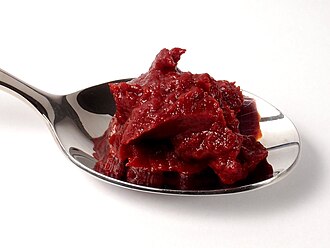
Photo: Wikipedia
This is concentrated tomato paste, a thick, deep-red purée made by cooking tomatoes for hours to remove most of their water. It has a potent, sweet-tart tomato flavor and a smooth, dense texture that coats a spoon. Nutritionally, it's a low-calorie, high-fiber source of natural sugars and plant-based protein.
Calorie split: 18% protein · 78% carbs · 4% fat
↓ Full nutrition💚 Why it's loved
People love it for its ability to instantly add a rich, savory tomato depth and vibrant color to sauces, stews, and soups. It's a pantry staple that transforms simple ingredients into complex, satisfying meals.
⚠️ Watch-outs & how to enjoy it better
Its concentrated natural sugars can cause a quicker blood-sugar spike compared to whole tomatoes. To counteract this, pair it with protein (like beans or meat) and healthy fats (like olive oil) in a meal to slow digestion. Those monitoring blood sugar should be mindful of portion sizes in sauces.
Key benefits
- Rich source of the antioxidant lycopene, which becomes more bioavailable with cooking.
- High in dietary fiber, supporting digestive health.
- Provides a concentrated dose of vitamins A and C.
- Low in fat and naturally cholesterol-free.
- Versatile base for building deep flavor in countless dishes.
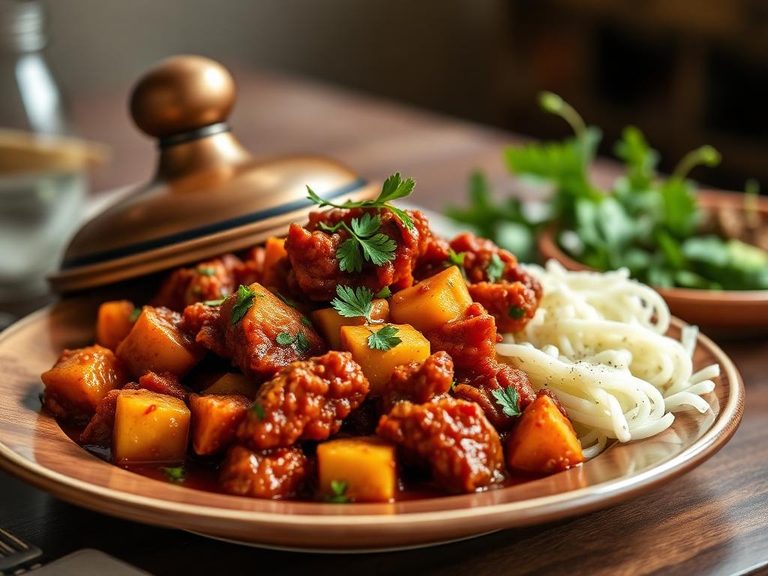
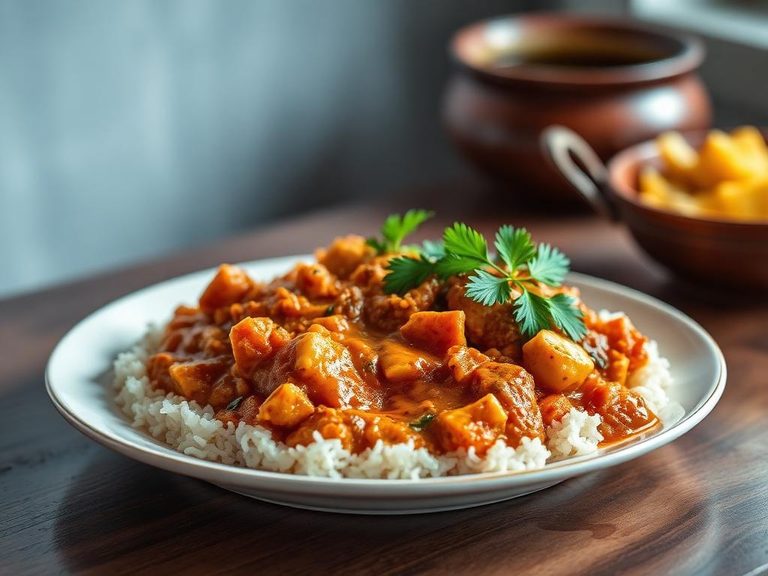
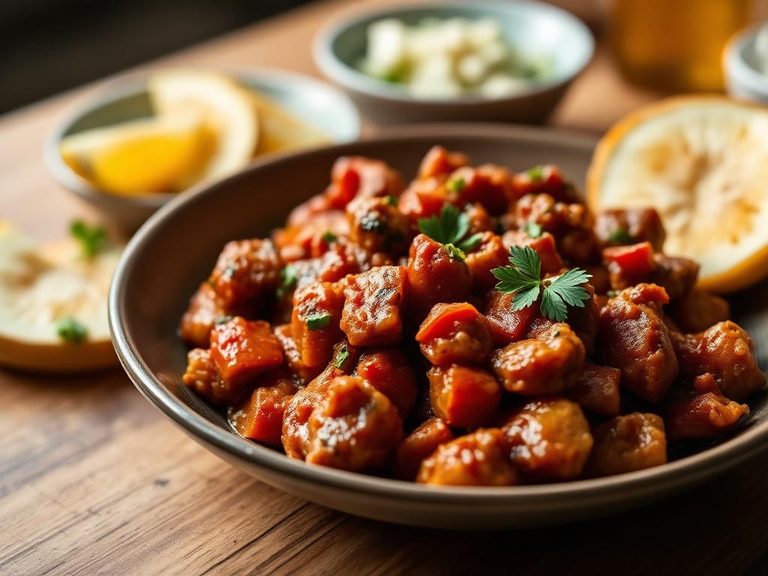
🍽️ Popular dishes


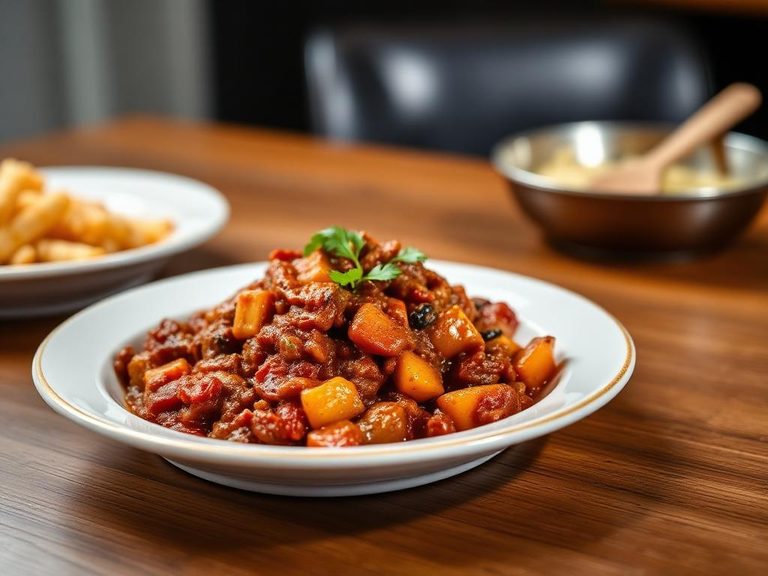
🌍 Where it's eaten
💡 Did you know?
The process of making tomato paste is so water-intensive that it takes about 2.5 pounds of fresh tomatoes to produce just 4 ounces (113g) of paste.
Full nutrition (USDA data · scales with serving)
| Water | 73.5 g |
| Energy | 82.0 kcal |
| Energy | 343 kj |
| Protein | 4.3 g |
| Total lipid (fat) | 0.47 g |
| Ash | 2.8 g |
| Carbohydrate, by difference | 18.9 g |
| Fiber, total dietary | 4.1 g |
| Total Sugars | 12.2 g |
| Sucrose | 0.30 g |
| Glucose | 5.8 g |
| Fructose | 5.8 g |
| Lactose | 0.00 g |
| Maltose | 0.28 g |
| Galactose | 0.00 g |
| Starch | 0.22 g |
| Calcium, Ca | 36.0 mg |
| Iron, Fe | 3.0 mg |
| Magnesium, Mg | 42.0 mg |
| Phosphorus, P | 83.0 mg |
| Potassium, K | 1014 mg |
| Sodium, Na | 59.0 mg |
| Zinc, Zn | 0.63 mg |
| Copper, Cu | 0.36 mg |
| Manganese, Mn | 0.30 mg |
| Selenium, Se | 5.3 ug |
| Vitamin C, total ascorbic acid | 21.9 mg |
| Thiamin | 0.06 mg |
| Riboflavin | 0.15 mg |
| Niacin | 3.1 mg |
| Pantothenic acid | 0.14 mg |
| Vitamin B-6 | 0.22 mg |
| Folate, total | 12.0 ug |
| Folic acid | 0.00 ug |
| Folate, food | 12.0 ug |
| Folate, DFE | 12.0 ug |
| Choline, total | 38.5 mg |
| Betaine | 0.40 mg |
| Vitamin B-12 | 0.00 ug |
| Vitamin B-12, added | 0.00 ug |
| Vitamin A, RAE | 76.0 ug |
| Retinol | 0.00 ug |
| Carotene, beta | 901 ug |
| Carotene, alpha | 29.0 ug |
| Cryptoxanthin, beta | 0.00 ug |
| Vitamin A, IU | 1525 iu |
| Lycopene | 28764 ug |
| Lutein + zeaxanthin | 0.00 ug |
| Vitamin E (alpha-tocopherol) | 4.3 mg |
| Vitamin E, added | 0.00 mg |
| Tocopherol, beta | 0.00 mg |
| Tocopherol, gamma | 0.52 mg |
| Tocopherol, delta | 0.00 mg |
| Vitamin D (D2 + D3), International Units | 0.00 iu |
| Vitamin D (D2 + D3) | 0.00 ug |
| Vitamin K (phylloquinone) | 11.4 ug |
| Vitamin K (Dihydrophylloquinone) | 0.00 ug |
| Alcohol, ethyl | 0.00 g |
| Caffeine | 0.00 mg |
| Theobromine | 0.00 mg |
Fat & fatty acid profile (per 100g)
| Fatty acids, total saturated | 0.10 g |
| SFA 4:0 | 0.00 g |
| SFA 6:0 | 0.00 g |
| SFA 8:0 | 0.00 g |
| SFA 10:0 | 0.00 g |
| SFA 12:0 | 0.00 g |
| SFA 14:0 | 0.00 g |
| SFA 16:0 | 0.08 g |
| SFA 18:0 | 0.02 g |
| Fatty acids, total monounsaturated | 0.07 g |
| MUFA 16:1 | 0.00 g |
| MUFA 18:1 | 0.06 g |
| MUFA 20:1 | 0.00 g |
| MUFA 22:1 | 0.00 g |
| Fatty acids, total polyunsaturated | 0.16 g |
| PUFA 18:2 | 0.15 g |
| PUFA 18:3 | 0.01 g |
| PUFA 18:4 | 0.00 g |
| PUFA 20:4 | 0.00 g |
| PUFA 20:5 n-3 (EPA) | 0.00 g |
| PUFA 22:5 n-3 (DPA) | 0.00 g |
| PUFA 22:6 n-3 (DHA) | 0.00 g |
| Fatty acids, total trans | 0.00 g |
| Cholesterol | 0.00 mg |
Amino acid profile (per 100g)
| Tryptophan | 0.03 g |
| Threonine | 0.13 g |
| Isoleucine | 0.09 g |
| Leucine | 0.12 g |
| Lysine | 0.13 g |
| Methionine | 0.03 g |
| Cystine | 0.05 g |
| Phenylalanine | 0.13 g |
| Tyrosine | 0.07 g |
| Valine | 0.09 g |
| Arginine | 0.10 g |
| Histidine | 0.07 g |
| Alanine | 0.13 g |
| Aspartic acid | 0.66 g |
| Glutamic acid | 2.1 g |
| Glycine | 0.10 g |
| Proline | 0.07 g |
| Serine | 0.13 g |
FAQ
What's the difference between tomato paste and tomato sauce?
Tomato paste is tomatoes cooked down to a very thick, concentrated paste with most water removed. Tomato sauce is much thinner, more liquid, and often seasoned. Paste is used to add depth and body, while sauce is a ready-to-use base.
How should I store leftover canned tomato paste?
Transfer unused paste to an airtight container, top with a thin layer of olive oil to prevent oxidation, and refrigerate for up to a week. It also freezes perfectly in ice cube trays for pre-portioned future use.
Is 'no salt added' tomato paste significantly healthier?
For those managing sodium intake, yes. Regular tomato paste can have over 100mg of sodium per tablespoon. 'No salt added' versions have virtually none, giving you full control over seasoning in your cooking.
Nutrient density (calculated · NRF9.3)
Nutrient Rich Foods index: beneficial nutrients (protein, fiber, vitamins, minerals) minus saturated fat, added sugar & sodium, per 100 kcal.
NRF9.3 index — Fulgoni, Keast & Drewnowski, 2009. Computed from USDA nutrients.
Weight-loss friendliness (composite index)
Energy density 0.82 kcal/g · 21% calories from protein · 4.1 g fiber · 12.2 g sugar per 100 g.
Composite of energy density (Rolls et al., 1999), protein & fiber satiety, minus sugar. A calculated heuristic — ranks satiety-per-calorie, not a clinical measure.
Dietary load (calculated from USDA values)
Potential renal acid load. Positive = acid-forming, negative = alkaline-forming.
Sodium-to-potassium ratio: 0.06 (lower is better — aim for ≤ 1)
Sodium:potassium per WHO potassium guidance. Computed from USDA nutrients.