

Nuts, pecans, dry roasted, without salt added
Whole food · Nut and Seed Products

Photo: Wikipedia
Dry-roasted pecans are a rich, buttery nut with a satisfying crunch and a deep, caramel-like sweetness that intensifies with heat. Packed with healthy monounsaturated fats and fiber, they offer a substantial energy boost with minimal protein. Their smooth, slightly oily texture makes them a versatile snack or ingredient, perfect for adding depth to both sweet and savory dishes.
Calorie split: 5% protein · 7% carbs · 88% fat
↓ Full nutrition💚 Why it's loved
People love pecans for their uniquely rich, buttery flavor and satisfying crunch, which pairs beautifully with both sweet and savory recipes. They are a staple in Southern U.S. cuisine and holiday baking, symbolizing comfort and tradition.
⚠️ Watch-outs & how to enjoy it better
Due to their high fat and calorie density (710 kcal/100g), overconsumption can lead to weight gain; portion control is key. They are a common tree nut allergen, and their high oxalate content may be a concern for those prone to kidney stones. To counteract, pair with protein-rich foods like Greek yogurt to balance blood sugar, and stick to a 1-ounce (28g) serving.
Key benefits
- High in heart-healthy monounsaturated fats
- Good source of dietary fiber (9.4g per 100g)
- Rich in antioxidants, including ellagic acid
- Contains manganese and copper for bone health
- Provides a quick, sustained energy source
🍽️ Popular dishes


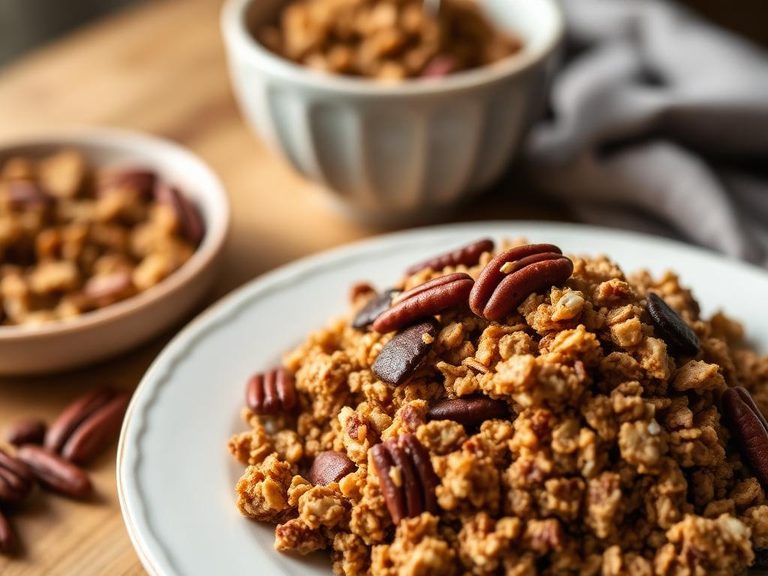


🌍 Where it's eaten
💡 Did you know?
Pecans are the only major tree nut native to North America, and the word 'pecan' comes from an Algonquin word meaning 'a nut too hard to crack by hand.'
Full nutrition (USDA data · scales with serving)
| Water | 1.1 g |
| Energy | 710 kcal |
| Energy | 2969 kj |
| Protein | 9.5 g |
| Total lipid (fat) | 74.3 g |
| Ash | 1.6 g |
| Carbohydrate, by difference | 13.6 g |
| Fiber, total dietary | 9.4 g |
| Total Sugars | 4.1 g |
| Sucrose | 4.0 g |
| Glucose | 0.04 g |
| Fructose | 0.04 g |
| Lactose | 0.00 g |
| Maltose | 0.00 g |
| Starch | 0.24 g |
| Calcium, Ca | 72.0 mg |
| Iron, Fe | 2.8 mg |
| Magnesium, Mg | 132 mg |
| Phosphorus, P | 293 mg |
| Potassium, K | 424 mg |
| Sodium, Na | 1.0 mg |
| Zinc, Zn | 5.1 mg |
| Copper, Cu | 1.2 mg |
| Manganese, Mn | 3.9 mg |
| Selenium, Se | 4.0 ug |
| Vitamin C, total ascorbic acid | 0.70 mg |
| Thiamin | 0.45 mg |
| Riboflavin | 0.11 mg |
| Niacin | 1.2 mg |
| Pantothenic acid | 0.70 mg |
| Vitamin B-6 | 0.19 mg |
| Folate, total | 16.0 ug |
| Folic acid | 0.00 ug |
| Folate, food | 16.0 ug |
| Folate, DFE | 16.0 ug |
| Vitamin B-12 | 0.00 ug |
| Vitamin A, RAE | 7.0 ug |
| Retinol | 0.00 ug |
| Carotene, beta | 84.0 ug |
| Carotene, alpha | 0.00 ug |
| Vitamin A, IU | 140 iu |
| Vitamin E (alpha-tocopherol) | 1.3 mg |
| Tocopherol, beta | 0.14 mg |
| Tocopherol, gamma | 23.6 mg |
| Tocopherol, delta | 0.77 mg |
| Vitamin D (D2 + D3), International Units | 0.00 iu |
| Vitamin D (D2 + D3) | 0.00 ug |
| Alcohol, ethyl | 0.00 g |
Fat & fatty acid profile (per 100g)
| Fatty acids, total saturated | 6.3 g |
| SFA 4:0 | 0.00 g |
| SFA 6:0 | 0.00 g |
| SFA 8:0 | 0.00 g |
| SFA 10:0 | 0.00 g |
| SFA 12:0 | 0.00 g |
| SFA 13:0 | 0.00 g |
| SFA 14:0 | 0.00 g |
| SFA 15:0 | 0.00 g |
| SFA 16:0 | 4.4 g |
| SFA 17:0 | 0.00 g |
| SFA 18:0 | 1.8 g |
| SFA 20:0 | 0.07 g |
| SFA 22:0 | 0.00 g |
| SFA 24:0 | 0.00 g |
| Fatty acids, total monounsaturated | 44.0 g |
| MUFA 14:1 | 0.00 g |
| MUFA 16:1 | 0.00 g |
| MUFA 18:1 | 43.7 g |
| MUFA 20:1 | 0.21 g |
| MUFA 22:1 | 0.00 g |
| MUFA 24:1 c | 0.00 g |
| Fatty acids, total polyunsaturated | 20.6 g |
| PUFA 18:2 | 19.6 g |
| PUFA 18:3 | 0.99 g |
| PUFA 18:4 | 0.00 g |
| PUFA 20:2 n-6 c,c | 0.00 g |
| PUFA 20:3 | 0.00 g |
| PUFA 20:4 | 0.00 g |
| PUFA 20:5 n-3 (EPA) | 0.00 g |
| PUFA 22:5 n-3 (DPA) | 0.00 g |
| PUFA 22:6 n-3 (DHA) | 0.00 g |
| Cholesterol | 0.00 mg |
| Phytosterols | 85.0 mg |
| Stigmasterol | 2.0 mg |
| Campesterol | 4.0 mg |
| Beta-sitosterol | 78.0 mg |
Amino acid profile (per 100g)
| Tryptophan | 0.10 g |
| Threonine | 0.32 g |
| Isoleucine | 0.35 g |
| Leucine | 0.62 g |
| Lysine | 0.30 g |
| Methionine | 0.19 g |
| Cystine | 0.16 g |
| Phenylalanine | 0.44 g |
| Tyrosine | 0.22 g |
| Valine | 0.43 g |
| Arginine | 1.2 g |
| Histidine | 0.27 g |
| Alanine | 0.41 g |
| Aspartic acid | 0.96 g |
| Glutamic acid | 1.9 g |
| Glycine | 0.47 g |
| Proline | 0.38 g |
| Serine | 0.49 g |
FAQ
Are dry-roasted pecans healthier than raw pecans?
Dry-roasting enhances flavor and crunch but doesn't significantly change nutritional content; both are healthy. Avoid oil-roasted or salted versions for a cleaner profile.
How should I store pecans to keep them fresh?
Store in an airtight container in a cool, dark place for up to 3 months, or refrigerate for up to 6 months to prevent rancidity from their high fat content.
Can pecans be used in savory dishes?
Yes, they add a rich, nutty crunch to salads, stuffings, and crusts for meats like chicken or fish, especially in Southern and Cajun cuisine.
Nutrient density (calculated · NRF9.3)
Nutrient Rich Foods index: beneficial nutrients (protein, fiber, vitamins, minerals) minus saturated fat, added sugar & sodium, per 100 kcal.
NRF9.3 index — Fulgoni, Keast & Drewnowski, 2009. Computed from USDA nutrients.
Weight-loss friendliness (composite index)
Energy density 7.10 kcal/g · 5% calories from protein · 9.4 g fiber · 4.1 g sugar per 100 g.
Composite of energy density (Rolls et al., 1999), protein & fiber satiety, minus sugar. A calculated heuristic — ranks satiety-per-calorie, not a clinical measure.
Dietary load (calculated from USDA values)
Potential renal acid load. Positive = acid-forming, negative = alkaline-forming.
Sodium-to-potassium ratio: 0.00 (lower is better — aim for ≤ 1)
Sodium:potassium per WHO potassium guidance. Computed from USDA nutrients.