

Flour, barley
Whole food · Cereal Grains and Pasta

Photo: Wikipedia
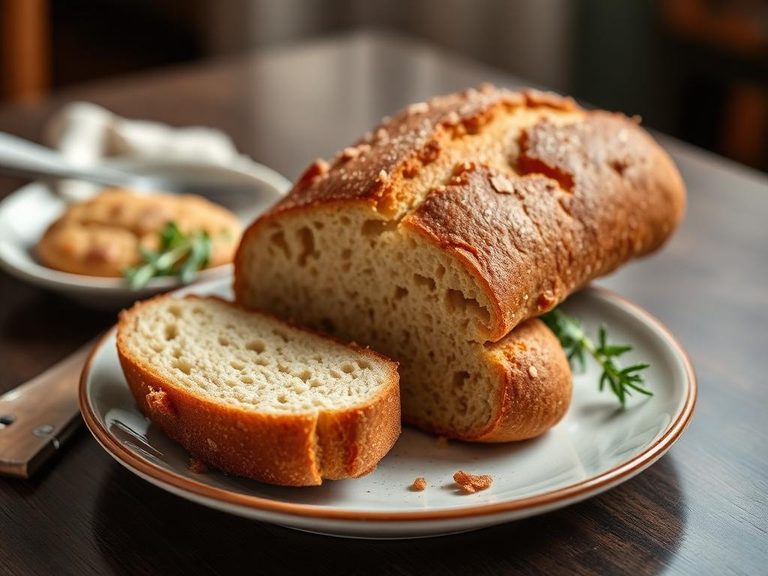
Barley flour is a whole-grain flour with a robust, nutty flavor and a slightly chewy texture that gives baked goods a hearty, satisfying bite. It's a nutritional powerhouse, packed with fiber and protein, making it a more substantial alternative to refined flours.
Calorie split: 10% protein · 84% carbs · 6% fat
↓ Full nutrition💚 Why it's loved
People love barley flour for its deep, earthy, and slightly malty flavor that adds complexity to breads, pancakes, and cookies. Its versatility allows it to be blended with other flours or used on its own for a distinctively wholesome, rustic taste.
⚠️ Watch-outs & how to enjoy it better
Barley flour contains gluten, making it unsuitable for those with celiac disease or gluten sensitivity. Its high fiber content can cause digestive discomfort if introduced too quickly; start with small portions and increase gradually. It also has a lower rise than wheat flour, so it's often blended for lighter textures.
Key benefits
- Excellent source of dietary fiber (12.79g per 100g)
- Provides plant-based protein (8.72g per 100g)
- Contains essential minerals like selenium and manganese
- Whole grain that supports digestive health
- Low in fat and contains no sugar
🍽️ Popular dishes



🌍 Where it's eaten
💡 Did you know?
Barley is one of the first domesticated grains, with evidence of its cultivation dating back over 10,000 years in the Fertile Crescent.
Full nutrition (USDA data · scales with serving)
| Water | 9.9 g |
| Energy (Atwater General Factors) | 367 kcal |
| Energy (Atwater Specific Factors) | 357 kcal |
| Nitrogen | 1.5 g |
| Protein | 8.7 g |
| Total lipid (fat) | 2.5 g |
| Ash | 1.5 g |
| Carbohydrate, by difference | 77.4 g |
| Fiber, total dietary | 12.8 g |
| Total dietary fiber (AOAC 2011.25) | 16.1 g |
| High Molecular Weight Dietary Fiber (HMWDF) | 13.8 g |
| Low Molecular Weight Dietary Fiber (LMWDF) | 2.3 g |
| Beta-glucan | 4.2 g |
| Starch | 56.9 g |
| Calcium, Ca | 35.6 mg |
| Iron, Fe | 3.3 mg |
| Magnesium, Mg | 88.0 mg |
| Phosphorus, P | 234 mg |
| Potassium, K | 367 mg |
| Sodium, Na | 20.3 mg |
| Zinc, Zn | 2.1 mg |
| Copper, Cu | 0.39 mg |
| Manganese, Mn | 1.2 mg |
| Selenium, Se | 13.1 ug |
| Molybdenum, Mo | 57.4 ug |
| Thiamin | 0.23 mg |
| Riboflavin | 0.15 mg |
| Niacin | 5.9 mg |
| Vitamin B-6 | 0.20 mg |
| Biotin | 8.6 ug |
Fat & fatty acid profile (per 100g)
Estimated from Pasta, gluten-free, corn flour and quinoa flour, cooked, ANCIENT HARVEST — USDA does not publish this profile for Flour.
| Fatty acids, total saturated | 0.15 g |
| SFA 4:0 | 0.00 g |
| SFA 6:0 | 0.00 g |
| SFA 8:0 | 0.00 g |
| SFA 10:0 | 0.00 g |
| SFA 12:0 | 0.00 g |
| SFA 14:0 | 0.01 g |
| SFA 15:0 | 0.00 g |
| SFA 16:0 | 0.09 g |
| SFA 17:0 | 0.00 g |
| SFA 18:0 | 0.04 g |
| SFA 20:0 | 0.01 g |
| SFA 22:0 | 0.00 g |
| SFA 24:0 | 0.00 g |
| Fatty acids, total monounsaturated | 0.66 g |
| MUFA 14:1 | 0.00 g |
| MUFA 15:1 | 0.17 g |
| MUFA 16:1 | 0.00 g |
| MUFA 16:1 c | 0.00 g |
| MUFA 17:1 | 0.00 g |
| MUFA 18:1 | 0.48 g |
| MUFA 18:1 c | 0.47 g |
| MUFA 20:1 | 0.01 g |
| MUFA 22:1 | 0.00 g |
| MUFA 22:1 c | 0.00 g |
| MUFA 24:1 c | 0.00 g |
| Fatty acids, total polyunsaturated | 0.95 g |
| PUFA 18:2 | 0.91 g |
| PUFA 18:2 n-6 c,c | 0.91 g |
| PUFA 18:2 CLAs | 0.00 g |
| PUFA 18:3 | 0.03 g |
| PUFA 18:3 n-3 c,c,c (ALA) | 0.03 g |
| PUFA 18:3 n-6 c,c,c | 0.00 g |
| PUFA 18:3i | 0.00 g |
| PUFA 18:4 | 0.00 g |
| PUFA 20:2 n-6 c,c | 0.00 g |
| PUFA 20:3 | 0.00 g |
| PUFA 20:3 n-3 | 0.00 g |
| PUFA 20:3 n-6 | 0.00 g |
| PUFA 20:4 | 0.00 g |
| PUFA 20:5 n-3 (EPA) | 0.00 g |
| PUFA 22:4 | 0.00 g |
| PUFA 22:5 n-3 (DPA) | 0.00 g |
| PUFA 22:6 n-3 (DHA) | 0.00 g |
| Fatty acids, total trans | 0.01 g |
| Fatty acids, total trans-monoenoic | 0.00 g |
| TFA 16:1 t | 0.00 g |
| TFA 18:1 t | 0.00 g |
| TFA 22:1 t | 0.00 g |
| TFA 18:2 t not further defined | 0.00 g |
| Fatty acids, total trans-polyenoic | 0.00 g |
| Cholesterol | 0.00 mg |
Amino acid profile (per 100g)
Estimated from Pasta, gluten-free, corn flour and quinoa flour, cooked, ANCIENT HARVEST — USDA does not publish this profile for Flour.
| Tryptophan | 0.02 g |
| Threonine | 0.10 g |
| Isoleucine | 0.09 g |
| Leucine | 0.35 g |
| Lysine | 0.16 g |
| Methionine | 0.06 g |
| Cystine | 0.07 g |
| Phenylalanine | 0.15 g |
| Tyrosine | 0.12 g |
| Valine | 0.11 g |
| Arginine | 0.18 g |
| Histidine | 0.09 g |
| Alanine | 0.21 g |
| Aspartic acid | 0.19 g |
| Glutamic acid | 0.46 g |
| Glycine | 0.12 g |
| Proline | 0.29 g |
| Serine | 0.15 g |
| Hydroxyproline | 0.00 g |
FAQ
Can I substitute barley flour 1:1 for all-purpose flour?
It's best to blend it. Start with a 1:1 substitution for up to 25-50% of the recipe's flour, then adjust. Using 100% barley flour will yield a denser, chewier product with less rise.
Is barley flour gluten-free?
No. Barley contains gluten. For gluten-free baking, you must use certified gluten-free flours like almond, oat (certified), or sorghum flour.
How should I store barley flour?
Due to its natural oils, store it in an airtight container in the refrigerator or freezer to prevent rancidity and extend freshness for several months.
Nutrient density (calculated · NRF9.3)
Nutrient Rich Foods index: beneficial nutrients (protein, fiber, vitamins, minerals) minus saturated fat, added sugar & sodium, per 100 kcal.
NRF9.3 index — Fulgoni, Keast & Drewnowski, 2009. Computed from USDA nutrients.
Weight-loss friendliness (composite index)
Energy density 3.67 kcal/g · 10% calories from protein · 12.8 g fiber · 0.0 g sugar per 100 g.
Composite of energy density (Rolls et al., 1999), protein & fiber satiety, minus sugar. A calculated heuristic — ranks satiety-per-calorie, not a clinical measure.
Dietary load (calculated from USDA values)
Potential renal acid load. Positive = acid-forming, negative = alkaline-forming.
Sodium-to-potassium ratio: 0.06 (lower is better — aim for ≤ 1)
Sodium:potassium per WHO potassium guidance. Computed from USDA nutrients.