

Eggnog
Whole food · Dairy and Egg Products

Photo: Wikipedia
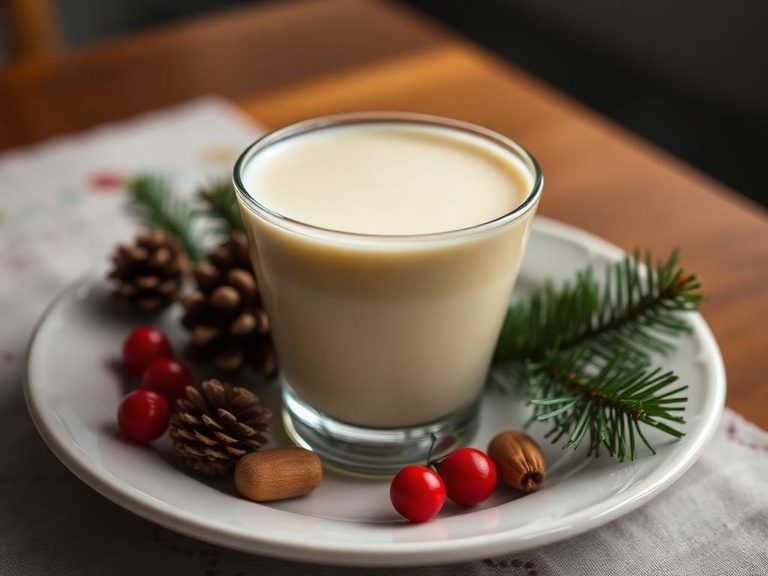
Eggnog is a rich, creamy holiday beverage traditionally made from milk, cream, sugar, whipped eggs, and spices like nutmeg and cinnamon. Its texture is velvety and indulgent, with a sweet, custard-like flavor profile. Nutritionally, it is a dense source of calories, protein, and fat, providing a quick energy boost.
Calorie split: 21% protein · 37% carbs · 43% fat
↓ Full nutrition💚 Why it's loved
People love eggnog for its luxurious, nostalgic flavor that evokes holiday traditions and festive gatherings. Its versatility allows it to be enjoyed chilled, warmed, or spiked with spirits like rum, brandy, or bourbon.
⚠️ Watch-outs & how to enjoy it better
Due to its high sugar and saturated fat content, it can cause blood-sugar spikes and is calorie-dense, which may be a concern for those monitoring weight or blood sugar. To counteract this, practice portion control, choose a smaller serving, and pair it with a source of fiber or protein (like nuts or a small piece of fruit) to slow sugar absorption. For those with egg or dairy allergies, it is a clear allergen risk.
Key benefits
- Provides high-quality protein from eggs and dairy.
- Good source of calcium for bone health.
- Contains fat-soluble vitamins like Vitamin A and D from dairy and eggs.
- Offers a quick, calorie-dense energy source.
- Traditional spices like nutmeg may have antioxidant properties.
🍽️ Popular dishes



🌍 Where it's eaten
💡 Did you know?
In the 18th century, eggnog was often called 'milk punch' and was a popular drink among the American elite, with George Washington reportedly having a particularly potent recipe.
Full nutrition (USDA data · scales with serving)
| Water | 82.5 g |
| Energy | 88.0 kcal |
| Energy | 367 kj |
| Protein | 4.5 g |
| Total lipid (fat) | 4.2 g |
| Ash | 0.67 g |
| Carbohydrate, by difference | 8.1 g |
| Fiber, total dietary | 0.00 g |
| Total Sugars | 8.1 g |
| Sucrose | 0.04 g |
| Glucose | 0.07 g |
| Fructose | 0.04 g |
| Lactose | 7.8 g |
| Maltose | 0.04 g |
| Galactose | 0.04 g |
| Calcium, Ca | 130 mg |
| Iron, Fe | 0.20 mg |
| Magnesium, Mg | 19.0 mg |
| Phosphorus, P | 109 mg |
| Potassium, K | 165 mg |
| Sodium, Na | 54.0 mg |
| Zinc, Zn | 0.46 mg |
| Copper, Cu | 0.01 mg |
| Manganese, Mn | 0.01 mg |
| Selenium, Se | 4.2 ug |
| Fluoride, F | 0.20 ug |
| Vitamin C, total ascorbic acid | 1.5 mg |
| Thiamin | 0.03 mg |
| Riboflavin | 0.19 mg |
| Niacin | 0.10 mg |
| Pantothenic acid | 0.42 mg |
| Vitamin B-6 | 0.05 mg |
| Folate, total | 1.0 ug |
| Folic acid | 0.00 ug |
| Folate, food | 1.0 ug |
| Folate, DFE | 1.0 ug |
| Choline, total | 52.2 mg |
| Betaine | 0.60 mg |
| Vitamin B-12 | 0.45 ug |
| Vitamin B-12, added | 0.00 ug |
| Vitamin A, RAE | 59.0 ug |
| Retinol | 58.0 ug |
| Carotene, beta | 7.0 ug |
| Carotene, alpha | 0.00 ug |
| Cryptoxanthin, beta | 0.00 ug |
| Vitamin A, IU | 206 iu |
| Lycopene | 0.00 ug |
| Lutein + zeaxanthin | 54.0 ug |
| Vitamin E (alpha-tocopherol) | 0.21 mg |
| Vitamin E, added | 0.00 mg |
| Tocopherol, beta | 0.00 mg |
| Tocopherol, gamma | 0.08 mg |
| Tocopherol, delta | 0.00 mg |
| Tocotrienol, alpha | 0.00 mg |
| Tocotrienol, beta | 0.00 mg |
| Tocotrienol, gamma | 0.00 mg |
| Tocotrienol, delta | 0.00 mg |
| Vitamin D (D2 + D3), International Units | 49.0 iu |
| Vitamin D (D2 + D3) | 1.2 ug |
| Vitamin D3 (cholecalciferol) | 1.2 ug |
| Vitamin K (phylloquinone) | 0.30 ug |
| Vitamin K (Dihydrophylloquinone) | 0.00 ug |
| Alcohol, ethyl | 0.00 g |
| Caffeine | 0.00 mg |
| Theobromine | 0.00 mg |
Fat & fatty acid profile (per 100g)
| Fatty acids, total saturated | 2.6 g |
| SFA 4:0 | 0.13 g |
| SFA 6:0 | 0.08 g |
| SFA 8:0 | 0.04 g |
| SFA 10:0 | 0.10 g |
| SFA 12:0 | 0.11 g |
| SFA 14:0 | 0.40 g |
| SFA 16:0 | 1.1 g |
| SFA 18:0 | 0.51 g |
| Fatty acids, total monounsaturated | 1.3 g |
| MUFA 16:1 | 0.10 g |
| MUFA 18:1 | 1.1 g |
| MUFA 20:1 | 0.00 g |
| MUFA 22:1 | 0.00 g |
| Fatty acids, total polyunsaturated | 0.20 g |
| PUFA 18:2 | 0.13 g |
| PUFA 18:3 | 0.06 g |
| PUFA 18:4 | 0.00 g |
| PUFA 20:4 | 0.00 g |
| PUFA 20:5 n-3 (EPA) | 0.00 g |
| PUFA 22:5 n-3 (DPA) | 0.00 g |
| PUFA 22:6 n-3 (DHA) | 0.00 g |
| Cholesterol | 59.0 mg |
Amino acid profile (per 100g)
| Tryptophan | 0.09 g |
| Threonine | 0.20 g |
| Isoleucine | 0.24 g |
| Leucine | 0.38 g |
| Lysine | 0.26 g |
| Methionine | 0.12 g |
| Cystine | 0.06 g |
| Phenylalanine | 0.23 g |
| Tyrosine | 0.20 g |
| Valine | 0.29 g |
| Arginine | 0.19 g |
| Histidine | 0.11 g |
| Alanine | 0.20 g |
| Aspartic acid | 0.40 g |
| Glutamic acid | 0.78 g |
| Glycine | 0.13 g |
| Proline | 0.35 g |
| Serine | 0.24 g |
FAQ
Is eggnog raw egg safe?
Traditional recipes may use raw eggs, which carry a risk of Salmonella. Commercial eggnog is pasteurized to kill bacteria. To make it safe at home, use a cooked custard base or pasteurized eggs.
Can I make eggnog without alcohol?
Absolutely. The core ingredients are milk, cream, eggs, and sugar. Simply omit the spirits and increase the vanilla or spices to taste.
How long does homemade eggnog last?
When stored in a sealed container in the refrigerator, homemade eggnog made with cooked eggs will keep for 3-4 days. If made with raw eggs, consume within 24 hours for safety.
Nutrient density (calculated · NRF9.3)
Nutrient Rich Foods index: beneficial nutrients (protein, fiber, vitamins, minerals) minus saturated fat, added sugar & sodium, per 100 kcal.
NRF9.3 index — Fulgoni, Keast & Drewnowski, 2009. Computed from USDA nutrients.
Weight-loss friendliness (composite index)
Energy density 0.88 kcal/g · 21% calories from protein · 0.0 g fiber · 8.1 g sugar per 100 g.
Composite of energy density (Rolls et al., 1999), protein & fiber satiety, minus sugar. A calculated heuristic — ranks satiety-per-calorie, not a clinical measure.
Dietary load (calculated from USDA values)
Potential renal acid load. Positive = acid-forming, negative = alkaline-forming.
Sodium-to-potassium ratio: 0.33 (lower is better — aim for ≤ 1)
Sodium:potassium per WHO potassium guidance. Computed from USDA nutrients.