

Beverages, coffee, brewed, espresso, restaurant-prepared, decaffeinated
Whole food · Beverages

Photo: Wikipedia
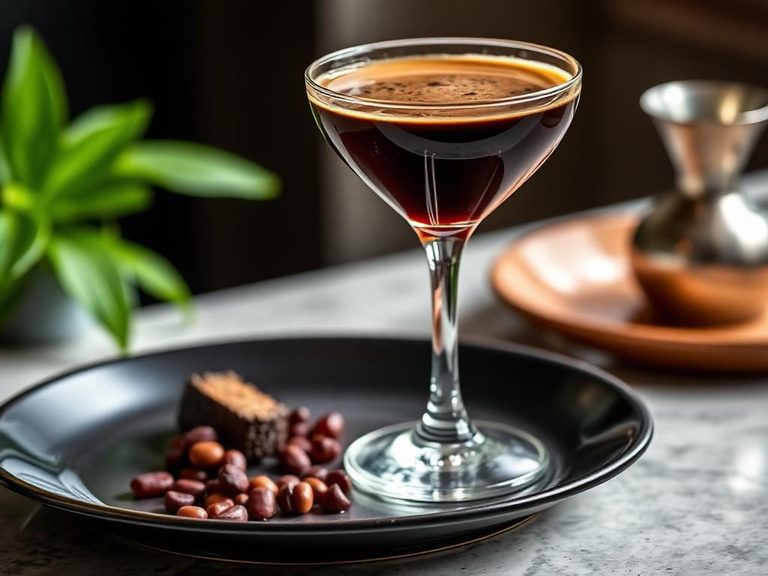
This is a concentrated, intensely flavored shot of coffee brewed under high pressure, delivering a robust, bittersweet liquid with a velvety, slightly viscous texture and a signature layer of golden crema. Nutritionally, it is a virtually calorie-free beverage, providing a pure caffeine kick with negligible macronutrients, making it a staple for those seeking flavor and alertness without added energy.
Calorie split: 5% protein · 77% carbs · 18% fat
↓ Full nutrition💚 Why it's loved
People love decaf espresso for its rich, complex flavor profile—the deep roast notes, slight bitterness, and aromatic crema—without the stimulant effects of caffeine. It's the cultural cornerstone of café life, enabling the ritual of a coffee break or the crafting of lattes and cappuccinos at any hour.
⚠️ Watch-outs & how to enjoy it better
The intense bitterness and acidity can be harsh on sensitive stomachs or contribute to acid reflux. Those monitoring caffeine intake should note that decaf still contains trace amounts (typically 2-15mg per shot). To counteract bitterness, pair with a small sweet treat or a splash of milk; for digestive sensitivity, avoid drinking it on an empty stomach.
Key benefits
- Extremely low in calories (9 kcal per 100g)
- Contains antioxidants like chlorogenic acids
- Provides a quick, focused caffeine boost
- Can enhance mental alertness and physical performance
- Serves as a versatile base for other coffee drinks
🍽️ Popular dishes





🌍 Where it's eaten
💡 Did you know?
A single shot of espresso contains less caffeine (about 63mg) than a standard cup of drip coffee (about 95mg), despite its stronger taste and higher concentration.
Full nutrition (USDA data · scales with serving)
| Water | 97.8 g |
| Energy | 9.0 kcal |
| Energy | 37.0 kj |
| Protein | 0.10 g |
| Total lipid (fat) | 0.18 g |
| Ash | 0.23 g |
| Carbohydrate, by difference | 1.7 g |
| Fiber, total dietary | 0.00 g |
| Total Sugars | 0.00 g |
| Calcium, Ca | 2.0 mg |
| Iron, Fe | 0.13 mg |
| Magnesium, Mg | 80.0 mg |
| Phosphorus, P | 7.0 mg |
| Potassium, K | 115 mg |
| Sodium, Na | 14.0 mg |
| Zinc, Zn | 0.05 mg |
| Copper, Cu | 0.05 mg |
| Manganese, Mn | 0.05 mg |
| Selenium, Se | 0.00 ug |
| Vitamin C, total ascorbic acid | 0.20 mg |
| Thiamin | 0.00 mg |
| Riboflavin | 0.18 mg |
| Niacin | 5.2 mg |
| Pantothenic acid | 0.03 mg |
| Vitamin B-6 | 0.00 mg |
| Folate, total | 1.0 ug |
| Folic acid | 0.00 ug |
| Folate, food | 1.0 ug |
| Folate, DFE | 1.0 ug |
| Choline, total | 1.0 mg |
| Vitamin B-12 | 0.00 ug |
| Vitamin B-12, added | 0.00 ug |
| Vitamin A, RAE | 0.00 ug |
| Retinol | 0.00 ug |
| Carotene, beta | 0.00 ug |
| Carotene, alpha | 0.00 ug |
| Cryptoxanthin, beta | 0.00 ug |
| Vitamin A, IU | 0.00 iu |
| Lycopene | 0.00 ug |
| Lutein + zeaxanthin | 0.00 ug |
| Vitamin E (alpha-tocopherol) | 0.00 mg |
| Vitamin E, added | 0.00 mg |
| Vitamin D (D2 + D3), International Units | 0.00 iu |
| Vitamin D (D2 + D3) | 0.00 ug |
| Vitamin K (phylloquinone) | 0.10 ug |
| Alcohol, ethyl | 0.00 g |
| Caffeine | 1.0 mg |
| Theobromine | 0.00 mg |
Fat & fatty acid profile (per 100g)
| Fatty acids, total saturated | 0.09 g |
| SFA 4:0 | 0.00 g |
| SFA 6:0 | 0.00 g |
| SFA 8:0 | 0.00 g |
| SFA 10:0 | 0.00 g |
| SFA 12:0 | 0.00 g |
| SFA 13:0 | 0.00 g |
| SFA 14:0 | 0.00 g |
| SFA 15:0 | 0.00 g |
| SFA 16:0 | 0.05 g |
| SFA 17:0 | 0.00 g |
| SFA 18:0 | 0.00 g |
| SFA 20:0 | 0.00 g |
| SFA 22:0 | 0.00 g |
| SFA 24:0 | 0.00 g |
| Fatty acids, total monounsaturated | 0.00 g |
| MUFA 14:1 | 0.00 g |
| MUFA 15:1 | 0.00 g |
| MUFA 16:1 | 0.00 g |
| MUFA 17:1 | 0.00 g |
| MUFA 18:1 | 0.00 g |
| MUFA 18:1 c | 0.01 g |
| MUFA 20:1 | 0.00 g |
| MUFA 22:1 | 0.00 g |
| Fatty acids, total polyunsaturated | 0.09 g |
| PUFA 18:2 | 0.09 g |
| PUFA 18:3 | 0.00 g |
| PUFA 18:3 n-3 c,c,c (ALA) | 0.00 g |
| PUFA 18:3 n-6 c,c,c | 0.00 g |
| PUFA 18:4 | 0.00 g |
| PUFA 20:2 n-6 c,c | 0.00 g |
| PUFA 20:3 | 0.00 g |
| PUFA 20:4 | 0.00 g |
| PUFA 20:5 n-3 (EPA) | 0.00 g |
| PUFA 22:5 n-3 (DPA) | 0.00 g |
| PUFA 22:6 n-3 (DHA) | 0.00 g |
| Fatty acids, total trans | 0.00 g |
| Fatty acids, total trans-monoenoic | 0.00 g |
| TFA 18:1 t | 0.00 g |
| Cholesterol | 0.00 mg |
Amino acid profile (per 100g)
Estimated from Beverages, carbonated, tonic water — USDA does not publish this profile for Beverages.
| Tryptophan | 0.00 g |
| Threonine | 0.00 g |
| Isoleucine | 0.00 g |
| Leucine | 0.00 g |
| Lysine | 0.00 g |
| Methionine | 0.00 g |
| Cystine | 0.00 g |
| Phenylalanine | 0.00 g |
| Tyrosine | 0.00 g |
| Valine | 0.00 g |
| Arginine | 0.00 g |
| Histidine | 0.00 g |
| Alanine | 0.00 g |
| Aspartic acid | 0.00 g |
| Glutamic acid | 0.00 g |
| Glycine | 0.00 g |
| Proline | 0.00 g |
| Serine | 0.00 g |
FAQ
Is decaf espresso completely caffeine-free?
No. The decaffeination process removes about 94-99% of the caffeine, but a small amount (typically 2-15mg per shot) remains. It's not suitable for those with extreme caffeine sensitivity or certain medical conditions.
Why does decaf espresso still taste so strong?
The flavor comes from the coffee beans' oils, acids, and Maillard reaction compounds developed during roasting, which are not removed by the decaffeination process. The high-pressure brewing method extracts these intensely.
Can I use decaf espresso beans to make regular drip coffee?
Yes, you can. However, the grind size for espresso is very fine, which would over-extract and taste bitter in a drip machine. You'd need to use a coarser grind setting specifically for drip or pour-over methods.
Nutrient density (calculated · NRF9.3)
Nutrient Rich Foods index: beneficial nutrients (protein, fiber, vitamins, minerals) minus saturated fat, added sugar & sodium, per 100 kcal.
NRF9.3 index — Fulgoni, Keast & Drewnowski, 2009. Computed from USDA nutrients.
Weight-loss friendliness (composite index)
Energy density 0.09 kcal/g · 4% calories from protein · 0.0 g fiber · 0.0 g sugar per 100 g.
Composite of energy density (Rolls et al., 1999), protein & fiber satiety, minus sugar. A calculated heuristic — ranks satiety-per-calorie, not a clinical measure.
Dietary load (calculated from USDA values)
Potential renal acid load. Positive = acid-forming, negative = alkaline-forming.
Sodium-to-potassium ratio: 0.12 (lower is better — aim for ≤ 1)
Sodium:potassium per WHO potassium guidance. Computed from USDA nutrients.