

Bagels, wheat
Whole food · Baked Products
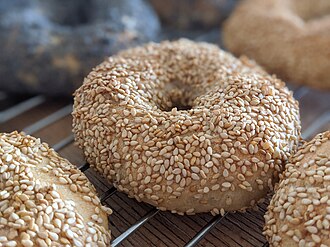
Photo: Wikipedia
A dense, chewy bread roll with a distinctive hole in the center, boasting a satisfyingly crisp crust and a soft, slightly springy interior. Its flavor is mildly sweet and malty, providing a hearty base for both savory and sweet toppings. Nutritionally, it's a significant source of complex carbohydrates and offers a respectable amount of plant-based protein.
Calorie split: 16% protein · 78% carbs · 6% fat
↓ Full nutrition💚 Why it's loved
People adore the bagel for its uniquely satisfying chewy texture and sturdy structure, which makes it the perfect vehicle for a wide array of spreads, cheeses, and fillings. It's deeply embedded in New York City culture and breakfast traditions, symbolizing a comforting, substantial start to the day.
⚠️ Watch-outs & how to enjoy it better
Its high carbohydrate content can lead to rapid blood-sugar spikes, especially when eaten plain and without balancing nutrients. It is also a common carrier of sodium and contains gluten, a primary allergen for those with celiac disease or sensitivity. To counteract this, pair it with protein (like cream cheese, smoked salmon, or eggs) and healthy fats (avocado) to slow digestion and stabilize blood sugar.
Key benefits
- Good source of complex carbohydrates for sustained energy
- Provides a notable amount of plant-based protein
- Contains dietary fiber to support digestive health
- Low in fat, making it a leaner bread option
- Versatile base for balanced meals with protein and healthy fats
🍽️ Popular dishes






🌍 Where it's eaten
💡 Did you know?
The bagel's distinctive hole is believed to have been invented in 1683 as a tribute to the Polish King Jan III Sobieski, with the shape representing the stirrup of his saddle after his victory at the Battle of Vienna.
Full nutrition (USDA data · scales with serving)
| Water | 37.5 g |
| Energy | 250 kcal |
| Energy | 1047 kj |
| Protein | 10.2 g |
| Total lipid (fat) | 1.5 g |
| Ash | 1.8 g |
| Carbohydrate, by difference | 48.9 g |
| Fiber, total dietary | 4.1 g |
| Total Sugars | 6.1 g |
| Calcium, Ca | 20.0 mg |
| Iron, Fe | 2.8 mg |
| Magnesium, Mg | 51.0 mg |
| Phosphorus, P | 142 mg |
| Potassium, K | 165 mg |
| Sodium, Na | 439 mg |
| Zinc, Zn | 1.1 mg |
| Copper, Cu | 0.17 mg |
| Manganese, Mn | 1.4 mg |
| Selenium, Se | 28.7 ug |
| Fluoride, F | 24.1 ug |
| Vitamin C, total ascorbic acid | 0.00 mg |
| Thiamin | 0.40 mg |
| Riboflavin | 0.21 mg |
| Niacin | 3.4 mg |
| Pantothenic acid | 0.38 mg |
| Vitamin B-6 | 0.15 mg |
| Folate, total | 76.0 ug |
| Folic acid | 46.0 ug |
| Folate, food | 31.0 ug |
| Folate, DFE | 108 ug |
| Choline, total | 9.8 mg |
| Betaine | 21.6 mg |
| Vitamin B-12 | 0.00 ug |
| Vitamin B-12, added | 0.00 ug |
| Vitamin A, RAE | 0.00 ug |
| Retinol | 0.00 ug |
| Carotene, beta | 2.0 ug |
| Carotene, alpha | 0.00 ug |
| Cryptoxanthin, beta | 0.00 ug |
| Vitamin A, IU | 0.00 iu |
| Lycopene | 0.00 ug |
| Lutein + zeaxanthin | 88.0 ug |
| Vitamin E (alpha-tocopherol) | 0.32 mg |
| Vitamin E, added | 0.00 mg |
| Vitamin D (D2 + D3), International Units | 0.00 iu |
| Vitamin D (D2 + D3) | 0.00 ug |
| Vitamin K (phylloquinone) | 1.5 ug |
| Alcohol, ethyl | 0.00 g |
| Caffeine | 0.00 mg |
| Theobromine | 0.00 mg |
Fat & fatty acid profile (per 100g)
| Fatty acids, total saturated | 0.00 g |
| SFA 4:0 | 0.00 g |
| SFA 6:0 | 0.00 g |
| SFA 8:0 | 0.00 g |
| SFA 10:0 | 0.00 g |
| SFA 12:0 | 0.00 g |
| SFA 14:0 | 0.00 g |
| SFA 15:0 | 0.00 g |
| SFA 16:0 | 0.00 g |
| SFA 17:0 | 0.00 g |
| SFA 18:0 | 0.00 g |
| SFA 20:0 | 0.00 g |
| SFA 22:0 | 0.00 g |
| SFA 24:0 | 0.00 g |
| Fatty acids, total monounsaturated | 0.29 g |
| MUFA 14:1 | 0.00 g |
| MUFA 15:1 | 0.00 g |
| MUFA 16:1 | 0.01 g |
| MUFA 17:1 | 0.00 g |
| MUFA 18:1 | 0.28 g |
| MUFA 20:1 | 0.01 g |
| MUFA 22:1 | 0.00 g |
| MUFA 24:1 c | 0.00 g |
| Fatty acids, total polyunsaturated | 0.94 g |
| PUFA 18:2 | 0.86 g |
| PUFA 18:3 | 0.08 g |
| PUFA 18:4 | 0.00 g |
| PUFA 20:2 n-6 c,c | 0.00 g |
| PUFA 20:3 | 0.00 g |
| PUFA 20:4 | 0.00 g |
| PUFA 20:5 n-3 (EPA) | 0.00 g |
| PUFA 21:5 | 0.00 g |
| PUFA 22:4 | 0.00 g |
| PUFA 22:5 n-3 (DPA) | 0.00 g |
| PUFA 22:6 n-3 (DHA) | 0.00 g |
| Fatty acids, total trans | 0.00 g |
| Cholesterol | 0.00 mg |
Amino acid profile (per 100g)
Estimated from Bagels, cinnamon-raisin — USDA does not publish this profile for Bagels.
| Tryptophan | 0.11 g |
| Threonine | 0.28 g |
| Isoleucine | 0.37 g |
| Leucine | 0.67 g |
| Lysine | 0.24 g |
| Methionine | 0.18 g |
| Cystine | 0.21 g |
| Phenylalanine | 0.47 g |
| Tyrosine | 0.27 g |
| Valine | 0.42 g |
| Arginine | 0.38 g |
| Histidine | 0.22 g |
| Alanine | 0.33 g |
| Aspartic acid | 0.48 g |
| Glutamic acid | 3.2 g |
| Glycine | 0.34 g |
| Proline | 1.1 g |
| Serine | 0.48 g |
FAQ
What's the difference between a bagel and a bread roll?
Bagels are uniquely boiled in water (often with malt or honey) before baking, which creates their signature shiny, crisp crust and dense, chewy interior. Standard bread rolls are typically only baked.
Are wheat bagels healthier than white bagels?
Generally, yes. Wheat bagels are made with whole-grain flour, which retains more fiber, vitamins, and minerals than refined white flour, offering more sustained energy and nutritional benefits.
How should I store bagels to keep them fresh?
For short-term use (1-2 days), store at room temperature in a paper bag to maintain crust texture. For longer storage, slice and freeze them in an airtight bag; they toast directly from frozen perfectly.
Nutrient density (calculated · NRF9.3)
Nutrient Rich Foods index: beneficial nutrients (protein, fiber, vitamins, minerals) minus saturated fat, added sugar & sodium, per 100 kcal.
NRF9.3 index — Fulgoni, Keast & Drewnowski, 2009. Computed from USDA nutrients.
Weight-loss friendliness (composite index)
Energy density 2.50 kcal/g · 16% calories from protein · 4.1 g fiber · 6.1 g sugar per 100 g.
Composite of energy density (Rolls et al., 1999), protein & fiber satiety, minus sugar. A calculated heuristic — ranks satiety-per-calorie, not a clinical measure.
Dietary load (calculated from USDA values)
Potential renal acid load. Positive = acid-forming, negative = alkaline-forming.
Sodium-to-potassium ratio: 2.66 (lower is better — aim for ≤ 1)
Sodium:potassium per WHO potassium guidance. Computed from USDA nutrients.