

Babyfood, cereal, Oatmeal, dry, GERBER, SINGLE GRAIN, fortified
Whole food · Baby Foods

Photo: Wikipedia
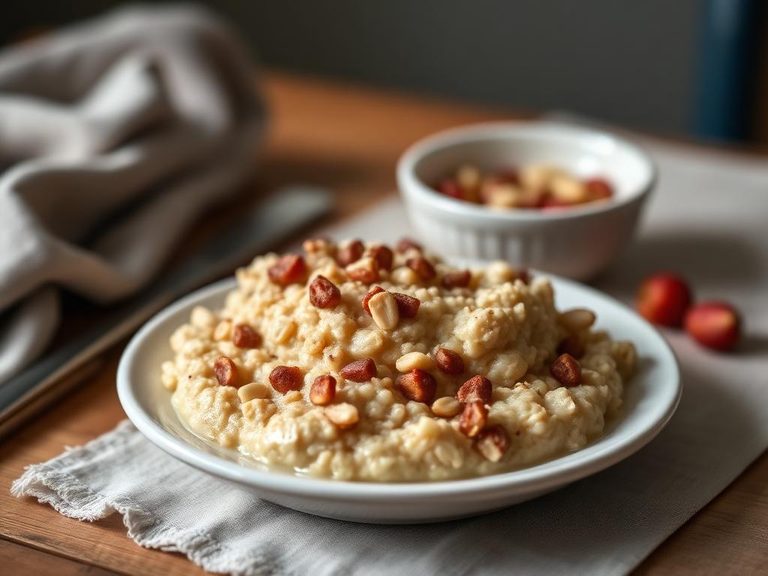
This is a finely milled, fortified dry oatmeal cereal designed as a baby's first solid food. It has a mild, slightly nutty flavor and a smooth, easily digestible texture when mixed with liquid. Nutritionally, it's a powerhouse of iron and B vitamins, crucial for early development.
Calorie split: 11% protein · 74% carbs · 15% fat
↓ Full nutrition💚 Why it's loved
Parents love its simplicity and reliability as a first food, offering a blank canvas to introduce new flavors like fruit purées. Its consistent, smooth texture is perfect for babies transitioning from liquids to solids.
⚠️ Watch-outs & how to enjoy it better
The high carbohydrate content can lead to rapid blood-sugar spikes if not balanced. To counteract this, always mix it with breast milk, formula, or a small amount of puréed avocado or nut butter to add protein and healthy fats, slowing digestion.
Key benefits
- Excellent source of iron for cognitive development
- Fortified with essential B vitamins like thiamin and riboflavin
- Good source of dietary fiber for digestive health
- Provides a quick, energy-dense calorie base for growing infants
- Single-grain formula helps isolate potential food sensitivities
🍽️ Popular dishes
🌍 Where it's eaten
💡 Did you know?
Gerber's single-grain oatmeal was one of the first commercially successful baby cereals in the U.S., introduced in 1928 and marketed with the iconic 'Nestlé' baby logo.
Full nutrition (USDA data · scales with serving)
| Water | 4.2 g |
| Energy | 396 kcal |
| Energy | 1656 kj |
| Protein | 10.9 g |
| Total lipid (fat) | 6.4 g |
| Ash | 4.9 g |
| Carbohydrate, by difference | 73.6 g |
| Fiber, total dietary | 7.0 g |
| Total Sugars | 12.3 g |
| Sucrose | 1.0 g |
| Glucose | 8.0 g |
| Fructose | 0.17 g |
| Lactose | 0.00 g |
| Maltose | 3.1 g |
| Galactose | 0.00 g |
| Starch | 44.7 g |
| Calcium, Ca | 1245 mg |
| Iron, Fe | 64.0 mg |
| Magnesium, Mg | 109 mg |
| Phosphorus, P | 459 mg |
| Potassium, K | 597 mg |
| Sodium, Na | 23.0 mg |
| Zinc, Zn | 12.3 mg |
| Copper, Cu | 0.42 mg |
| Manganese, Mn | 4.0 mg |
| Selenium, Se | 22.5 ug |
| Vitamin C, total ascorbic acid | 0.00 mg |
| Thiamin | 1.4 mg |
| Riboflavin | 1.6 mg |
| Niacin | 21.7 mg |
| Pantothenic acid | 0.98 mg |
| Vitamin B-6 | 0.84 mg |
| Folate, total | 250 ug |
| Folic acid | 215 ug |
| Folate, food | 35.0 ug |
| Folate, DFE | 401 ug |
| Choline, total | 26.6 mg |
| Betaine | 22.0 mg |
| Vitamin B-12 | 4.6 ug |
| Vitamin B-12, added | 4.6 ug |
| Vitamin A, RAE | 0.00 ug |
| Retinol | 0.00 ug |
| Carotene, beta | 0.00 ug |
| Carotene, alpha | 0.00 ug |
| Cryptoxanthin, beta | 0.00 ug |
| Vitamin A, IU | 0.00 iu |
| Lycopene | 0.00 ug |
| Lutein + zeaxanthin | 185 ug |
| Vitamin E (alpha-tocopherol) | 5.0 mg |
| Vitamin E, added | 4.5 mg |
| Vitamin D (D2 + D3), International Units | 508 iu |
| Vitamin D (D2 + D3) | 12.7 ug |
| Vitamin K (phylloquinone) | 1.3 ug |
| Vitamin K (Menaquinone-4) | 0.00 ug |
| Alcohol, ethyl | 0.00 g |
| Caffeine | 0.00 mg |
| Theobromine | 0.00 mg |
Fat & fatty acid profile (per 100g)
| Fatty acids, total saturated | 0.84 g |
| SFA 4:0 | 0.00 g |
| SFA 6:0 | 0.00 g |
| SFA 8:0 | 0.00 g |
| SFA 10:0 | 0.00 g |
| SFA 12:0 | 0.00 g |
| SFA 14:0 | 0.01 g |
| SFA 15:0 | 0.00 g |
| SFA 16:0 | 0.74 g |
| SFA 17:0 | 0.00 g |
| SFA 18:0 | 0.07 g |
| SFA 20:0 | 0.01 g |
| SFA 22:0 | 0.00 g |
| SFA 24:0 | 0.00 g |
| Fatty acids, total monounsaturated | 2.6 g |
| MUFA 14:1 | 0.00 g |
| MUFA 15:1 | 0.00 g |
| MUFA 16:1 | 0.01 g |
| MUFA 16:1 c | 0.01 g |
| MUFA 17:1 | 0.00 g |
| MUFA 18:1 | 1.5 g |
| MUFA 18:1 c | 1.5 g |
| MUFA 20:1 | 0.03 g |
| MUFA 22:1 | 0.00 g |
| MUFA 22:1 c | 0.00 g |
| MUFA 24:1 c | 0.00 g |
| Fatty acids, total polyunsaturated | 3.0 g |
| PUFA 18:2 | 1.7 g |
| PUFA 18:2 n-6 c,c | 1.7 g |
| PUFA 18:2 CLAs | 0.00 g |
| PUFA 18:3 | 0.06 g |
| PUFA 18:3 n-3 c,c,c (ALA) | 0.06 g |
| PUFA 18:3 n-6 c,c,c | 0.00 g |
| PUFA 18:3i | 0.00 g |
| PUFA 18:4 | 0.00 g |
| PUFA 20:2 n-6 c,c | 0.00 g |
| PUFA 20:3 | 0.00 g |
| PUFA 20:3 n-3 | 0.00 g |
| PUFA 20:3 n-6 | 0.00 g |
| PUFA 20:4 | 0.00 g |
| PUFA 20:5 n-3 (EPA) | 0.00 g |
| PUFA 22:4 | 0.00 g |
| PUFA 22:5 n-3 (DPA) | 0.00 g |
| PUFA 22:6 n-3 (DHA) | 0.00 g |
| Fatty acids, total trans | 0.00 g |
| Fatty acids, total trans-monoenoic | 0.00 g |
| TFA 16:1 t | 0.00 g |
| TFA 18:1 t | 0.00 g |
| TFA 22:1 t | 0.00 g |
| TFA 18:2 t not further defined | 0.00 g |
| Fatty acids, total trans-polyenoic | 0.00 g |
| Cholesterol | 0.00 mg |
Amino acid profile (per 100g)
| Hydroxyproline | 0.00 g |
FAQ
When can I start my baby on this cereal?
Most pediatricians recommend introducing single-grain cereals like this around 4 to 6 months of age, when the baby shows signs of readiness for solids.
How do I prepare it?
Mix the dry cereal with breast milk, formula, or water to your desired consistency. Start with a thinner mixture and gradually thicken it as your baby gets used to eating from a spoon.
Is it gluten-free?
While oats themselves are naturally gluten-free, they are often processed in facilities that handle wheat. Always check the label for a certified gluten-free seal if your baby has celiac disease or a sensitivity.
Nutrient density (calculated · NRF9.3)
Nutrient Rich Foods index: beneficial nutrients (protein, fiber, vitamins, minerals) minus saturated fat, added sugar & sodium, per 100 kcal.
NRF9.3 index — Fulgoni, Keast & Drewnowski, 2009. Computed from USDA nutrients.
Weight-loss friendliness (composite index)
Energy density 3.96 kcal/g · 11% calories from protein · 7.0 g fiber · 12.3 g sugar per 100 g.
Composite of energy density (Rolls et al., 1999), protein & fiber satiety, minus sugar. A calculated heuristic — ranks satiety-per-calorie, not a clinical measure.
Dietary load (calculated from USDA values)
Potential renal acid load. Positive = acid-forming, negative = alkaline-forming.
Sodium-to-potassium ratio: 0.04 (lower is better — aim for ≤ 1)
Sodium:potassium per WHO potassium guidance. Computed from USDA nutrients.