

Tomato products, canned, puree, with salt added
Whole food · Vegetables and Vegetable Products
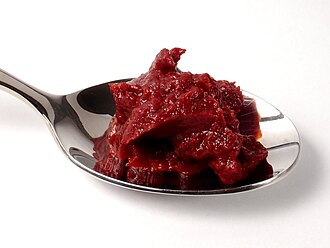
Photo: Wikipedia
A concentrated, velvety tomato paste with a deep, savory-sweet umami flavor and a thick, spreadable texture. At just 38 calories per 100g, it's a low-fat, low-calorie powerhouse of concentrated tomato flavor. Its high fiber content (1.9g) and minimal fat make it a nutrient-dense base for countless dishes.
Calorie split: 15% protein · 81% carbs · 4% fat
↓ Full nutrition💚 Why it's loved
People love it for its intense, concentrated tomato flavor that can instantly deepen a sauce, soup, or stew. Its versatility and long shelf life make it a pantry staple across many cultures, from Italian ragù to Indian curries.
⚠️ Watch-outs & how to enjoy it better
The added salt can be a concern for those monitoring sodium intake, and its natural sugars may cause blood-sugar spikes if consumed in large quantities. To counteract this, pair it with protein (like beans or meat) and healthy fats (like olive oil) to slow sugar absorption, and choose low-sodium versions when possible.
Key benefits
- Rich in lycopene, a potent antioxidant linked to heart health.
- High in vitamin C, supporting immune function and skin health.
- Excellent source of dietary fiber, aiding digestion and satiety.
- Low in calories and fat, ideal for weight management.
- Provides potassium, which helps regulate blood pressure.
🍽️ Popular dishes


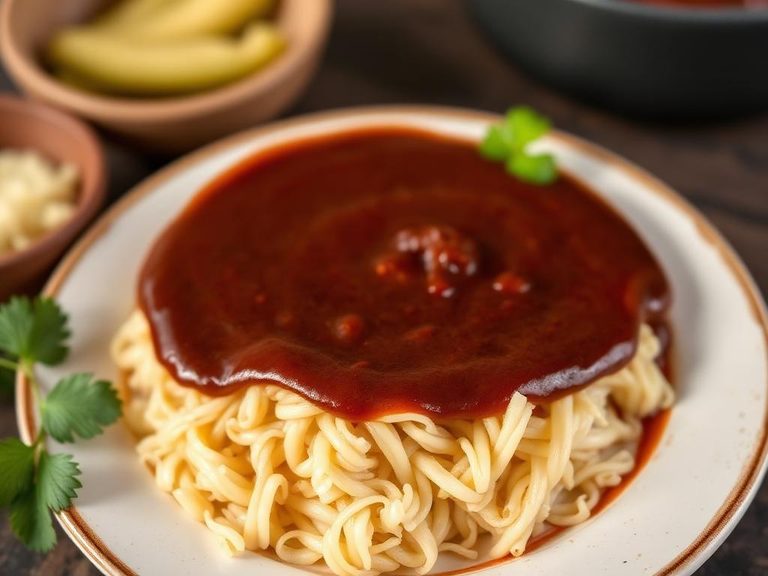
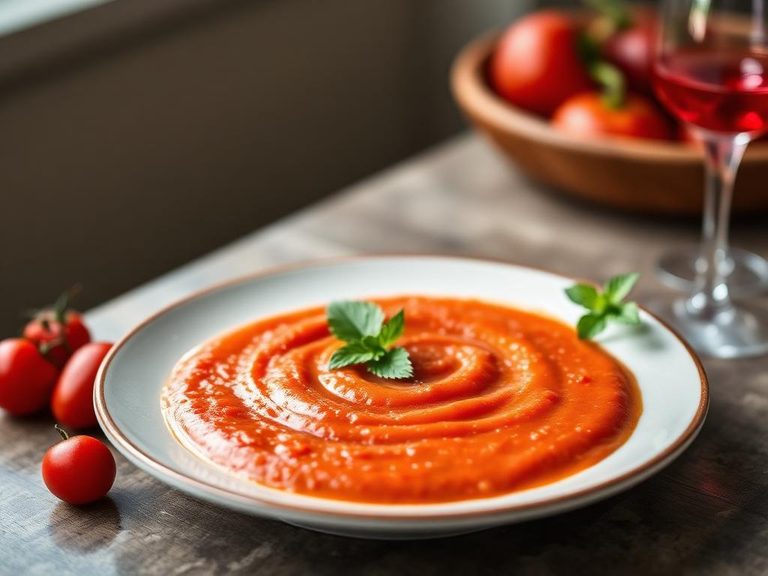
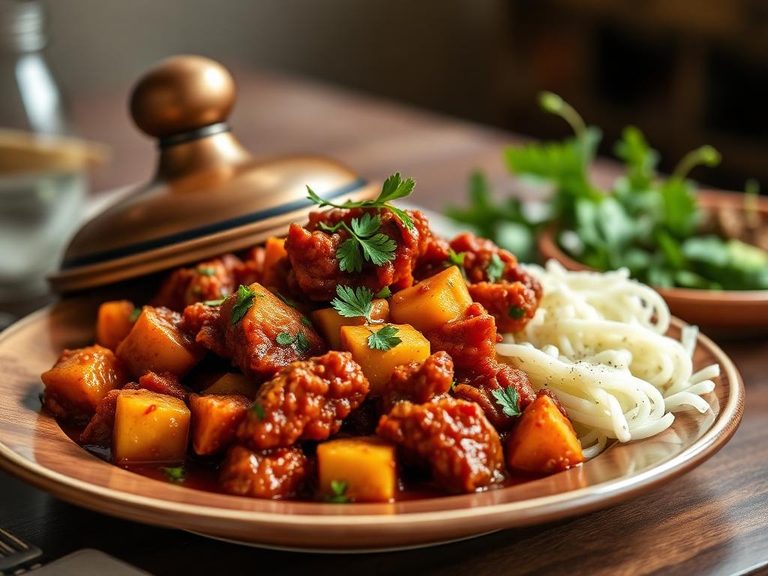
🌍 Where it's eaten
💡 Did you know?
Tomato puree was historically used as a red dye for textiles in the 18th century before its culinary popularity surged.
Full nutrition (USDA data · scales with serving)
| Water | 87.9 g |
| Energy | 38.0 kcal |
| Energy | 158 kj |
| Protein | 1.6 g |
| Total lipid (fat) | 0.21 g |
| Ash | 1.3 g |
| Carbohydrate, by difference | 9.0 g |
| Fiber, total dietary | 1.9 g |
| Total Sugars | 4.8 g |
| Sucrose | 0.00 g |
| Glucose | 2.5 g |
| Fructose | 2.4 g |
| Lactose | 0.00 g |
| Maltose | 0.00 g |
| Galactose | 0.00 g |
| Calcium, Ca | 18.0 mg |
| Iron, Fe | 1.8 mg |
| Magnesium, Mg | 23.0 mg |
| Phosphorus, P | 40.0 mg |
| Potassium, K | 439 mg |
| Sodium, Na | 202 mg |
| Zinc, Zn | 0.36 mg |
| Copper, Cu | 0.29 mg |
| Manganese, Mn | 0.17 mg |
| Selenium, Se | 0.70 ug |
| Vitamin C, total ascorbic acid | 10.6 mg |
| Thiamin | 0.03 mg |
| Riboflavin | 0.08 mg |
| Niacin | 1.5 mg |
| Pantothenic acid | 0.44 mg |
| Vitamin B-6 | 0.13 mg |
| Folate, total | 11.0 ug |
| Folic acid | 0.00 ug |
| Folate, food | 11.0 ug |
| Folate, DFE | 11.0 ug |
| Choline, total | 17.6 mg |
| Betaine | 0.20 mg |
| Vitamin B-12 | 0.00 ug |
| Vitamin B-12, added | 0.00 ug |
| Vitamin A, RAE | 26.0 ug |
| Retinol | 0.00 ug |
| Carotene, beta | 306 ug |
| Carotene, alpha | 0.00 ug |
| Cryptoxanthin, beta | 0.00 ug |
| Vitamin A, IU | 510 iu |
| Lycopene | 21754 ug |
| Lutein + zeaxanthin | 0.00 ug |
| Vitamin E (alpha-tocopherol) | 2.0 mg |
| Vitamin E, added | 0.00 mg |
| Tocopherol, beta | 0.00 mg |
| Tocopherol, gamma | 0.24 mg |
| Tocopherol, delta | 0.00 mg |
| Vitamin D (D2 + D3), International Units | 0.00 iu |
| Vitamin D (D2 + D3) | 0.00 ug |
| Vitamin K (phylloquinone) | 3.4 ug |
| Vitamin K (Dihydrophylloquinone) | 0.00 ug |
| Alcohol, ethyl | 0.00 g |
| Caffeine | 0.00 mg |
| Theobromine | 0.00 mg |
Fat & fatty acid profile (per 100g)
| Fatty acids, total saturated | 0.03 g |
| SFA 4:0 | 0.00 g |
| SFA 6:0 | 0.00 g |
| SFA 8:0 | 0.00 g |
| SFA 10:0 | 0.00 g |
| SFA 12:0 | 0.00 g |
| SFA 14:0 | 0.00 g |
| SFA 16:0 | 0.02 g |
| SFA 18:0 | 0.01 g |
| Fatty acids, total monounsaturated | 0.03 g |
| MUFA 16:1 | 0.00 g |
| MUFA 18:1 | 0.03 g |
| MUFA 20:1 | 0.00 g |
| MUFA 22:1 | 0.00 g |
| Fatty acids, total polyunsaturated | 0.09 g |
| PUFA 18:2 | 0.08 g |
| PUFA 18:3 | 0.00 g |
| PUFA 18:4 | 0.00 g |
| PUFA 20:4 | 0.00 g |
| PUFA 20:5 n-3 (EPA) | 0.00 g |
| PUFA 22:5 n-3 (DPA) | 0.00 g |
| PUFA 22:6 n-3 (DHA) | 0.00 g |
| Fatty acids, total trans | 0.00 g |
| Cholesterol | 0.00 mg |
Amino acid profile (per 100g)
| Tryptophan | 0.01 g |
| Threonine | 0.04 g |
| Isoleucine | 0.03 g |
| Leucine | 0.05 g |
| Lysine | 0.05 g |
| Methionine | 0.01 g |
| Cystine | 0.01 g |
| Phenylalanine | 0.04 g |
| Tyrosine | 0.02 g |
| Valine | 0.03 g |
| Arginine | 0.03 g |
| Histidine | 0.03 g |
| Alanine | 0.05 g |
| Aspartic acid | 0.28 g |
| Glutamic acid | 0.81 g |
| Glycine | 0.03 g |
| Proline | 0.04 g |
| Serine | 0.04 g |
FAQ
What is the difference between tomato puree and tomato paste?
Tomato puree is a smoother, less concentrated blend of tomatoes, while tomato paste is cooked down further to a thick, dense consistency with a more intense flavor.
Can I use tomato puree as a substitute for tomato paste?
Yes, but you'll need to use about twice the amount of puree to match the flavor intensity of paste, and you may need to cook it longer to reduce the liquid.
Is canned tomato puree safe to eat?
Yes, it is safe and widely consumed. The canning process preserves the tomatoes, and the added salt helps with preservation and flavor.
Nutrient density (calculated · NRF9.3)
Nutrient Rich Foods index: beneficial nutrients (protein, fiber, vitamins, minerals) minus saturated fat, added sugar & sodium, per 100 kcal.
NRF9.3 index — Fulgoni, Keast & Drewnowski, 2009. Computed from USDA nutrients.
Weight-loss friendliness (composite index)
Energy density 0.38 kcal/g · 17% calories from protein · 1.9 g fiber · 4.8 g sugar per 100 g.
Composite of energy density (Rolls et al., 1999), protein & fiber satiety, minus sugar. A calculated heuristic — ranks satiety-per-calorie, not a clinical measure.
Dietary load (calculated from USDA values)
Potential renal acid load. Positive = acid-forming, negative = alkaline-forming.
Sodium-to-potassium ratio: 0.46 (lower is better — aim for ≤ 1)
Sodium:potassium per WHO potassium guidance. Computed from USDA nutrients.