

Rolls, dinner, plain, commercially prepared (includes brown-and-serve)
Whole food · Baked Products
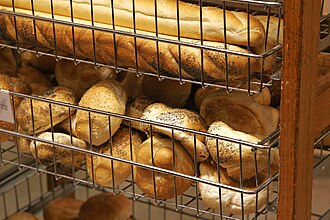
Photo: Wikipedia
A soft, pillowy, commercially baked dinner roll, often sold in a convenient 'brown-and-serve' format for quick finishing in the oven. Its texture is tender and slightly chewy with a mild, subtly sweet wheat flavor and a golden-brown crust. Nutritionally, it's a dense source of quick energy from carbohydrates, providing about 310 calories per 100 grams.
Calorie split: 14% protein · 67% carbs · 19% fat
↓ Full nutrition💚 Why it's loved
People love these rolls for their reliable, soft texture and mild flavor that complements rather than competes with savory dishes. Their ultimate versatility—from a simple butter vehicle to a mini sandwich base—makes them a crowd-pleasing staple at family dinners and holiday feasts.
⚠️ Watch-outs & how to enjoy it better
The primary downside is their high glycemic load, which can cause rapid blood-sugar spikes, especially for those with insulin sensitivity or diabetes. To counteract this, pair a roll with a source of protein (like turkey or beans) and healthy fat (like avocado or a pat of butter) to slow digestion. Be mindful of portion control, as it's easy to consume multiple rolls in one sitting.
Key benefits
- Provides quick, accessible energy from complex carbohydrates.
- Offers a modest amount of plant-based protein (10.86g per 100g).
- Low in fat (6.47g per 100g), making it a lighter bread option.
- Convenient and versatile for a wide range of meals and snacks.
- A familiar, comforting staple in many Western-style meals.
🍽️ Popular dishes


🌍 Where it's eaten
💡 Did you know?
The 'brown-and-serve' method was popularized in the 1930s as a way for home cooks to enjoy fresh-baked bread without the time commitment, essentially inventing the concept of 'par-baked' goods for the consumer market.
Full nutrition (USDA data · scales with serving)
| Water | 28.4 g |
| Energy | 310 kcal |
| Energy | 1297 kj |
| Protein | 10.9 g |
| Total lipid (fat) | 6.5 g |
| Ash | 2.2 g |
| Carbohydrate, by difference | 52.0 g |
| Fiber, total dietary | 2.0 g |
| Total Sugars | 5.5 g |
| Calcium, Ca | 178 mg |
| Iron, Fe | 3.7 mg |
| Magnesium, Mg | 26.0 mg |
| Phosphorus, P | 122 mg |
| Potassium, K | 139 mg |
| Sodium, Na | 467 mg |
| Zinc, Zn | 0.99 mg |
| Copper, Cu | 0.14 mg |
| Manganese, Mn | 0.58 mg |
| Selenium, Se | 26.8 ug |
| Vitamin C, total ascorbic acid | 0.20 mg |
| Thiamin | 0.53 mg |
| Riboflavin | 0.37 mg |
| Niacin | 5.4 mg |
| Pantothenic acid | 0.45 mg |
| Vitamin B-6 | 0.10 mg |
| Folate, total | 101 ug |
| Folic acid | 71.0 ug |
| Folate, food | 30.0 ug |
| Folate, DFE | 150 ug |
| Choline, total | 14.6 mg |
| Vitamin B-12 | 0.13 ug |
| Vitamin B-12, added | 0.00 ug |
| Vitamin A, RAE | 1.0 ug |
| Retinol | 1.0 ug |
| Carotene, beta | 0.00 ug |
| Carotene, alpha | 0.00 ug |
| Cryptoxanthin, beta | 0.00 ug |
| Vitamin A, IU | 5.0 iu |
| Lycopene | 0.00 ug |
| Lutein + zeaxanthin | 13.0 ug |
| Vitamin E (alpha-tocopherol) | 0.28 mg |
| Vitamin E, added | 0.00 mg |
| Vitamin D (D2 + D3), International Units | 0.00 iu |
| Vitamin D (D2 + D3) | 0.00 ug |
| Vitamin K (phylloquinone) | 10.6 ug |
| Alcohol, ethyl | 0.00 g |
| Caffeine | 0.00 mg |
| Theobromine | 0.00 mg |
Fat & fatty acid profile (per 100g)
| Fatty acids, total saturated | 1.4 g |
| SFA 4:0 | 0.00 g |
| SFA 6:0 | 0.00 g |
| SFA 8:0 | 0.00 g |
| SFA 10:0 | 0.00 g |
| SFA 12:0 | 0.00 g |
| SFA 14:0 | 0.01 g |
| SFA 15:0 | 0.00 g |
| SFA 16:0 | 0.79 g |
| SFA 17:0 | 0.00 g |
| SFA 18:0 | 0.54 g |
| SFA 20:0 | 0.02 g |
| SFA 22:0 | 0.02 g |
| SFA 24:0 | 0.00 g |
| Fatty acids, total monounsaturated | 1.9 g |
| MUFA 14:1 | 0.00 g |
| MUFA 15:1 | 0.00 g |
| MUFA 16:1 | 0.03 g |
| MUFA 17:1 | 0.00 g |
| MUFA 18:1 | 1.8 g |
| MUFA 20:1 | 0.02 g |
| MUFA 22:1 | 0.00 g |
| Fatty acids, total polyunsaturated | 2.5 g |
| PUFA 18:2 | 2.3 g |
| PUFA 18:3 | 0.22 g |
| PUFA 18:3 n-3 c,c,c (ALA) | 0.22 g |
| PUFA 18:3 n-6 c,c,c | 0.00 g |
| PUFA 18:4 | 0.00 g |
| PUFA 20:2 n-6 c,c | 0.00 g |
| PUFA 20:3 | 0.00 g |
| PUFA 20:4 | 0.00 g |
| PUFA 20:5 n-3 (EPA) | 0.00 g |
| PUFA 22:5 n-3 (DPA) | 0.00 g |
| PUFA 22:6 n-3 (DHA) | 0.00 g |
| Fatty acids, total trans | 0.00 g |
| Cholesterol | 4.0 mg |
Amino acid profile (per 100g)
| Tryptophan | 0.08 g |
| Threonine | 0.29 g |
| Isoleucine | 0.34 g |
| Leucine | 0.73 g |
| Lysine | 0.23 g |
| Methionine | 0.14 g |
| Cystine | 0.23 g |
| Phenylalanine | 0.51 g |
| Tyrosine | 0.29 g |
| Valine | 0.40 g |
| Arginine | 0.38 g |
| Histidine | 0.22 g |
| Alanine | 0.34 g |
| Aspartic acid | 0.45 g |
| Glutamic acid | 3.5 g |
| Glycine | 0.39 g |
| Proline | 1.2 g |
| Serine | 0.55 g |
FAQ
What's the difference between a dinner roll and a bread roll?
In common usage, they are often synonymous. 'Dinner roll' typically refers to a soft, slightly sweet roll served alongside a meal, while 'bread roll' is a more general term that can include crustier, savory varieties.
Are 'brown-and-serve' rolls pre-cooked?
Yes, they are fully baked at the factory but designed to be reheated at home. This final, brief baking step re-crisps the exterior and warms them through, mimicking the experience of fresh-from-the-oven bread.
How can I make store-bought rolls taste more homemade?
After reheating, brush them with melted butter mixed with fresh herbs like parsley or rosemary, or a sprinkle of flaky sea salt. A quick toast under the broiler can also add a superior, crackly crust.
Nutrient density (calculated · NRF9.3)
Nutrient Rich Foods index: beneficial nutrients (protein, fiber, vitamins, minerals) minus saturated fat, added sugar & sodium, per 100 kcal.
NRF9.3 index — Fulgoni, Keast & Drewnowski, 2009. Computed from USDA nutrients.
Weight-loss friendliness (composite index)
Energy density 3.10 kcal/g · 14% calories from protein · 2.0 g fiber · 5.5 g sugar per 100 g.
Composite of energy density (Rolls et al., 1999), protein & fiber satiety, minus sugar. A calculated heuristic — ranks satiety-per-calorie, not a clinical measure.
Dietary load (calculated from USDA values)
Potential renal acid load. Positive = acid-forming, negative = alkaline-forming.
Sodium-to-potassium ratio: 3.36 (lower is better — aim for ≤ 1)
Sodium:potassium per WHO potassium guidance. Computed from USDA nutrients.